
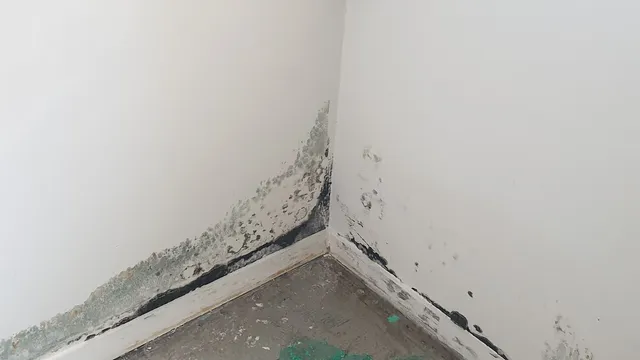
Corner mold isn’t a cleaning problem — it’s a physics problem. That dark patch creeping up the joint where your wall meets the ceiling, or lurking behind the wardrobe you haven’t moved in three years, is the end result of a specific chain of thermal and airflow events that most guides completely ignore. They tell you to scrub with bleach and open a window. That’s not wrong, exactly, but it treats the symptom while the cause keeps running quietly in the background.
Why Do Corners Get Mold When the Rest of the Wall Stays Clean?
The short answer: corners are structurally colder than flat wall surfaces, and colder surfaces attract moisture from the air. Here’s the mechanism that most articles skip over. A flat wall section loses heat from one direction. A corner loses heat from two directions simultaneously — from both walls meeting at that point — which means the surface temperature there can be 2–4°C lower than the surrounding wall even in the same room, in the same conditions.
That temperature drop matters because it pushes the surface closer to the dew point — the temperature at which water vapor in the air condenses into liquid water. Once a surface sits at or below the dew point consistently, you get condensation. Condensation gives mold the moisture it needs to germinate and grow. The mold isn’t appearing in the corner because corners are dirty or poorly built — it’s appearing there because corners are the coldest spots, and cold spots are always the first to collect water.
This is the thing people routinely get wrong: they assume mold in corners of rooms means there’s a leak, or that the wall is damp from outside. Sometimes that’s true. But far more often, the moisture source is the air inside the room itself.
What Is Thermal Bridging and Why Does It Cause Corner Mold?
Thermal bridging is the real villain here, and it’s underexplored in almost every piece written about corner mold. A thermal bridge is any point in a building’s fabric where heat escapes faster than it does through the surrounding material. Corners are inherent thermal bridges — the geometry alone creates more surface area for heat loss with less insulating material behind it.
In solid brick or block construction, corner junctions often have interrupted or reduced insulation simply because of how walls are built. The wall ties, the brickwork bonding pattern, and the reduced depth of insulation at the junction all conspire to make corners dramatically colder in winter. In timber-framed buildings, the structural studs at corners conduct heat away efficiently, again creating a cold spot right where two walls meet.
Here’s the counterintuitive fact worth knowing: adding insulation to the inside of one wall sometimes makes the corner mold problem worse, not better. By insulating the main wall surface, you raise its temperature — but the corner junction, which is harder to insulate properly, stays cold. The temperature differential between the insulated flat wall and the uninsulated corner actually increases, making the corner even more prone to condensation relative to the surrounding surface.
“Thermal bridging at internal corners is one of the most frequently overlooked causes of condensation-related mold in domestic buildings. The surface temperature at a poorly detailed corner can fall 3 to 5 degrees below the adjacent wall, which in a room maintained at typical indoor humidity is often enough to push that surface below the dew point throughout winter months.”
Dr. Helen Marsh, Building Physics Consultant and Fellow of the Chartered Institute of Building Services Engineers
How Does Poor Airflow Make Mold in Corners of Rooms Worse?
Airflow — or the lack of it — is the second half of the corner mold equation. Warm air carries moisture. When warm, humid air from inside the room circulates freely across a wall surface, it doesn’t sit still long enough to deposit much condensation. But corners naturally interrupt air circulation. Room airflow tends to follow straight paths along walls; it slows and stagnates right at the junction where two walls meet.
Stagnant air at a cold surface is essentially a perfect mold incubator. The air layer immediately against the cold corner wall cools down, its relative humidity climbs toward 100%, and moisture starts depositing on the surface. Unlike the rest of the room — where air movement keeps humidity from building up at any one point — the corner acts as a trap.
Furniture placement amplifies this dramatically. Corners behind wardrobes, beds, or cabinets get almost zero air movement, which means the cold surface behind them is perpetually bathed in stagnant, humid air. A wardrobe pushed flush against an external corner wall is one of the most reliable ways to grow mold in a home — not because of anything wrong with the wardrobe, but because it eliminates the one thing that could counteract the cold surface: airflow.
Why Do Ceiling Corners Get Mold So Often?
Ceiling corners are particularly prone because they combine two problems at once: the thermal bridging effect of a corner junction, and the natural tendency of warm, moist air to rise. Warm air rises and accumulates at ceiling level. If the ceiling corner is cold — which it often is, especially in top-floor rooms or where loft insulation doesn’t extend fully to the eaves — that rising humid air meets the cold surface and condenses there.
It’s a conveyor belt of moisture delivery, running continuously whenever the room is occupied and heated. Cooking, showering in an adjacent bathroom, even breathing — these all add water vapor to room air, which rises, travels to the ceiling corners, and deposits condensation on the coldest available surface. Many people notice ceiling corner mold in bedrooms specifically, because a sleeping person exhales roughly 400ml of water vapor per night into a relatively small, poorly ventilated space.
The honest nuance here: ceiling corner mold doesn’t always mean your insulation is inadequate. In older properties with high ceilings, even well-insulated ceiling junctions can develop condensation during very cold spells, because the temperature differential simply gets too large for normal ventilation to compensate. Context matters.
What Conditions Does Mold Need to Grow in a Corner?
Mold isn’t mysterious. It needs four things: a surface to grow on, moisture, an ambient temperature above about 3°C, and a food source. Corners tick every box. The surface is the wall or ceiling material — plaster, paint, paper, and especially the dust that settles in undisturbed corners all serve as food sources for mold species like Cladosporium and Aspergillus, which are the most common culprits in residential mold.
The moisture threshold matters: most mold species need the relative humidity at the surface to exceed 80% for a sustained period to germinate. On a cold corner wall in a room where indoor humidity sits at 60% — which is common and not alarming for the rest of the room — the surface relative humidity at the cold spot can easily exceed 85 or 90%. The room feels fine. The hygrometer on your desk reads 60%. But the corner is sitting in conditions mold finds ideal.
That’s the deceptive part of corner mold: the room’s average humidity can be perfectly acceptable, and you still grow mold. It’s not about average conditions — it’s about local conditions at the coldest surface.
| Room Humidity (Average) | Estimated Surface RH at Cold Corner | Mold Risk |
|---|---|---|
| 50% | ~65–70% | Low |
| 60% | ~80–85% | Moderate–High |
| 70% | ~90–95% | Very High |
How to Diagnose Whether Your Corner Mold Is from Condensation or a Leak
Getting this diagnosis right matters, because the fix for condensation mold and the fix for leak-driven mold are completely different. Applying anti-mold paint to a leaking wall is a waste of money and time. Calling a plumber when you have a ventilation problem is equally pointless.
Condensation mold follows a seasonal pattern — it’s typically worse in autumn and winter when external temperatures drop and the cold corner problem intensifies, then improves or disappears in warmer months. It tends to appear on internal surfaces (the room-side face of the wall), especially in rooms that are heated intermittently, poorly ventilated, or heavily occupied. The wall behind the mold is usually dry to the touch after a warm spell.
Leak-driven mold behaves differently. It tends to be persistent regardless of season, often accompanied by visible staining that’s yellowish or brown rather than the black or green of surface mold. The wall may feel damp to the touch even in summer, and the mold pattern often follows the path of water movement rather than sitting neatly in the geometric corner.
A cheap thermal imaging camera attachment for a smartphone — available for under £50 — can show you exactly which corners are running cold, which makes diagnosis much faster than guesswork. Alternatively, a surface thermometer applied to the corner versus the flat wall next to it will tell you whether you have a significant temperature differential. More than 2°C difference between the corner and the surrounding wall in normal winter conditions is significant.
What Actually Fixes Mold in Corners of Rooms (Not Just Covers It)
There are two categories of fixes: things that address the symptom, and things that address the cause. Bleach, anti-mold paint, and mold-resistant sealant all fall into the first category. They’re not useless — surface treatment buys time and prevents spread — but they won’t stop mold returning if the underlying conditions remain unchanged.
Real fixes target either the cold surface problem, the humidity problem, or both. Here’s how to approach each one systematically:
- Raise the surface temperature of the corner. Internal wall insulation using insulated plasterboard (PIR-backed boards) applied to the external walls — including carried fully into the corner — raises the wall surface temperature significantly. This is the most direct fix for thermal bridging. The insulation must wrap fully into the corner, not stop short of it, or you simply shift the cold spot rather than eliminate it.
- Reduce indoor humidity at source. Identify where moisture is being generated and manage it. Cooking without an extractor fan, drying laundry indoors, and poor bathroom extraction are the three biggest domestic moisture sources. A bathroom extractor fan running for 20 minutes after a shower removes far more moisture than opening a window for 5 minutes, because it actively pulls humid air out rather than mixing it.
- Improve air circulation at the corner. Move furniture at least 50mm away from external walls — ideally 100mm or more. In built-in wardrobe situations, fitting ventilation grilles at the top and bottom of the wardrobe back panel creates enough airflow to prevent stagnation. Small desk fans pointed at problem corners during cold weather sound extreme but genuinely work.
- Heat rooms more consistently. Intermittent heating — blasting a room warm for an hour then letting it cool for eight hours — causes more condensation than maintaining a steady lower temperature. A room held at 17°C continuously produces less corner mold than one swinging between 12°C and 22°C, because the cold surface never gets cold enough to drop below dew point for prolonged periods.
- Treat the surface correctly before repainting. If you’re going to repaint, do it properly. Remove all visible mold with a fungicidal wash — not bleach, which kills surface mold but leaves the hyphae and spores intact in porous materials. Allow the surface to dry completely (at least 48 hours), apply a mold-resistant primer, then two coats of anti-mold paint. This won’t stop mold returning if conditions remain the same, but it significantly extends the interval.
Pro-Tip: If you’re insulating an internal corner to fix a thermal bridging problem, cut the insulated board so one piece laps over the edge of the other at the corner junction — don’t butt both boards straight into the corner from each side. The lap means there’s continuous insulation across the junction point, which is exactly where thermal bridges form. This one detail makes the difference between a fix that works and one that just moves the cold spot slightly.
Which Rooms Get Mold in Corners Most Often?
Bedrooms on the north-facing or north-east-facing side of a property are statistically the most common location for corner mold in the UK and northern Europe. The wall never gets direct sunlight to warm it, heating is often turned down at night, and the room generates significant moisture from sleeping occupants. It’s a consistent combination of all the factors that drive corner mold simultaneously.
Kitchens and bathrooms are obvious candidates because of moisture generation, but they often have better ventilation installed, which partially compensates. The rooms that catch people off guard are living rooms with bay windows — the internal corners created by bay window returns are notorious cold spots, often with poor airflow because furniture naturally gets positioned in front of them.
Here’s a real-world scenario worth picturing: a ground-floor flat, north-facing bedroom, with a double wardrobe pushed into the corner between the external wall and the party wall. The tenant runs the central heating during the day but turns it off at night. The corner behind the wardrobe sits at around 10°C on winter nights while the room is 18°C. Room humidity is 65% — not unreasonable for an occupied bedroom. Surface humidity at the corner: well above 90%. Within six months, there’s significant mold behind the wardrobe that the tenant hasn’t seen and the landlord hasn’t addressed. This is the default situation in thousands of homes.
Does Room Humidity Level Actually Predict Corner Mold Risk?
Not as reliably as people assume — and this is the observation that challenges the standard advice. Humidity guides consistently say to keep indoor relative humidity between 40–60% to prevent mold. That’s good advice for flat, well-insulated surfaces. But for cold corners, it’s not the room’s relative humidity that determines mold risk — it’s the surface relative humidity at the corner.
Because the corner is colder than the room air, the relative humidity there is always higher than what your hygrometer reads. The gap between measured room humidity and corner surface humidity depends on how cold the corner is relative to the room. In a well-insulated modern home with no significant thermal bridges, the difference might be 5–10 percentage points. In an older property with poor corner detailing, it can be 25–30 percentage points — meaning a room reading 55% RH has corner surfaces at 80–85% RH.
This is why people are frustrated when they follow humidity advice carefully and still get corner mold. They’re measuring the right thing in the wrong place.
When Should You Call a Professional About Corner Mold?
Most corner mold caused by condensation is something a reasonably handy homeowner or tenant can address. But there are situations that genuinely need professional assessment.
- Mold returns within 4–6 weeks of thorough treatment — this suggests the moisture source is too significant for surface fixes to manage, or there’s a structural issue (rising damp, penetrating damp) contributing alongside condensation.
- Mold covers an area larger than 1 square metre — at this scale, amateur treatment becomes less effective and the health implications of disturbing a large colony without proper containment become a real consideration.
- Anyone in the household has respiratory conditions — asthma, COPD, or immune-compromised individuals are at significantly higher risk from mold exposure, and professional remediation with containment is worth the cost in these situations.
- The mold is inside a wall cavity or behind structural elements — visible corner mold is often just the surface expression of a deeper problem. If removing a skirting board or cutting a small inspection hole reveals extensive mold growth inside the structure, you need a specialist.
- You’re in rented accommodation — document everything with dated photographs, report it in writing to the landlord, and keep records. In many jurisdictions, landlords have legal obligations to address mold caused by structural deficiencies. Knowing whether the cause is condensation behavior or thermal bridging from inadequate construction matters for establishing whose responsibility the fix is.
Are Some Paints and Surface Treatments Actually Worth It for Corner Mold?
Honestly, it depends entirely on what you’re trying to achieve. Anti-mold paints — the ones containing biocides like zinc pyrithione or silver compounds — do inhibit mold growth on the painted surface for a period. Independent testing suggests quality anti-mold paints can extend the interval before mold returns by 12–24 months compared to standard emulsion. That’s not nothing, especially if you’re simultaneously addressing airflow and humidity.
Where they fail is when they’re used as the only intervention. Paint doesn’t change the surface temperature of the wall. It doesn’t improve airflow. It doesn’t reduce room humidity. A biocide-treated surface that remains cold and perpetually damp will eventually support mold growth — the biocide gets exhausted or the mold adapts. You’re buying time, not a solution.
Thermal anti-mold paints — sometimes marketed as “insulating paints” — make stronger claims, suggesting their ceramic or aerogel additives raise wall surface temperature enough to prevent condensation. The evidence for significant thermal performance from paint alone is weak. A 0.1mm paint layer cannot meaningfully replicate the insulating effect of even 10mm of board insulation. Use them as part of a broader approach, not as a standalone fix.
How to Keep Corner Mold from Coming Back Long-Term
Maintaining a corner mold-free home in an older or poorly insulated property isn’t a one-time project — it’s an ongoing set of habits. The good news is that the habits aren’t difficult once you understand what you’re actually trying to achieve: keep cold surfaces above dew point, keep air moving, and keep moisture generation manageable.
Check corners visually every month or two, especially in late autumn and winter when conditions are most favorable for mold. Catching a small patch of 5–10cm diameter costs ten minutes with a fungicidal spray. Catching a 50cm patch after six months of growth costs significantly more time, money, and stress. Early intervention is simply more efficient than periodic major remediation.
The longer-term picture points toward fabric improvement rather than behavioral change alone. Ventilation upgrades, corner insulation, and consistent heating are structural solutions that reduce the gap between room humidity and corner surface humidity — which is, ultimately, the only measurement that actually predicts where mold will grow.
Frequently Asked Questions
Why does mold grow in corners?
Because corners are cooler and have less airflow.
Can mold appear without leaks?
Yes, humidity and condensation are enough.
Why does mold keep coming back in corners?
Because moisture behavior in corners does not change easily.
Are corner walls always colder?
Often yes, especially on exterior walls.
Disclaimer: This article is for informational purposes only and isn’t a substitute for professional mold inspection or remediation advice. Mold problems vary a lot depending on the material affected, the extent of growth, and your specific health situation. Always follow product label instructions when using cleaning chemicals, ensure proper ventilation, and consider consulting a certified mold remediation professional for anything beyond a small, surface-level patch. If you have respiratory conditions, allergies, or a compromised immune system, talk to a doctor before starting any DIY mold removal.