
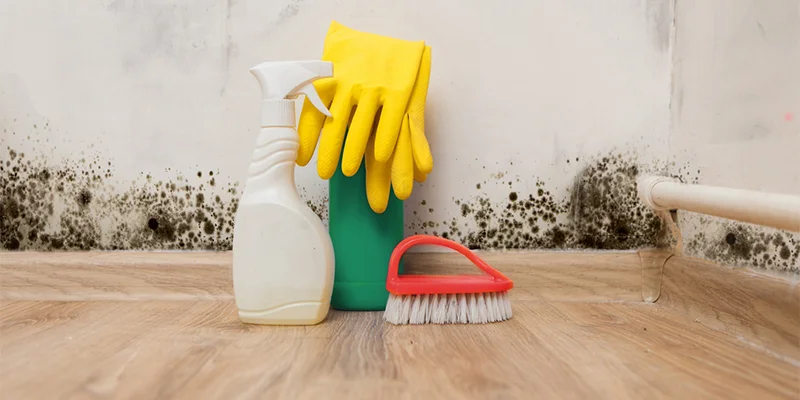
Landlords fix the leak. Tenants still lose the mold case. That’s the part nobody warns you about — and it happens constantly. The common assumption is that proving a landlord knew about water damage automatically means they’re on the hook for mold remediation. But “mold and landlord responsibility” is far more conditional than either landlords or tenants realize, and the line between “your problem” and “their problem” shifts based on state law, lease language, timing, and who caused what.
BLUF: Who Actually Owns the Mold Problem?
The short answer: landlords are responsible for mold that results from structural failures or conditions they control — roof leaks, foundation seepage, faulty plumbing, poor ventilation built into the unit. Tenants are responsible for mold caused by their own behavior — running a humidifier without ventilation, leaving wet laundry on floors, or failing to report a slow drip for months. The messy reality is that most mold situations involve both.
There is no single federal mold law in the United States. Responsibility is governed by a patchwork of state statutes, implied warranty of habitability doctrine, and whatever the lease actually says. That gap is where disputes live — and where landlords often win even when tenants have legitimate grievances.
What Is the Implied Warranty of Habitability (and Does It Cover Mold)?
Every state except Arkansas recognizes the implied warranty of habitability — a legal baseline requiring landlords to keep rental units livable, whether or not the lease spells it out. Mold, in most jurisdictions, qualifies as a habitability violation when it’s extensive enough to pose a health risk. The threshold matters: a small patch of surface mildew near a bathroom caulk line is treated very differently than black mold spreading across drywall behind a radiator.
Courts have generally held that landlords violate this warranty when mold results from conditions they were responsible for maintaining and failed to repair within a reasonable time after notice. “Reasonable time” is rarely defined precisely — 30 days is a common benchmark in tenant-landlord statutes, but emergency conditions (mold visible in a child’s bedroom, for instance) can shorten that window considerably. The key mechanism here is causation plus notice plus inaction — all three usually need to line up before a tenant has a strong legal claim.
“The single biggest mistake tenants make is assuming that the presence of mold is itself proof of landlord negligence. You still have to establish how it got there, when the landlord knew, and what they did — or didn’t do — afterward. Courts want a timeline, not just a photograph.”
Dr. Renata Osei, J.D., Environmental Health Law, Tenant-Landlord Policy Consultant
Which States Have Specific Mold Laws for Landlords?
A handful of states have moved beyond general habitability law to write mold-specific statutes. California, Texas, New Jersey, Indiana, and Virginia are among the most notable. California’s law requires landlords to disclose known mold conditions before a tenant signs a lease — failure to do so can expose them to liability even if the mold never caused documented harm. Texas requires landlords to remediate mold that materially affects health or safety, once a tenant submits written notice.
In states without explicit mold statutes, tenants lean on the habitability doctrine and any applicable housing codes. New York City, for example, has some of the most aggressive local mold regulations in the country — Local Law 55 requires landlords to investigate and remediate mold covering more than 10 square feet. That’s a city-level rule, not a state one. The takeaway: your rights depend on your zip code more than most people expect.
| Jurisdiction | Mold-Specific Law | Key Provision |
|---|---|---|
| California | Yes (Health & Safety Code §17920.3) | Disclosure required before lease; landlord must remediate visible mold |
| Texas | Yes (Property Code §92.056) | Written notice triggers 7-day remediation requirement for health/safety mold |
| New York City | Yes (Local Law 55) | Landlord must remediate mold areas over 10 sq ft; annual inspections in some buildings |
| Most other states | No (habitability doctrine applies) | Mold must rise to a level that makes the unit “unlivable” to trigger landlord duty |
What Types of Mold Are Landlords Required to Fix?
Here’s the counterintuitive fact most articles skip: the species of mold rarely determines a landlord’s legal obligation. Whether it’s Stachybotrys chartarum (the infamous “black mold”) or a more common Cladosporium strain, what matters legally is the extent of the infestation and its impact on habitability — not its genus. Landlords and tenants both over-fixate on “is it toxic black mold?” when the more legally relevant question is “does this mold materially affect health or safety?”
That said, landlords are generally required to address mold that:
- Covers more than 10 square feet of surface area (a common regulatory threshold)
- Grows inside HVAC systems, ductwork, or behind walls — areas tenants cannot access
- Results from structural issues like roof leaks, plumbing failures, or inadequate weatherproofing
- Was present before the tenant moved in (pre-existing condition)
- Returned after a prior remediation attempt the landlord completed
- Was disclosed to the landlord in writing and ignored for more than 30 days
Surface mildew in a bathroom that a tenant could reasonably clean themselves sits in a gray zone. Most housing courts won’t treat a scrubable tile grout issue as a habitability failure — though if the underlying cause is a slow plumbing leak in the wall, that changes the picture entirely.
What Are Tenants’ Rights When a Landlord Refuses to Address Mold?
Tenants aren’t powerless when a landlord goes quiet after a mold complaint — but the options available depend heavily on state law. The most widely available remedies fall into a predictable progression, and skipping steps can undermine a legal claim later.
- Send written notice: A documented complaint — dated, sent via certified mail or email with read receipt — establishes the landlord’s awareness and starts the legal clock. Verbal complaints are almost impossible to prove.
- Request a third-party inspection: Contact your local housing authority or health department. An official citation carries more weight than a tenant’s complaint alone and often triggers faster landlord action.
- Withhold rent (where legal): About half of U.S. states allow rent withholding when a landlord fails to maintain habitability. In many of those states, you must deposit withheld rent into an escrow account — pocketing it can get you evicted.
- Repair and deduct: Around 35 states allow tenants to hire a professional and deduct the cost from rent, usually capped at one month’s rent. This requires prior written notice and a reasonable waiting period.
- Break the lease without penalty: If mold renders a unit genuinely uninhabitable, most states allow constructive eviction — the tenant moves out and is no longer liable for remaining rent. Documentation is everything here.
Pro-Tip: Before you do anything else, photograph every visible mold patch with a ruler in frame for scale, document the date with your phone’s timestamp, and save every piece of communication with your landlord in a single folder. Courts decide mold cases on paper trails, not memories.
Can a Landlord Blame the Tenant for Mold — and Win?
Yes, and more often than tenants expect. Landlord-blaming-tenant arguments succeed most often in three situations: when the tenant demonstrably contributed to high humidity conditions, when the tenant failed to report a known issue, or when the lease includes specific tenant obligations around ventilation or moisture control. A tenant who ran a clothes dryer without venting it to the outside, or who kept windows sealed all winter in a steam-heated building with 70%+ indoor humidity, has a weaker claim even if the building itself has poor vapor management.
There’s a real scenario that plays out in housing courts regularly: a tenant reports a small ceiling stain, the landlord patches it but doesn’t investigate the roof, and six months later the mold is everywhere. The landlord argues the tenant should have followed up. The tenant argues the landlord’s repair was inadequate. Both arguments have merit — and the case often settles for partial remediation costs, not the full damages the tenant sought. That’s the honest nuance that aggressive tenant-rights content glosses over: partial fault produces partial outcomes.
Leases frequently include clauses requiring tenants to run exhaust fans, report water damage within 24 to 48 hours, and keep indoor humidity below a specified level — often 50 to 60 percent. If you signed that lease and didn’t follow those terms, a landlord has something to work with in court.
What Happens When Mold Appears After a Renovation?
Renovation-related mold is a particularly contentious area because the source of moisture is often ambiguous and the responsible party genuinely unclear. When a landlord opens walls during a remodel, any moisture trapped inside — from prior leaks, inadequate drying after water damage, or construction itself — can suddenly have the oxygen and warmth it needs to bloom. This is surprisingly common, and it’s covered in detail in our guide on Mold After Renovation.
Legally, mold that appears during or immediately after a landlord-initiated renovation is almost always the landlord’s responsibility. The mechanism is simple: the landlord controlled the conditions that allowed mold growth to occur or to be exposed. If a contractor improperly dried a subfloor before installing new flooring and mold appeared two months later, the landlord can’t reasonably assign that to the tenant’s lifestyle habits.
Where it gets complicated is when renovations are done while a unit is occupied and the tenant’s behavior during construction — like failing to manage humidity while the HVAC was disconnected — contributed to the outcome. Landlords pursuing that argument need documentation of what they told tenants during the renovation period. Most don’t have it.
How Should Landlords Properly Handle a Mold Complaint?
Landlords who respond quickly, document everything, and fix the actual cause — not just the visible mold — almost never end up in housing court. The ones who do end up there typically made one of two mistakes: they ignored the complaint, or they treated symptoms without investigating the source. Painting over mold without eliminating the moisture source is the property management equivalent of putting a bandage on a broken pipe — it doesn’t fix anything and creates liability when the mold returns.
A responsible mold response from a landlord looks like this: acknowledge the complaint in writing within 24 hours, inspect within 3 to 5 days, bring in a certified industrial hygienist if the affected area exceeds 10 square feet, eliminate the moisture source before or simultaneous with remediation, and document all steps taken with photos and contractor invoices. Sending that paper trail to the tenant in writing closes most dispute loops before they open.
Landlords often underestimate how much a written acknowledgment alone de-escalates conflict. Tenants who feel heard and see action rarely escalate to housing court — it’s the ones who are stonewalled who call lawyers.
Does Renter’s Insurance Cover Mold Damage to Personal Property?
Most standard renter’s insurance policies explicitly exclude mold, which catches tenants completely off guard. If your landlord’s negligence allowed a burst pipe to go unrepaired and your furniture, books, and clothing were destroyed by subsequent mold growth, your renter’s insurance may not cover it — even though the cause was clearly the landlord’s fault. Your remedy in that scenario is a claim against the landlord directly, not your own insurer.
A small number of renter’s insurance policies offer mold coverage as an add-on rider, usually capped at $1,000 to $5,000 for personal property. It’s worth checking your policy documents specifically for the words “fungi,” “mold,” or “wet rot” — that’s where exclusions tend to hide. If you’re in a building with a history of water issues, that rider is cheap insurance for a genuinely plausible scenario.
Landlord insurance is similarly inconsistent on mold. Many commercial property policies exclude mold remediation costs unless they’re linked to a covered peril like a sudden pipe burst — meaning slow leaks and chronic moisture problems often fall into an uninsured gap. That’s one reason why landlords sometimes resist mold remediation: it can come out of pocket rather than from a claim.
What Documentation Do Both Parties Need to Protect Themselves?
The entire mold-and-landlord-responsibility framework ultimately comes down to documentation — who noticed what, when they told whom, and what happened next. Both sides have an interest in creating a clear record, and both sides often fail to do it until there’s already a dispute.
For tenants, the minimum documentation set includes: dated photographs of visible mold with a size reference, copies of all written complaints to the landlord (email is ideal), any professional or health department inspection reports, and medical records if there were health impacts. For landlords, it includes: written acknowledgment of the complaint and the response timeline, inspection reports, contractor invoices and scope of work, and any communications explaining the cause and the remediation plan. Neither party should rely on verbal communication for anything substantive once mold has been identified.
One observation that doesn’t get said enough: landlords who document proactively almost always do better in disputes, even when they’re partially at fault. Showing a court that you responded in good faith, investigated thoroughly, and fixed the underlying cause tends to limit damages even when the initial failure was real. Courts aren’t just looking at whether mold existed — they’re evaluating conduct.
Can a Landlord Legally Evict a Tenant for Complaining About Mold?
Retaliatory eviction — evicting or threatening to evict a tenant for making a habitability complaint — is illegal in virtually every U.S. state. The protection typically kicks in once a tenant has made a formal complaint, contacted a housing authority, or joined a tenant organization. If a landlord serves an eviction notice within 60 to 90 days of a mold complaint (the window varies by state), courts will often presume retaliation, flipping the burden of proof onto the landlord to show a legitimate, independent reason for the eviction.
That said, retaliatory eviction protections don’t make tenants bulletproof. A landlord can still legally evict for nonpayment of rent, lease violations, or other documented causes that exist independent of the mold complaint. The timing and sequence of events matter enormously. Tenants who withheld rent (especially in states where that’s not permitted) while simultaneously filing mold complaints can find themselves in a legally murky position where their own lease violations undercut their habitability claims.
The cleanest path for a tenant who fears retaliation is to maintain full rent payment (or proper escrow in states that require it), keep complaint channels strictly formal and in writing, and consult a tenant-rights attorney before withholding anything. Free legal aid clinics exist in most mid-size cities specifically for housing issues — they’re dramatically underused.
What’s the Most Overlooked Part of Mold Responsibility: Lease Language
This is where most coverage of mold and landlord responsibility stops short: the lease itself can dramatically shift what each party owes the other, within the limits of state law. Landlords in low-regulation states often include clauses requiring tenants to maintain interior humidity below 55 percent, run exhaust fans during and after cooking and bathing, and report any water intrusion within 24 hours. Failure to comply with those lease terms can be used to defeat a habitability claim — even in cases where the landlord’s building envelope was also flawed.
Tenants rarely read these clauses carefully before signing. The assumption is that anything mold-related is the landlord’s problem because they own the building — and that’s simply not how lease law works. A lease clause that contradicts state habitability law is unenforceable, but a clause that adds reasonable tenant obligations on top of baseline protections is almost always valid.
Before signing any lease, search the document for the words “mold,” “moisture,” “humidity,” “ventilation,” and “reporting.” Understand what you’re agreeing to. And if you’re a landlord drafting a lease, understand that overly aggressive “tenant is responsible for all mold” clauses are likely unenforceable in states with strong habitability law — courts don’t let landlords contract out of their statutory duties entirely.
Mold law is a slow-moving area that’s been gradually tightening for two decades, and that trajectory shows no signs of reversing. Buildings that meet minimum code today may face stricter moisture and ventilation standards within a single lease cycle — which means both landlords and tenants who understand the underlying principles of mold responsibility now are the ones best positioned to act correctly when the rules shift around them.
Frequently Asked Questions
Is a landlord always responsible for mold?
No. Responsibility depends on the cause of moisture and conditions.
Does mold always mean the apartment is defective?
Not necessarily. Mold often reflects humidity or condensation issues.
Who is responsible if there are no leaks?
Responsibility may be shared, depending on ventilation and use.
Is mold common in rental apartments?
Yes. Many apartments experience moisture-related mold.
Do mold rules vary by country?
Yes. Laws and responsibilities differ widely by location.
Disclaimer: This article is for informational purposes only and isn’t a substitute for professional mold inspection or remediation advice. Mold problems vary a lot depending on the material affected, the extent of growth, and your specific health situation. Always follow product label instructions when using cleaning chemicals, ensure proper ventilation, and consider consulting a certified mold remediation professional for anything beyond a small, surface-level patch. If you have respiratory conditions, allergies, or a compromised immune system, talk to a doctor before starting any DIY mold removal.