
Forty percent of homes in humid climates maintain indoor relative humidity above 60% year-round — and the owners have no idea why, because they’re blaming the wrong things. The real culprit isn’t usually the weather outside or even a leaky roof. It’s the invisible, cumulative moisture being generated inside the home every single day, with nowhere to go.
That’s the angle almost every article on this topic misses. They hand you a list of causes — cooking, showers, houseplants — and send you off to buy a dehumidifier. But treating high indoor humidity without understanding the mechanism behind it is like mopping the floor while the tap is still running. You’ll keep mopping forever unless you trace the water back to its source.
This article is about that source. More specifically, it’s about why moisture builds up faster than your home can release it, and what that means for how you actually fix the problem — not just manage it.
What Is High Indoor Humidity and What Level Should You Be At?
Relative humidity (RH) is the percentage of moisture in the air relative to how much it could hold at that temperature. The sweet spot for indoor air is between 40% and 50% RH. Go below 30% and you’ll notice dry skin, static electricity, and cracking wood. Climb above 60% and you’ve created conditions where mold, dust mites, and structural damage all become real, active risks.
A basic digital hygrometer — you can find one for under $15 — will tell you exactly where you stand. Don’t guess. Humidity problems often develop silently for months before any visible sign appears, and by the time you spot mold on a wall, you’re already dealing with a problem that’s been festering since last season.
Here’s something that surprises people: the same RH reading can feel very different depending on temperature. 55% RH at 68°F feels comfortable. 55% RH at 80°F feels oppressively sticky, and it accelerates mold growth significantly. The moisture content of the air is the same — but the thermal behavior changes everything.
Why Does Indoor Humidity Get So High in the First Place?
The core mechanism is simple: moisture enters your home faster than it leaves. That imbalance is what drives high humidity. There are three main entry routes — moisture generated indoors, moisture infiltrating from outside, and moisture rising up through building materials — and most homes are dealing with all three simultaneously without realizing it.
Indoor generation is relentless and underestimated. A single person sleeping releases roughly a pint of moisture through breathing and perspiration overnight. Cooking a meal on the stovetop without a functioning range hood can add another pint or two. A ten-minute hot shower contributes around half a pint. Add a load of laundry air-drying on a rack, a few medium-sized houseplants, and a gas stove (which releases water vapor as a combustion byproduct), and a family of four can generate 10 to 15 pints of moisture on an average day — inside a sealed house.
That number is what most people don’t fully absorb. It’s not that any single activity is the problem. It’s that they all stack on top of each other inside a building that may have minimal ventilation.
What Are the Most Common Causes of High Indoor Humidity?
Causes fall into two broad categories: behavioral and structural. Most households have a mix of both, which is exactly why slapping a dehumidifier in the corner doesn’t fully solve it.
- Inadequate ventilation: Homes built after the energy efficiency improvements of the 1980s are significantly tighter than older construction. That tightness is great for heating bills but terrible for moisture — there’s no natural air exchange to carry humid air out. Bathroom fans vented into the attic instead of outside (a common installation error) make this worse.
- Crawl space or basement moisture: Ground moisture migrates upward constantly. An unsealed crawl space or a damp basement is essentially an open door for ground-sourced humidity to enter the living areas above it, driven upward by stack effect air movement.
- Poor or missing insulation: Cold surfaces cause warm, moist air to condense — think of a cold glass of water on a summer day. Inadequate insulation around exterior walls, pipes, and rim joists creates cold spots where moisture consistently condenses and accumulates, sometimes inside wall cavities where you’ll never see it.
- Oversized air conditioning: A common but rarely discussed cause. An AC unit that’s too large for the space short-cycles — it cools the air quickly but shuts off before it has time to dehumidify properly. The air feels cool but remains humid, and you keep wondering why it also feels clammy.
- Unvented combustion appliances: Gas stoves, dryers not properly vented to the exterior, and even some types of space heaters release water vapor directly into your living space as part of their normal operation.
- Seasonal outdoor humidity infiltration: In warm, humid climates, outdoor air pushed inside by wind pressure or HVAC return air draws brings significant moisture with it. This is especially acute when doors are opened frequently in summer, or when window seals have deteriorated.
What Are the Warning Signs Your Home Has a Humidity Problem?
Some signs are obvious. Others are easy to misread as different problems entirely, which is how humidity damage quietly compounds for years without triggering a fix.
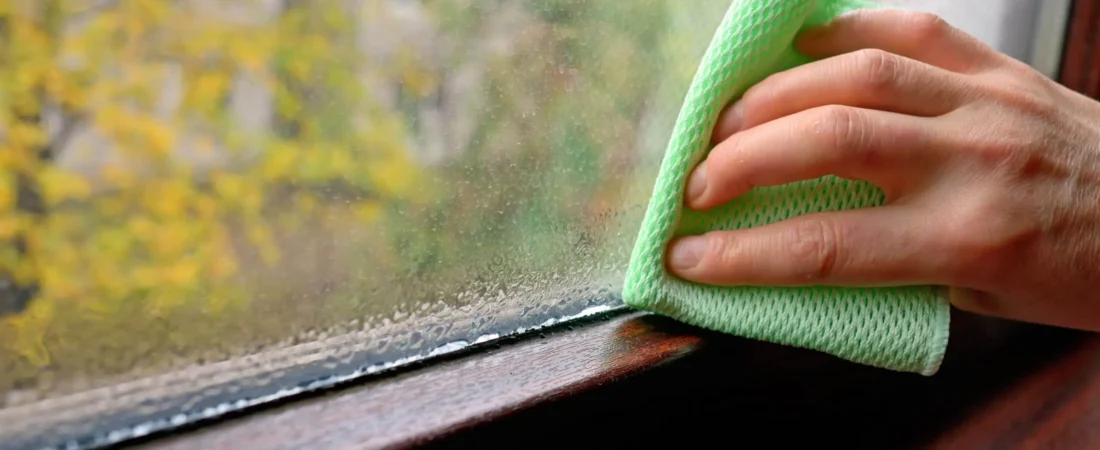
- Condensation on windows: Moisture forming on the inside of windows, especially in morning, is a direct indicator that interior humidity is too high. The glass is cooler than the dew point of the room air.
- Musty or earthy smell: That familiar damp-basement smell isn’t the smell of moisture itself — it’s the smell of mold and mildew metabolizing organic material. If you can smell it, mold is already present somewhere.
- Sticking doors and windows: Wood absorbs moisture and swells. If interior doors that fit fine in winter start sticking in summer, that’s your home telling you the humidity has climbed.
- Peeling paint or bubbling wallpaper: Moisture migrating through walls breaks the adhesive bond between surfaces. This often gets misdiagnosed as a paint quality issue.
- Visible mold growth: Particularly in corners, behind large furniture pieces, and around window frames. These are the coldest surfaces in a room and the first places moisture condenses.
A scenario worth picturing: you notice a dark stain appearing on the corner of a bedroom ceiling. You assume it’s a roof leak. A roofer comes out, finds no breach, charges you $200 for the inspection, and leaves. The stain keeps spreading. What’s actually happening is that the corner has a cold spot due to missing insulation in the attic, and warm, humid interior air is condensing there every night. It’s a humidity problem wearing the disguise of a structural one.
Why Is the Basement the Biggest Humidity Source Most Homeowners Overlook?
Stack effect is the reason your basement humidity problem doesn’t stay in the basement. Warm air rises, and as it does, it pulls air upward from the lower levels of a home. That means whatever moisture exists in your basement gets drawn into the rest of the house continuously, day and night, without any deliberate action on your part.
Ground moisture is persistent because the soil beneath and around your home is always damp to some degree. Concrete is porous — water vapor migrates through it slowly but relentlessly. A basement with no visible standing water can still contribute thousands of pints of moisture to the home’s air annually, all of it traveling invisibly upward through the floor assembly and air gaps.
This is why a dehumidifier placed only in the living room often feels like it’s fighting an uphill battle — because it literally is. The moisture source is below it, being continuously fed by soil moisture, and the dehumidifier is only dealing with the tail end of the problem.
How Does Poor Insulation Make Indoor Humidity Worse?
This one genuinely surprises people who think of insulation purely as a temperature issue. Here’s the mechanism: warm, humid indoor air contains water vapor in suspension. When that air contacts a surface cold enough to drop it below its dew point — typically somewhere between 45°F and 55°F depending on interior humidity levels — that water vapor becomes liquid condensation.
Poor or missing insulation creates cold surfaces on exterior walls, rim joists, and around windows. Air circulates, hits these cold spots, deposits moisture, and then the condensation either evaporates back into the air (perpetuating the cycle) or soaks into building materials (causing rot and mold). Properly installed insulation keeps those surfaces warmer, which keeps air temperatures above the dew point, which means no condensation.
The counterintuitive part: adding insulation in the wrong place can actually make condensation worse. If you insulate the interior side of a cold wall without addressing the vapor barrier, you push the dew point further into the wall cavity where it’s hidden and even harder to dry out. Insulation placement and vapor control work together, not independently.
“High indoor humidity is almost never a single-source problem. What we consistently find is a combination of inadequate ventilation and an uncontrolled moisture entry point — most often the crawl space or basement — that’s been ignored because it’s out of sight. Homeowners address the symptoms without ever auditing the whole building envelope, and then they’re frustrated when the problem keeps coming back.”
Dr. Marcus Ellery, Building Science Consultant and Certified Indoor Air Quality Professional
What’s the Difference Between Seasonal and Year-Round High Humidity?
Seasonal high humidity — typically peaking in summer — is mostly driven by outdoor air infiltration and the gap between what your AC can dehumidify and the rate of moisture generation inside. When temperatures drop and windows close for winter, these homes often return to acceptable levels without intervention.
Year-round high humidity is a different beast. It points to a structural or mechanical issue: an uncontrolled crawl space, inadequate ventilation, a chronic plumbing leak adding moisture behind walls, or an HVAC system that’s consistently undersized for dehumidification duty. These problems don’t resolve with seasons — they need direct intervention.
Honestly, if your humidity climbs in summer but recovers in winter, that’s actually useful diagnostic information. It means your home’s envelope is reasonably intact and your issue is more about managing peak load. If humidity stays high regardless of what the weather is doing outside, you need to audit your home’s structure before investing in any equipment.
| Humidity Pattern | Likely Primary Cause | Priority Fix |
|---|---|---|
| High in summer, normal in winter | Outdoor air infiltration, AC dehumidification gap | Seal air leaks, check AC sizing |
| High year-round, worse in basement | Ground moisture migration via crawl space or basement | Encapsulate crawl space, waterproof basement |
| High in specific rooms only | Poor local ventilation or cold surface condensation | Improve exhaust ventilation, add insulation to cold spots |
| Sudden increase with no seasonal change | Active plumbing leak, HVAC issue, or new moisture source | Professional inspection — don’t delay |
Does Outdoor Humidity Always Drive Indoor Humidity Up?
Not automatically — and this is where it gets interesting. A well-sealed, well-conditioned home in a humid climate can maintain comfortable indoor humidity even when outdoor RH is at 90%. The outdoor humidity becomes a problem when it has pathways to get inside: open windows, gaps in the building envelope, leaky ductwork pulling from humid attic or crawl space air, or a whole-house ventilation system that brings in unfiltered outdoor air without dehumidifying it first.
There’s also a thermal component worth understanding. When very humid outdoor air enters a well-air-conditioned home and contacts cooler surfaces, it sheds moisture rapidly — directly onto your floors, walls, and furniture. That’s why opening windows on a hot, humid night to “let the house breathe” often makes things worse rather than better. You’re inviting in more moisture than you’re pushing out.
The key variable is air exchange — how much outdoor air comes in, at what humidity level, and whether your home’s systems can process it before it condenses or accumulates. That’s a function of envelope tightness and mechanical ventilation design, not just geography.
How Do You Actually Fix High Indoor Humidity — Not Just Manage It?
There’s an important distinction between managing humidity (running a dehumidifier indefinitely) and fixing the underlying cause. Both have a place, but if you’re relying entirely on management without addressing sources, you’re spending money on electricity without solving the problem.
Start with source reduction. Every liter of moisture you prevent from entering the air is one your systems don’t have to remove. Run bathroom exhaust fans for at least 20 minutes after a shower — not just during it. Use range hoods on high when cooking and make sure they vent to the exterior, not into the attic. Cover pots while boiling water. Move air-drying laundry to a ventilated space or switch to machine drying. These behavioral changes alone can reduce indoor moisture generation by 30 to 40%.
Next, address the building envelope. Seal the basement or crawl space. A vapor barrier on a crawl space floor, properly sealed at the seams and edges, can dramatically reduce the ground moisture migrating upward. Check that bathroom fans are actually venting outside — it’s worth going into the attic to verify, because incorrectly terminated bath fans are one of the most common installation errors found in home inspections.
Then look at your HVAC. If your AC is oversized, it may be cooling the air adequately while leaving humidity too high. This is a nuanced situation — replacing an oversized unit isn’t always cost-effective — but a qualified HVAC technician can evaluate whether your system is running long enough to dehumidify, and can sometimes program the fan to run longer after the compressor shuts off to extend dehumidification cycles. Some modern thermostats have a dedicated humidity control mode that does this automatically.
Pro-Tip: If you’re running a portable or whole-house dehumidifier, place it near the primary moisture source, not in the middle of the living space. A dehumidifier in the basement works on the problem at its origin point and benefits the entire home through stack effect — often more efficiently than a larger unit placed upstairs.
When Is High Indoor Humidity a Health Risk?
Sustained indoor humidity above 60% creates conditions where dust mite populations double roughly every 10 days. Dust mites are the single largest biological trigger of year-round allergic rhinitis and asthma in indoor environments. You don’t need visible mold to have a health problem — the mite population explosion in high-humidity bedding and upholstery is enough to significantly worsen respiratory symptoms.
Mold growth on surfaces typically begins within 24 to 48 hours when RH stays above 70% and a food source (any organic material — drywall paper, wood, dust) is present. At 80% RH, most common household mold species can colonize surfaces in as little as 12 hours under warm conditions. The health risk from mold is not just allergic — certain mold species produce mycotoxins that can cause neurological symptoms in sensitive individuals.
Children, the elderly, and anyone with asthma, COPD, or compromised immune function are most vulnerable, and their symptoms often improve noticeably — sometimes dramatically — when indoor humidity is brought back to the 40–50% range. This isn’t a speculative claim; it’s documented across multiple clinical environments and home audit programs run by public health agencies.
What Equipment Actually Helps and What’s a Waste of Money?
A digital hygrometer is the first thing to buy — always, before any dehumidification equipment. You can’t manage what you can’t measure, and guessing at your humidity level leads to under-treating or over-treating, both of which have costs.
For equipment, the decision tree matters. If humidity is high in one room or area, a room-sized portable dehumidifier with a built-in humidistat (so it cycles off rather than running constantly) is appropriate. For whole-house problems, a whole-house dehumidifier integrated with the HVAC system is significantly more efficient than running multiple portables — it treats all the air cycling through the system, not just the air in one location.
Here’s where people commonly waste money: buying a dehumidifier rated for a larger space than they need, assuming bigger is always better. Oversizing a dehumidifier creates the same short-cycling problem as an oversized AC — it dehumidifies in bursts rather than maintaining a stable level, and the on-off cycling reduces the unit’s efficiency and lifespan. Match the unit’s pint-per-day rating to your actual square footage and humidity severity — manufacturers provide these pairings in their specifications.
Heat recovery ventilators (HRVs) and energy recovery ventilators (ERVs) are worth serious consideration in tight, well-insulated homes where indoor moisture generation is the primary problem. They exchange stale, humid indoor air with fresh outdoor air without losing the thermal energy — so you’re not paying to re-heat or re-cool all the replacement air. An ERV also transfers some moisture from the outgoing air to the incoming air, which helps moderate swings in both directions.
How Do You Know If Your Ventilation Is Actually Working?
Most people assume their ventilation is fine because they have exhaust fans installed. Installed and working are not the same thing. Bathroom exhaust fans accumulate lint and dust that reduces their airflow capacity dramatically over time — a fan that moved 50 CFM when new might be moving 20 CFM after a few years without cleaning. That’s not enough to handle shower moisture effectively.
A simple tissue test tells you a lot: hold a single piece of tissue paper near the exhaust grille while the fan is running. It should hold firmly against the grille. If it flutters or falls, your fan isn’t generating enough suction to do its job. Clean the grille and fan blades with a vacuum brush, and retest. If airflow is still weak, the motor may need replacement — fan motors are typically inexpensive to replace and it’s often worth doing rather than running an underperforming fan indefinitely.
Also verify that all ductwork connected to exhaust fans terminates outside the building envelope — not into an attic, not into a wall cavity, not under a floor. In cold climates, uninsulated exhaust ducts can cause condensation inside the duct itself, creating a second moisture source you’re completely unaware of.
A Note on When Fixes Depend on Your Specific Situation
There’s no single solution that works for every home, and anyone who tells you otherwise is oversimplifying. A concrete slab house in coastal Georgia has a fundamentally different humidity profile than a wood-frame house with a crawl space in the Pacific Northwest. The causes overlap, but the priority order of fixes doesn’t.
Climate zone matters significantly. In humid, mixed climates (much of the US Southeast and mid-Atlantic), the battle is primarily against outdoor moisture infiltration and high latent loads in summer. In cold climates, the winter concern shifts — indoor moisture from occupants trying to escape into cold exterior surfaces creates condensation and ice damming in attic spaces. The same underlying physics applies, but the season of peak risk and the recommended interventions differ.
If your humidity problem is severe, persistent, or has been present long enough that you suspect structural damage or mold colonization inside wall cavities, a building diagnostician or certified industrial hygienist is worth the cost
Frequently Asked Questions
Why is indoor humidity high even in winter?
Cold air holds less moisture, which raises relative humidity indoors, especially with limited ventilation.
Can indoor humidity be high without leaks?
Yes. Daily activities and poor airflow are common causes.
Is high humidity worse at night?
Often yes. Cooler temperatures increase relative humidity, especially in bedrooms.
Does opening windows always reduce humidity?
Not always. It helps when outdoor air is drier than indoor air.
Can small apartments have higher humidity?
Yes. Moisture builds up faster in smaller spaces.
Is indoor humidity the same in every room?
No. Bathrooms and kitchens usually have higher humidity levels.