
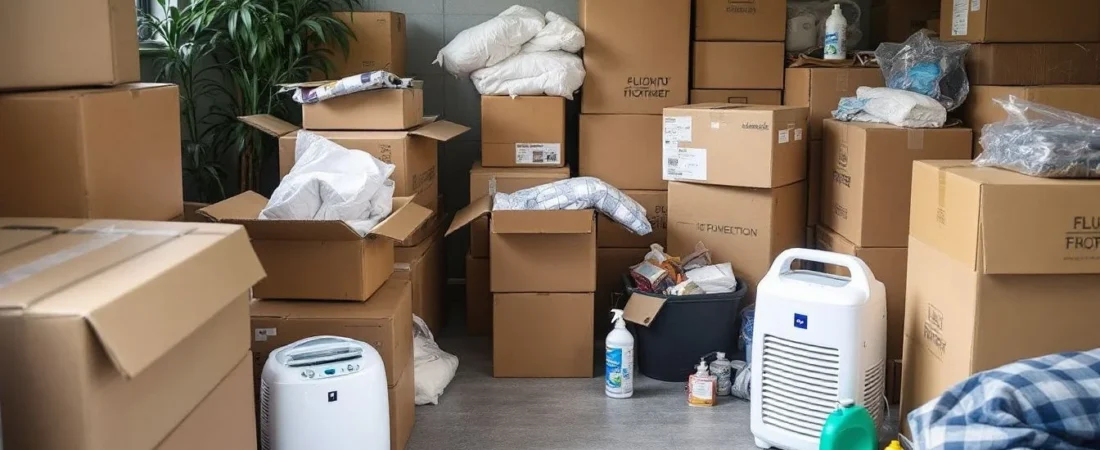
Your storage room doesn’t have a moisture problem — it has a ventilation problem that creates a moisture problem. That distinction matters more than most people realize, because it completely changes how you fix it.
The typical advice floating around is to throw a dehumidifier in the corner and call it done. Sometimes that works. But plenty of people run dehumidifiers in their storage rooms for months and still open the door to that unmistakable wall of damp air. The reason isn’t that the dehumidifier is weak — it’s that the room itself is working against you in ways that are genuinely fascinating once you understand the physics involved.
This article is about the mechanism behind that trapped dampness. Not just “what to do,” but why storage rooms behave so differently from the rest of your home — and why the fix that works in a bedroom often fails completely in a closet or storage space.
Why Storage Rooms Feel Damp Even When There’s No Leak
The first thing most people do when their storage room feels damp is go looking for a leak. That’s a reasonable instinct. But the vast majority of damp storage rooms have no pipe dripping, no crack letting in groundwater, no visible source at all. The humidity is self-generated and self-sustaining.
Here’s what’s actually happening: every object stored in that room — cardboard boxes, fabric, wood shelving, old books, sports equipment — contains moisture. Materials absorb ambient humidity from the air and release it back when conditions change. This is called hygroscopic behavior, and almost everything you own exhibits it to some degree. Your storage room is essentially a sealed box full of sponges.
When the air inside gets warmer (say, on a summer afternoon), those materials release moisture vapor into the air. When it cools at night, that vapor tries to condense somewhere — often on the walls, the floor, or the cooler surfaces of the stored items themselves. Over weeks and months, this cycling creates a persistent dampness that no amount of cleaning will solve.
What Is “Trapped Humidity” and Why Does It Happen in Storage Spaces Specifically?
Trapped humidity isn’t a term you’ll find in a physics textbook, but it describes something very real. It refers to moisture that enters a space — through air infiltration, off-gassing from stored materials, or minor condensation — and then can’t exit fast enough to prevent buildup. Storage rooms are uniquely vulnerable to this because of three structural features they almost always share.
First, they’re small. A smaller volume of air reaches saturation faster — it takes far less moisture to push a 60-cubic-foot closet to 80% relative humidity than it does a 500-square-foot living room. Second, they’re poorly ventilated. Most storage rooms have no HVAC return, no window, and a door that stays closed for days or weeks at a time. Air movement is essentially zero. Third, they’re packed with hygroscopic materials that continuously cycle moisture in and out of the air.
The underexplored part of this equation — and the thing most articles completely miss — is that slow air movement is the core problem, not just moisture quantity. Even a storage room with a moderate moisture load can stay comfortable if air cycles through regularly. The same moisture load in a sealed room will create a swampy mess within weeks. Humidity doesn’t just accumulate; it stagnates, and stagnant humid air feels dramatically wetter than moving air at the same relative humidity.
How Does Air Stagnation Make Humidity Feel Worse Than It Actually Is?
There’s a counterintuitive fact buried in psychrometrics — the science of air and moisture — that almost never gets mentioned in home improvement content: still air at 65% relative humidity genuinely feels wetter than moving air at 70% relative humidity. The sensation of dampness isn’t purely a function of the numbers on your hygrometer. It’s partly a function of how much moisture your skin can evaporate off into the surrounding air.
When you open a storage room door and feel that immediate “wall of damp,” you’re partly responding to the still, saturated boundary layer of air right at the doorway. Moving air disrupts that boundary layer and increases evaporation from surfaces, which is why rooms with even minimal airflow feel drier. A stagnant room creates micro-environments where localized humidity near surfaces can run 10–15% higher than the center of the room — which is why you’ll find mold on the back wall of a shelf before you find it anywhere else.
This is the insight that changes how you should be thinking about storage room moisture. It’s not enough to reduce total moisture — you have to move the air. A hygrometer reading of 55% in a dead-still storage room may feel worse and cause more surface damage than 60% in a room with a small fan running.
“Relative humidity alone is a poor predictor of moisture damage in enclosed spaces. What matters equally is dwell time — how long humid air stays in contact with surfaces. In a room with near-zero air changes per hour, you can have seemingly acceptable average humidity and still see condensation, mold colonization, and material degradation within a single season.”
Dr. Patricia Holmgren, Building Science Consultant and Certified Industrial Hygienist
Why Does Slow Drying Make Storage Rooms Worse Over Time?
Think about what happens when a cardboard box gets slightly damp — say, from a brief period of high humidity. In a well-ventilated space, that moisture evaporates within hours. In a sealed storage room, it doesn’t. The surrounding air has nowhere near enough capacity to absorb additional moisture, especially if it’s already at 70–80% relative humidity. So the box stays damp. And a damp cardboard box is one of the fastest-colonizing surfaces for mold, which produces its own moisture as a metabolic byproduct.
This is the compounding cycle that makes storage rooms progressively worse over time rather than reaching a stable equilibrium. Dampness enables mold. Mold produces more humidity. That humidity dampens more materials. Those materials off-gas more moisture. Without intervention, the room slowly but persistently inches toward worse conditions every season. Storage rooms that develop that characteristic musty odor are often well into this cycle before anyone notices.
Slow drying also causes a problem that’s easy to overlook: materials that dry unevenly. Wood shelving that absorbs moisture and dries slowly on its surface but retains internal moisture will warp, swell, and eventually crack. Fabric stored in conditions like this doesn’t just smell musty — the fibers themselves can break down, and mold staining often penetrates deep enough that cleaning doesn’t fully restore the item.
What Actually Causes Condensation on Storage Room Walls and Floors?
Condensation forms when warm, moisture-laden air contacts a surface that’s cooler than the dew point of that air. In storage rooms, the walls and floors are often the coldest surfaces in the room — especially in basement or exterior-wall storage spaces — which makes them magnets for condensation. But the timing of when condensation forms is often misunderstood.
Many people assume condensation happens when it’s cold outside. Actually, in storage rooms, the worst condensation often happens when warm humid air from summer enters a cooler storage space. If your storage room sits against an exterior wall or is partially below grade, the wall temperature may be 15–20°F cooler than the incoming air in summer. Warm summer air at 75°F and 70% relative humidity has a dew point of about 63°F — so any surface below 63°F will collect liquid water. That’s most of the walls in a below-grade or partially insulated storage room during summer months.
The honest nuance here: whether this is a problem in your specific room depends heavily on how your home is constructed, how the space is used, and your climate. A storage room in a well-insulated newer home in a dry climate may never see this issue. The same-sized room in an older humid-climate home with uninsulated concrete walls can develop serious condensation problems within a single summer.
| Air Temperature (°F) | Relative Humidity | Dew Point (°F) | Surface Risk |
|---|---|---|---|
| 75°F | 70% | ~63°F | High — most below-grade walls |
| 70°F | 60% | ~55°F | Moderate — depends on insulation |
| 65°F | 50% | ~45°F | Low — typical well-insulated space |
Which Stored Items Make Humidity Problems Significantly Worse?
Not all stored items are equal when it comes to their contribution to humidity. Some are relatively inert. Others are essentially slow-release moisture pumps. Understanding which is which lets you make smarter choices about what goes in your storage room — and how you store it.
- Cardboard boxes — Cardboard is extremely hygroscopic, absorbs moisture rapidly, and dries slowly. It’s also a preferred colonization surface for mold. Replacing cardboard with sealed plastic bins is one of the highest-impact changes you can make.
- Fabric and clothing — Natural fibers like cotton, wool, and linen absorb and release moisture continuously. Storing large quantities of fabric in a sealed space significantly raises the moisture load of the room’s air.
- Wood furniture and shelving — Wood contains internal moisture (measured as “moisture content,” typically 6–12% in kiln-dried lumber) and exchanges moisture with its environment constantly. Unsealed or poorly finished wood is especially active.
- Books and paper — Paper is highly hygroscopic and provides excellent surface area for mold growth. A storage room full of old books can have measurably higher humidity than an equivalent space without them.
- Sports and outdoor equipment — Gear stored while slightly damp (think camping tents, coolers, sports bags) introduces direct moisture into the room. Even one tent packed away with residual moisture can meaningfully spike the room’s humidity over several days.
Why Doesn’t Opening the Door More Often Actually Fix the Problem?
This is where a common assumption falls apart. The intuitive fix for a stuffy, damp storage room is to open the door more often and “let it breathe.” That works sometimes — specifically when the outside air or hallway air is drier than the storage room air. But it can actively make things worse when it isn’t.
On humid summer days, the air in your hallway or home may be 65–75% relative humidity. Opening the door to your storage room then introduces more moisture, not less. And because the storage room walls and floor are often cooler than the rest of the home, that newly introduced warm humid air is more likely to condense on those surfaces than the air that was already in the room.
The fix isn’t more air exchange — it’s controlled air exchange. Ventilating a storage room on cool, dry days (or with conditioned air from your HVAC system) helps. Ventilating on warm, humid days without dehumidification hurts. This is why a basic mechanical solution — a small fan, a dehumidifier, or a duct connection to your HVAC return — outperforms simply leaving the door open.
Pro-Tip: Run a small 6-inch USB-powered fan pointed at the lowest part of your storage room wall for 30–60 minutes after any major access or disturbance. The bottom 12 inches of a storage room is where condensation and mold colonization almost always start first — that’s where the coldest air settles and where moisture dwell time is highest. Moving that layer of air breaks the cycle before it can establish itself.
How Do You Know If Your Storage Room Humidity Is Actually Dangerous?
There’s a wide spectrum between “slightly musty” and “actively damaging,” and knowing where your storage room falls determines how aggressively you need to respond. Relative humidity above 60% sustained for more than 48 hours creates conditions where mold can begin colonizing porous surfaces. Above 70%, growth accelerates dramatically — mold can establish visible colonies in under a week on materials like cardboard or damp fabric.
A cheap digital hygrometer — they run about $10–15 at most hardware stores — tells you the relative humidity and temperature in real time. But a single reading is misleading. What matters is the pattern over 24–48 hours, because storage rooms often swing dramatically between day and night as temperatures change. A room that reads 52% at noon may spike to 78% at 3 a.m. when temperatures drop and the air can’t hold as much moisture vapor. If you can get a logger-style hygrometer (around $20–30) that records min/max readings, you’ll get a far more accurate picture of what’s actually happening in that room.
Physical signs are also reliable indicators: white or gray fuzzy growth on stored items or walls, a persistent earthy or sour smell that doesn’t clear when the door is open, warping or staining on wood surfaces, or rust forming on metal objects. Any of these indicates sustained high humidity and active damage.
What Actually Works to Fix a Damp Storage Room?
Solutions fall into three categories: reducing moisture sources, improving air movement, and controlling temperature differentials. The best outcome comes from addressing all three, but if you’re prioritizing, air movement is where you’ll get the fastest improvement — because it solves both the humidity concentration problem and the slow-drying problem simultaneously.
- Switch to airtight plastic bins — This reduces the moisture contribution from hygroscopic stored materials. Sealed bins don’t exchange moisture with the room’s air. This alone can drop the room’s baseline humidity by several percentage points if you’re currently using cardboard boxes.
- Install a small dedicated dehumidifier — For storage rooms under 200 square feet, a compact 20–30 pint unit is sufficient. Position it toward the center of the room, not in a corner where airflow is minimal. Empty or auto-drain regularly — a dehumidifier with a full tank does nothing.
- Add a louvered vent or transfer grille to the door — This creates passive airflow from conditioned space into the storage room without requiring an active fan. Works best when the adjacent space is climate-controlled and drier than the storage room.
- Insulate cold walls and floors — Raising the surface temperature of walls closes the gap between surface temperature and dew point, dramatically reducing condensation. Rigid foam board insulation on a below-grade wall can raise surface temperature by 10–15°F in a single-season installation.
- Use desiccant packets or rechargeable moisture absorbers — Products like silica gel canisters or calcium chloride absorbers are useful for individual bins or sealed storage areas within the room. They’re not a substitute for room-level humidity control, but they protect high-value items well.
Does the Location of Your Storage Room Change What You Should Do?
Location matters enormously — possibly more than any other single factor. A storage room built into an interior wall of an air-conditioned home has a completely different humidity profile than a storage room sharing an exterior wall, sitting above a crawlspace, or existing in a partially below-grade basement level.
Below-grade or exterior-wall storage rooms face the condensation problem described earlier, and their priority fix is thermal insulation of the walls and floor. Interior storage rooms — like a large closet off a hallway — are more likely dealing with poor air circulation rather than temperature differential condensation. Their priority fix is airflow: a vent, a fan, or a connection to the HVAC return.
Garage storage rooms sit in their own category. Garages are often not climate-controlled, which means the storage room within a garage experiences wild humidity swings tied directly to outdoor conditions. These spaces are genuinely hard to control without sealing them very well from the garage itself and adding dedicated climate control. Running a standard home dehumidifier in an uninsulated garage storage room in summer can be a losing battle if the garage air is continuously introducing new moisture faster than the unit can remove it.
How Long Does It Take to Dry Out a Damp Storage Room Once You Fix the Source?
This question almost never gets answered concretely, and the vague “a few days” response that floats around is often wildly optimistic. A storage room that’s been running high humidity for a full season — with damp stored materials, moist walls, and potentially early mold growth — can take 2–4 weeks to fully stabilize even with aggressive dehumidification and airflow improvements.
The reason is that moisture isn’t just in the air — it’s deep in the materials. A wood shelf that’s been sitting at 80% relative humidity for three months may have a moisture content of 18–20%, nearly double what it should be. Drying that wood back to a stable 9–11% takes time because moisture moves from the interior of the material to the surface slowly, and then evaporates into the air. You can accelerate this with warmth and airflow, but you can’t rush the physics of diffusion.
A real-world scenario: say you have a 10×8 foot storage room off your basement that you’ve been packing with cardboard boxes, fabric storage bags, and old wooden furniture for two years. You install a 30-pint dehumidifier and add a louvered vent to the door. In the first week, the dehumidifier will pull water very aggressively — potentially a full tank every 12–18 hours — as it strips moisture from the air. By week two, the rate slows as the air comes down to target humidity, but the materials are still releasing moisture slowly. Consistent 50% relative humidity is probably achievable in 10–14 days. Material equilibrium — the point where the wood, fabric, and cardboard stop actively contributing moisture — may take another 2–3 weeks.
Can You Prevent Storage Room Dampness Without Any Equipment?
Yes — with meaningful limitations. Equipment-free prevention works best in mild climates, well-insulated homes, and storage rooms that aren’t below grade. The strategies rely entirely on reducing moisture sources and improving passive airflow.
Switching to sealed plastic bins is the single highest-impact no-equipment change. Leaving at least 2–3 inches of clearance between stored items and all walls prevents dead-air pockets from forming where moisture concentrates. Installing a door with a bottom gap or a louvered vent allows passive air movement. Never storing items that are even slightly damp — and allowing outdoor gear to fully dry in a ventilated space before bringing it into storage — eliminates most of the “surprise moisture” events that drive humidity spikes.
The honest limitation: if your storage room has concrete walls, sits below grade, or experiences significant temperature swings, passive measures will help but won’t solve the problem. At some point, the physics of dew point condensation on cold surfaces requires either insulation or active dehumidification. No amount of organizational changes can overcome a wall that’s 15 degrees colder than the dew point of the incoming air.
Understanding why storage rooms feel damp — the stagnant air, the hygroscopic materials, the slow drying, the condensation on cold surfaces — is more useful than any list of products, because it lets you diagnose your specific situation rather than applying generic advice that may not fit your room’s actual physics. The storage rooms that stay dry year after year aren’t just better equipped; they’re better understood by the people who maintain them. Get a cheap hygrometer, watch the patterns for a week, and the right fix will usually become obvious on its own.
Frequently Asked Questions
Why does my storage room feel damp without leaks?
Because humidity becomes trapped and dries slowly.
Is dampness in storage rooms normal?
Some dampness is common, especially in basements.
Why do stored items feel slightly damp?
They absorb moisture and release it slowly.
Can damp storage rooms lead to mold?
Yes, if dampness persists over time.