
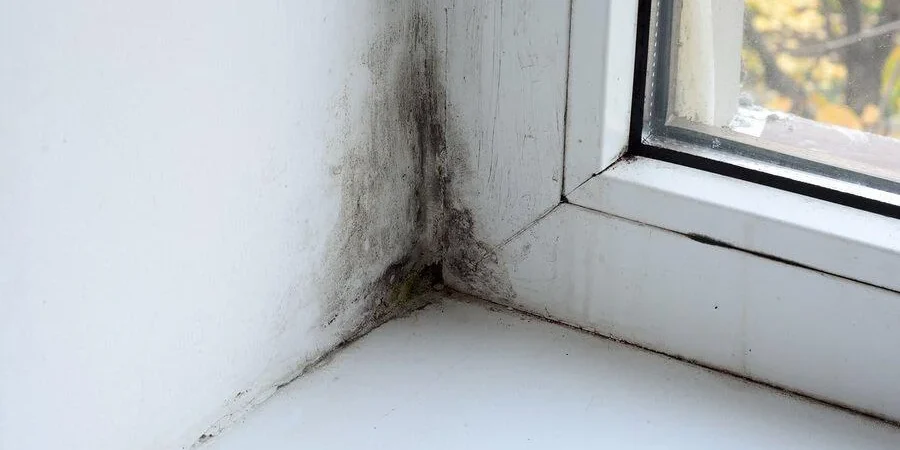
Mold around windows is almost never a window problem. That distinction matters more than most people realize — and it’s why millions of homeowners clean the same patch of mold every spring and watch it come right back.
What Actually Causes Mold Around Windows (It’s Not What You Think)
The conventional explanation goes like this: your window is leaking, water gets in, mold grows. Simple. Except that in the majority of cases, there’s no leak at all. The water producing that black or grey fuzz on your window frame is coming from inside your home, not outside it.
Here’s the mechanism: warm, moisture-laden indoor air drifts toward your windows, which are the coldest surfaces in the room during winter. When that air contacts glass or a frame sitting below the dew point temperature, moisture condenses out of it — the same physics that fogs up a cold drink on a humid day. That liquid water then sits on the sill, seeps into the corner gaskets, and feeds mold spores that are already present in virtually every home.
This is why wiping it away doesn’t fix it. You’re treating the symptom, not the source. The source is indoor humidity colliding with a cold surface, and until you deal with that collision, the mold comes back every single time.
Why Windows Are So Vulnerable Compared to Other Surfaces
Windows are thermal bridges — points where the insulating barrier of your wall is interrupted by a far less insulating material. Even a double-pane window has an R-value of roughly R-2 to R-4, while the insulated wall surrounding it might be R-13 to R-21. That gap in thermal performance makes your window the coldest interior surface in the room by a wide margin.
Mold spores need four things to colonize a surface: moisture, a food source, the right temperature, and time. Window frames — especially older wood or aluminum ones — tick every box. Dust and organic debris accumulate in the corners. Temperatures stay cool enough to slow evaporation. And condensation provides a near-constant moisture supply through the coldest months.
Single-pane windows are dramatically worse, with interior glass temperatures dropping low enough to condense moisture at indoor humidity levels as low as 30%. Triple-pane windows push that threshold significantly higher, which is partly why upgrading glazing actually reduces mold risk — not because it seals better against rain, but because it keeps the interior surface warmer.
“The persistent misunderstanding I see in practice is homeowners focusing on exterior waterproofing when their condensation problem is entirely interior-driven. If your indoor relative humidity is sitting at 55% or above during cold weather, you will get condensation on standard windows regardless of how well they’re sealed against rain. Reducing interior moisture load is the primary intervention — everything else is secondary.”
Dr. Sandra Kowalski, Certified Industrial Hygienist and Indoor Environmental Consultant
Hidden Causes of Window Mold Most Homeowners Never Suspect
Cooking and showering get all the blame, but the real culprits are often less obvious. Here are the sources that silently push indoor humidity past the condensation threshold:
- Houseplants grouped near windows. A cluster of large tropical plants can transpire a surprising volume of water vapor daily — sometimes over a pint per plant — directly into the air around the nearest cold surface.
- Unvented gas appliances. Combustion produces water vapor. A single unvented gas heater running for a few hours can add several pints of moisture to indoor air.
- Drying laundry indoors. A standard load of wet laundry releases approximately 2 liters of water into the air as it dries. Do this regularly in winter with the windows closed and humidity climbs fast.
- Crawl space vapor intrusion. If your crawl space isn’t properly sealed and vapor-barriered, ground moisture migrates upward through floors and into living spaces year-round.
- Poorly placed humidifiers. Running a whole-home or room humidifier at too high a setting in winter is one of the most common causes of condensation mold that homeowners attribute to a “bad window.”
The counterintuitive one that trips people up most: new construction and recent weatherization. Tightly sealing a house reduces natural air exchange, which means moisture generated indoors has nowhere to go. Homes that never had a mold problem suddenly develop one after new windows, added insulation, or door weatherstripping — because the building is now too tight without a mechanical ventilation strategy to compensate.
How to Tell If It’s a Leak or Condensation (This Changes Everything)
Getting this diagnosis right determines whether you call a glazier or change your habits. A few clear patterns separate the two causes.
Condensation mold appears consistently on the interior face of the glass and frame, shows up most aggressively in winter during cold snaps, and tends to be uniform across multiple windows in the same room or same side of the house. You’ll often notice moisture droplets on the glass in the mornings, even when there’s been no rain. The mold is usually grey-black and sits on the surface without penetrating deeply into the material.
Leak mold behaves differently. It appears after specific rain events, tends to concentrate near one corner or one spot (usually where the frame meets the wall), and may be accompanied by water staining, peeling paint, or soft drywall. Run your hand along the exterior caulk bead and check the flashing above the window — those are the two most common failure points in a genuine water intrusion scenario.
| Indicator | Condensation Mold | Leak Mold |
|---|---|---|
| Timing | Cold weather, mornings | After rain events |
| Location | Multiple windows, interior glass/frame surface | One window, corner or edge near wall |
| Associated damage | Moisture droplets on glass | Water staining, soft drywall |
| Fix required | Humidity control, ventilation | Caulk, flashing, or frame repair |
That said, both causes can coexist — a poorly sealed frame can allow both exterior water infiltration and interior condensation accumulation in the same corner. Don’t assume it’s only one or the other until you’ve ruled out both.
What Types of Mold Grow Around Windows
Not all window mold is the same, and the species matters when you’re deciding how aggressively to respond. The most common types are Cladosporium, Aspergillus, and Stachybotrys — though lab testing is the only way to confirm which you’re dealing with.
Cladosporium is the mold you’re most likely seeing. It appears olive-green to black, grows readily on cool surfaces with intermittent moisture, and is the classic condensation mold of window sills and frames. It’s not harmless — it’s a known trigger for respiratory irritation and allergies — but it’s far more common and far less toxic than Stachybotrys, which requires sustained saturation to establish.
Stachybotrys (the type people call “black mold”) at windows is actually rare unless there’s a chronic, unaddressed leak feeding significant moisture into building materials over weeks or months. Its presence signals a more serious moisture problem than condensation alone. Mold on walls adjacent to window frames, particularly if it’s spreading beyond the immediate window area, warrants professional assessment rather than DIY cleaning.
How to Remove Mold Around Windows Without Making It Worse
Before you reach for bleach — which is what most people do first — understand that bleach is effective on non-porous surfaces like glass but essentially useless on porous materials like wood, drywall, or grout. On those surfaces, it kills surface cells while leaving the root structure (hyphae) intact, and the mold regrows within weeks.
Here’s a practical sequence that actually works:
- Protect yourself first. Wear an N95 or P100 respirator, nitrile gloves, and eye protection. Disturbing mold releases spores — you don’t want to breathe those in, especially if the colony is large.
- Dry the area thoroughly. Use a fan or dehumidifier to drop moisture levels before cleaning. Scrubbing wet mold spreads it more than it removes it.
- Clean glass and painted metal with diluted bleach or hydrogen peroxide. A solution of 1 cup bleach per gallon of water works on glass and non-porous painted frames. Hydrogen peroxide (3%) is equally effective and less harsh on finishes.
- Use white vinegar or an EPA-registered fungicide on porous surfaces. Undiluted white vinegar penetrates porous materials better than bleach and kills a broader range of mold species on wood and painted drywall surfaces.
- Let it dry completely — at least 24 hours — before assessing. Mold that appears removed may still be present in lower layers. Only a fully dry surface reveals the true extent of penetration.
- Replace, don’t just clean, if wood is soft or deeply stained. Soft or crumbling wood means fungal penetration has compromised the material. Cleaning the surface won’t restore structural integrity, and the mold will return from the inside out.
Pro-Tip: After cleaning, apply a mold-resistant primer or paint to window sill surfaces before repainting. Standard latex paint offers no protection against regrowth — mold-inhibiting formulas contain fungistatic compounds that can suppress new colonization for several years in moderately humid conditions.
What Indoor Humidity Level Prevents Window Condensation
There’s a specific target range, and it shifts with outdoor temperature — which is something most humidity guides skip entirely. The colder it is outside, the lower your indoor humidity needs to be to prevent condensation on standard windows.
A useful rule of thumb: when outdoor temps are between 20°F and 35°F, keep indoor relative humidity below 40%. When outdoor temps drop below 20°F, target below 35%. When outdoor temps fall below 0°F, 25% or lower is necessary to prevent condensation on standard double-pane windows. High-performance triple-pane windows can tolerate higher indoor humidity without condensing — that’s a meaningful real-world advantage in cold climates, not just an energy argument.
A digital hygrometer costs between $10 and $30 and tells you exactly where your indoor humidity sits right now. It’s the most useful diagnostic tool you can own for this problem — more useful than any cleaning product. Place one near the most affected window and check it on cold mornings; that’s when your condensation risk is highest and your real humidity reading is most instructive.
How to Permanently Prevent Mold Around Windows
Permanent prevention requires attacking the problem at each of its three leverage points: reducing moisture generation, improving air circulation, and upgrading the thermal performance of the window itself. Addressing only one rarely solves it long-term.
On the moisture side: run kitchen and bathroom exhaust fans during and for at least 15 minutes after any activity that generates steam. Vent your dryer to the outside (a surprising number of older setups don’t). Check that your crawl space has a continuous vapor barrier covering at least 90% of the ground surface, with seams overlapped by 12 inches and taped. These three steps alone eliminate the majority of unintentional indoor moisture sources in most homes.
Circulation matters more than people expect. Stagnant air near a cold window surface accelerates condensation because the air immediately adjacent to the glass isn’t mixing with drier air from the center of the room. Running ceiling fans on low, keeping furniture from blocking baseboard heat registers near windows, and cracking the window slightly on milder winter days to flush humid air outward all reduce the stagnation problem without requiring any renovation.
On the window itself: exterior-grade caulk applied to the joint between the window frame and the surrounding wall — both inside and outside — stops liquid water intrusion from rain while also reducing cold air infiltration that depresses frame temperatures. Window insulation film kits add a secondary air layer and can raise the interior surface temperature of the frame by 5°F to 10°F, which meaningfully shifts the condensation threshold.
When to Call a Professional Instead of Handling It Yourself
Size is the standard threshold — the EPA’s general guidance is that mold patches under 10 square feet are manageable for most homeowners, while larger areas warrant professional remediation. But location matters as much as size for window mold specifically.
If mold has spread from the window frame into the surrounding drywall or into the wall cavity — which you can often detect by a musty smell that persists after surface cleaning, or by soft spots in the drywall — you’re looking at a remediation job, not a cleaning job. Opening that wall without proper containment and negative pressure protocols releases a much larger spore load into your living space than simply cleaning the window frame.
Anyone with asthma, an autoimmune condition, or compromised respiratory function should also seriously consider professional help even for smaller patches. The spore exposure during cleaning is real, and an N95 respirator, while helpful, is not a substitute for a sealed work environment when health vulnerability is a factor.
Does Window Replacement Actually Solve the Mold Problem
Sometimes yes, sometimes it barely helps — and the outcome depends entirely on what’s driving the condensation in the first place. New windows with higher thermal performance keep interior glass and frame surfaces warmer, which directly reduces condensation. If your current windows are single-pane or older double-pane units with failed seals, upgrading to modern triple-pane windows can eliminate condensation-driven mold almost entirely.
But if your indoor humidity is sitting at 60% in winter, even excellent new windows will condense at sufficiently cold temperatures. The window upgrade shifts the threshold — it doesn’t remove the threshold. Homeowners who spend $8,000 on new windows and skip the humidity control step are often disappointed to find mold returning, usually at the corners of the frame where thermal bridging is worst even on premium units.
The honest sequence: fix the humidity problem first. Then evaluate whether the windows still need upgrading based on actual condensation performance after the indoor moisture load is under control. You might find that better ventilation habits and a dehumidifier solve 80% of the problem without any window investment at all.
Specific Window Types and Locations With Higher Mold Risk
Not all windows in a house face equal mold risk, and knowing which ones to watch most closely lets you prioritize your effort. North-facing windows have no direct solar gain to warm the glass and are consistently the coldest interior surfaces in the house — they’re almost always the first to show condensation mold. Basement windows face elevated humidity from below-grade moisture sources on top of the cold-surface problem.
Aluminum frames conduct cold far more efficiently than vinyl or fiberglass, making them dramatically more prone to condensation on the frame itself even when the glass is adequate. A wood-framed window with aluminum cladding on the exterior sounds like the best of both worlds, but the thermal break between the two materials is critical — low-quality versions of this design still allow significant cold transfer to the interior wood surface.
Bay windows and picture windows that extend outward from the wall plane lose heat from three or five sides rather than one, creating frame temperatures well below those of a standard flush-mounted window. Kitchens and bathrooms are the highest-risk rooms by humidity load. Put a north-facing aluminum-framed window in a bathroom and you have essentially optimized for mold growth.
The Role of Window Treatments in Making Mold Worse
This is the angle that almost no article covers, and it’s a genuine trap for people who think they’re doing everything right. Heavy curtains and cellular blinds drawn close to the window actually make condensation mold more likely, not less — even though the intuition is that covering a cold window should help.
Here’s why: window treatments trap warm, humid room air in the dead space between the covering and the glass. That pocket of air cools as it contacts the window but doesn’t mix with the drier air in the main room. The relative humidity in that trapped pocket can exceed 80% even when the room’s measured humidity is only 45%. The condensation happens in that hidden space, and you don’t see it until the mold is already established on the sill and lower frame.
The practical fix is to leave a gap at the bottom of any curtain or blind — at least 2 to 3 inches — to allow air circulation. On very cold nights, pulling curtains back entirely is better for mold prevention than drawing them close, even though it feels counterintuitive. Cellular shades installed with a gap between the shade and the glass perform significantly better than those mounted flush to the frame.
Window mold is ultimately a systems problem — your windows, your humidity levels, your ventilation habits, and even your curtains are all connected. The homeowner who finally gets ahead of it is usually the one who stops looking for a single fix and starts thinking about the whole chain. Improving window insulation standards and ventilation technology together are gradually making condensation mold a solvable problem at the building level — but until that’s the norm, the most powerful tool you have is a $15 hygrometer and the knowledge of what the number actually means for your specific windows on your coldest nights.
Frequently Asked Questions
Can mold grow around windows without leaks?
Yes. Condensation and humidity are the most common causes.
Why is mold worse around windows in winter?
Cold glass causes condensation when warm indoor air contacts it.
Does window mold mean windows need replacing?
Not usually. Most cases are caused by indoor conditions.
Why does mold return after cleaning?
Because condensation and humidity continue to occur.
Is mold around windows common in apartments?
Yes. Apartments often have limited airflow and cold window surfaces.
Disclaimer: This article is for informational purposes only and isn’t a substitute for professional mold inspection or remediation advice. Mold problems vary a lot depending on the material affected, the extent of growth, and your specific health situation. Always follow product label instructions when using cleaning chemicals, ensure proper ventilation, and consider consulting a certified mold remediation professional for anything beyond a small, surface-level patch. If you have respiratory conditions, allergies, or a compromised immune system, talk to a doctor before starting any DIY mold removal.