
Dry indoor air is quietly doing more damage than most people realize — and the fix isn’t as simple as buying a humidifier and calling it done. The real problem is that most guides treat “how to increase humidity” as a shopping list. They skip the part where they explain why your home loses moisture in the first place, which means you end up running your humidifier 24/7 and still waking up with a dry throat. Understanding the mechanism changes everything about how you approach the solution.
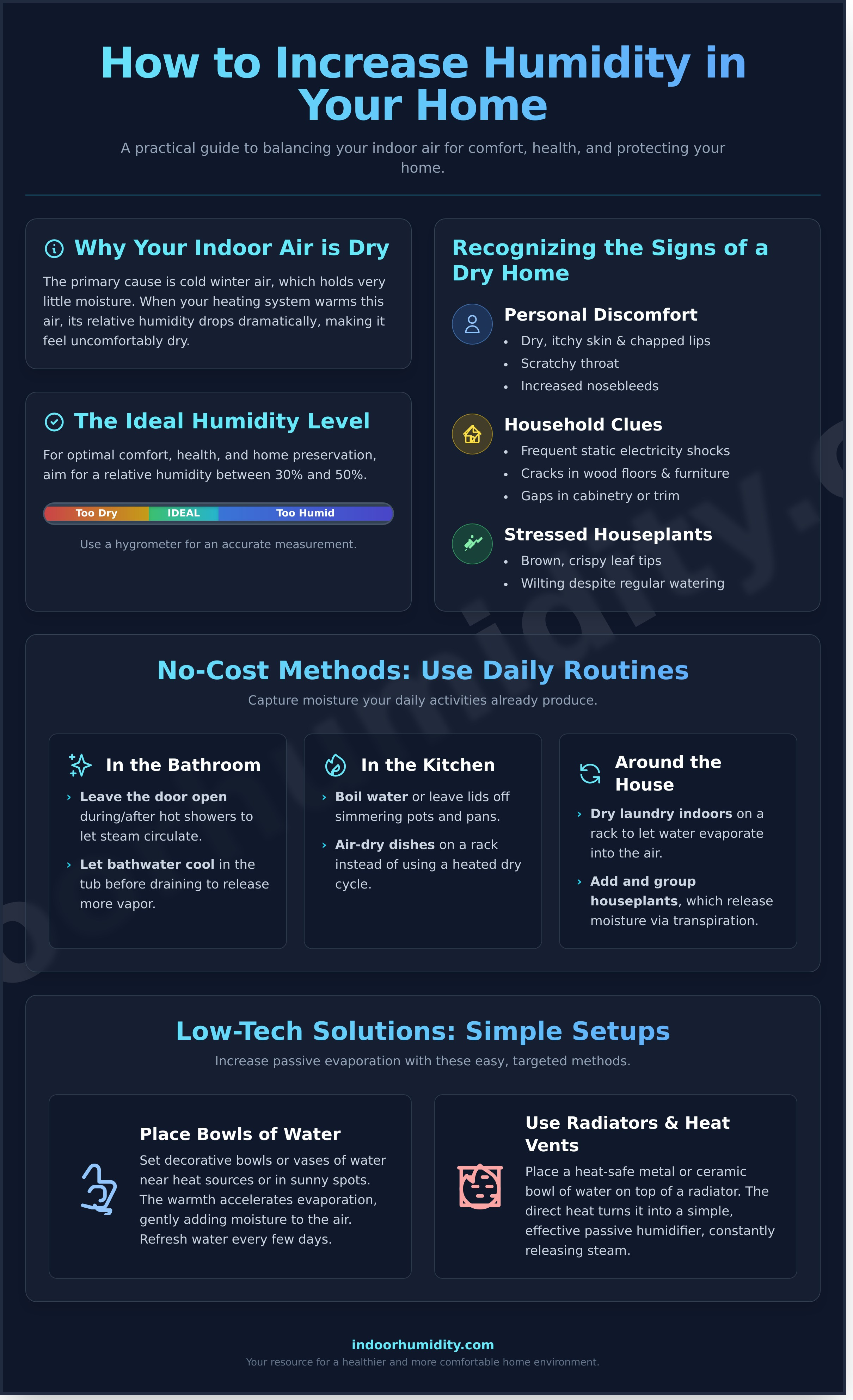
The target you’re aiming for is 40–60% relative humidity indoors. Below 30%, you’ll notice it in your skin, your sinuses, your wood furniture — even your static-electricity shocks. Above 60%, you’re inviting mold and dust mites. The sweet spot is real, and getting there consistently requires more than one tactic working together.
This guide covers the full picture: why your home dries out, which methods actually move the needle, and how to layer them intelligently so you’re not fighting your own HVAC system. For a solid grounding in what we’re working with, here’s the technical definition of humidity — but we’ll keep things practical from here on out.
Why Does Indoor Air Get So Dry in the First Place?
Cold outdoor air holds very little water vapor. When that air leaks into your home and gets heated to 68–72°F, its relative humidity plummets — sometimes to 10–15% on a bitter winter day. Your heating system doesn’t add moisture; it just warms the air, making it even thirstier for water.
Forced-air furnaces are the biggest culprits. They pull air across a heat exchanger and push it out hot and bone-dry, cycling through your rooms dozens of times a day. Every time that heated air passes through, it pulls moisture off surfaces, skin, wood, and fabric — your home essentially becomes a slow dehydrator.
There’s also a counterintuitive factor most people overlook: well-insulated, tightly sealed modern homes can actually be drier than older drafty ones in winter. The reason is that older homes had enough air leakage to occasionally pull in outside air that, once warmed slightly, wasn’t as desperately low in humidity. Tight homes trap the dry heated air and recirculate it continuously. Better sealing is still worth doing — but it means you need to be more proactive about adding moisture intentionally.
What Are the Real Health Effects of Low Indoor Humidity?
Low humidity doesn’t just make you uncomfortable — it actively impairs your body’s defenses. Your nasal passages and throat are lined with mucous membranes that rely on moisture to trap pathogens. When humidity drops below 30%, those membranes dry out and crack, giving viruses a much easier entry point.
Research on the health effects of humidity shows that respiratory viruses survive longer and travel farther in dry air. Influenza virus, for example, has significantly higher transmission rates when indoor humidity falls below 40%. That’s not a coincidence — it’s physics. Dry air allows respiratory droplets to shrink and stay airborne longer instead of quickly settling to surfaces.
Beyond respiratory health, chronic low humidity accelerates skin dehydration, worsens eczema flares, causes nosebleeds, and dries out contact lenses uncomfortably fast. People often blame seasonal illness on “being outside in the cold” when the real exposure is happening inside their own heated homes.
“Maintaining indoor relative humidity between 40 and 60 percent is one of the simplest environmental changes people can make to reduce viral transmission risk at home. The mucous membranes function significantly better in that range, and most people underestimate how much drier their homes get once heating season starts.”
Dr. Miriam Chu, Environmental Health Researcher and Indoor Air Quality Consultant
How to Increase Humidity Without a Humidifier
Humidifiers are effective, but they’re not the only lever available — and in some rooms or situations, passive methods make more practical sense. The key is understanding that anything that releases water vapor into still indoor air will raise relative humidity, even incrementally.
Consider what happens in a typical bathroom: a 10-minute shower can temporarily push that room’s humidity to 90%+. Most people immediately turn on the exhaust fan and flush all that moisture outside. Leaving the bathroom door open after a shower instead of venting it — at least for 15–20 minutes — lets that humidity drift into adjacent rooms and do useful work before it dissipates.
That’s a small example, but it illustrates the principle: you’re probably already generating humidity you’re actively throwing away. Capturing and redirecting it is free, and it adds up.
- Air-dry laundry indoors: A single load of wet laundry releases roughly 2 liters of water as it dries. Hanging clothes on a drying rack in a living space — rather than using a dryer — is one of the most efficient passive humidification methods available, especially in winter.
- Leave dishwasher open after the cycle: Skip the heated drying cycle and open the door after washing. Steam from the hot dishes dissipates into your kitchen and can noticeably raise humidity in that zone for an hour or more.
- Place water containers near heat sources: Shallow bowls or pans of water set on or near radiators, baseboard heaters, or sunny windowsills evaporate steadily throughout the day. The heat accelerates evaporation without any electricity cost.
- Add moisture-releasing houseplants: Plants like peace lilies, Boston ferns, and spider plants release water through transpiration. A cluster of 5–6 plants in a single room contributes meaningfully to ambient humidity — and they’re more pleasant to look at than a plastic tank.
- Simmer water on the stovetop: A pot of water at a low simmer releases a significant amount of steam quickly. This is a good short-term fix when you notice humidity has dropped sharply. Add citrus peel or herbs if you want it to double as aromatherapy.
- Seal drafts strategically: Reducing cold-air infiltration means less dry outside air entering your space. Weatherstripping doors and sealing window gaps keeps your existing indoor moisture from being diluted by incoming dry air.
Which Type of Humidifier Actually Works Best for Your Home?
There are four main humidifier technologies, and choosing the wrong one for your situation means spending money without solving the problem. The differences aren’t just about price — they’re about how each type interacts with your room size, water quality, and maintenance habits.
Evaporative humidifiers use a fan to blow air through a wet wick or filter, releasing moisture as water vapor. They’re self-regulating — as humidity rises, the evaporation rate naturally slows — which makes them harder to over-humidify with. Ultrasonic models use vibrations to create a fine cool mist and are quieter, but they disperse minerals from tap water as white dust that settles on surfaces and can irritate lungs. If you’re going ultrasonic, use distilled water.
Warm mist humidifiers boil water before releasing it as steam, which kills bacteria and mold in the process — a genuine hygiene advantage — but they consume more energy and pose a burn risk around children. Whole-home humidifiers connect directly to your HVAC system and are the most effective solution for consistent whole-house humidity control, though installation costs run $300–$800 or more. For apartment dwellers navigating small-space constraints, resources like this guide to choosing a humidifier for urban living are genuinely useful.
| Humidifier Type | Best For | Key Drawback | Approx. Cost |
|---|---|---|---|
| Evaporative | Medium rooms, self-regulation | Filter replacement needed | $30–$150 |
| Ultrasonic (Cool Mist) | Quiet spaces, bedrooms | White dust with tap water | $25–$120 |
| Warm Mist / Steam | Hygiene-sensitive users | Higher energy use, burn risk | $30–$100 |
| Whole-Home (HVAC) | Whole-house coverage | High install cost | $300–$800+ |
Pro-Tip: Place your portable humidifier near the center of the room rather than against a wall or in a corner. Walls trap moisture and can lead to condensation or mold on the surface behind the unit — central placement allows vapor to circulate freely before it settles anywhere.
How Do You Know If You’ve Increased Humidity Enough?
Guessing isn’t good enough here. You need a hygrometer — a small device that measures relative humidity — and they cost as little as $10–$15 for a basic digital model. Without one, you’re flying blind, and it’s entirely possible to overshoot the target range without realizing it, which creates a different set of problems.
Signs you’re still too dry: static electricity sparks when touching doorknobs, wood floors and furniture developing small cracks, lips chapping without obvious cause, and waking up congested or with a scratchy throat. Signs you’ve gone too far in the other direction: condensation forming on windows (especially in inner panes), a musty smell developing, or visible moisture on walls near the humidifier.
Place your hygrometer in the room where you spend the most time — typically the bedroom — rather than in a hallway or central location. Humidity varies significantly by room depending on ventilation, proximity to moisture sources, and how well your home’s air circulates. A reading from one spot doesn’t represent your whole house.
What’s the Biggest Mistake People Make When Trying to Increase Indoor Humidity?
The single most common mistake is running a humidifier without ever cleaning it. This sounds basic, but the consequences are genuinely serious — a dirty humidifier tank grows mold and bacteria within 24–48 hours of stagnant water sitting in it. Then the device aerosolizes those pathogens directly into the air you’re breathing. You end up with worse air quality than if you’d done nothing.
Tanks should be emptied, rinsed, and dried daily if possible — or at absolute minimum every two to three days. A weekly deep clean with a diluted white vinegar solution (1 part vinegar to 1 part water, soaked for 30 minutes) prevents mineral scale buildup and inhibits microbial growth. Filters on evaporative models need replacing every 1–3 months depending on use and water hardness.
The second mistake is treating humidity as a single-room problem when it’s actually a whole-home system. Running one humidifier in the bedroom all winter while the rest of the house stays at 15% relative humidity means your body gets 8 hours of relief and 16 hours of continued stress. The goal should be baseline comfort throughout your living space, not a single oasis.
Does Increasing Humidity Actually Affect Your Home’s Structure?
Yes — and this is where the honest nuance lives, because the answer depends entirely on how far you push it. Maintaining 40–50% humidity indoors protects wood floors, furniture, trim, and musical instruments from the cracking and warping that low humidity causes. Hardwood floors in particular can develop visible gaps between boards when indoor humidity stays below 30% for extended periods.
However, overshooting — pushing above 60% for sustained periods — causes the opposite problem. Wood absorbs moisture and swells, which can cause floors to buckle, doors to stick, and painted surfaces to bubble. More seriously, condensation on cold surfaces like exterior walls and window frames creates the conditions for mold growth inside wall cavities, which is expensive and potentially hazardous to remediate.
In very cold climates (think sustained outdoor temperatures below 20°F), even 50% indoor humidity can cause condensation inside wall assemblies if the vapor barrier isn’t adequate. In those conditions, keeping indoor humidity at 35–40% during the coldest stretches is a reasonable compromise — still meaningfully better than 15%, and safer for your building envelope. This is one situation where the “ideal” range genuinely shifts based on your climate and construction.
How to Layer Multiple Methods for Consistent Indoor Humidity
The most effective approach isn’t picking one method and maxing it out — it’s stacking several lighter-touch strategies so the overall system is resilient without being fragile. Think of it as redundancy: if the humidifier needs cleaning for a day, the plants and the drying laundry keep things from crashing back to 15%.
Here’s a practical scenario: a family in a 1,400-square-foot home during winter. They run a whole-room evaporative humidifier in the bedroom overnight (targeting 45–50%), air-dry two loads of laundry per week indoors, keep a cluster of houseplants in the main living area, and leave the bathroom door open after showers. Their hygrometer readings stay between 38–52% throughout the heating season without any single method being pushed to its limit.
That kind of layered approach is more sustainable than running one powerful humidifier at maximum output constantly — which tends to create localized over-humidification near the unit while the rest of the space stays dry. Distribution matters as much as total moisture output.
Which Rooms Need Humidity Attention Most?
Bedrooms are the highest priority. You spend 7–9 hours there with your airways exposed to whatever the air quality is — and unlike waking hours when you’re moving around, sleep is passive, giving dry air uninterrupted time to affect your mucous membranes, skin, and hydration.
Home offices deserve more attention than they typically get. Extended screen time in a dry room already causes eye strain; dry air on top of that accelerates contact lens discomfort and headaches. If you work from home, your office humidity matters almost as much as your bedroom’s.
Rooms with hardwood floors, musical instruments, or antique furniture have material stakes in maintaining humidity — not just human comfort ones. A vintage guitar or a solid wood dining table can be permanently damaged by a single season of low humidity. If you have either, those rooms move up the priority list regardless of who sleeps or works there.
Quick-Reference: What to Try First
If you’re not sure where to start, here’s a practical sequence ranked by ease and impact:
- Buy a hygrometer first — you can’t manage what you can’t measure. A basic digital model costs under $15 and tells you immediately how serious your problem is.
- Start air-drying laundry indoors — zero cost, immediate impact, especially effective in small apartments.
- Stop venting bathroom steam immediately after showers — leave the door open for 15–20 minutes and let that free moisture work for you before turning on the fan.
- Add 4–6 moisture-releasing plants — Boston ferns, peace lilies, and spider plants are effective, low-maintenance, and improve air quality beyond just humidity.
- Add a quality evaporative or ultrasonic humidifier to your bedroom — once you’ve maxed out the free passive methods, a dedicated unit in your highest-priority room fills the gap.
- Consider a whole-home bypass humidifier if you own your home and want a set-it-and-forget-it solution that handles every room consistently.
You can Download a reference guide to keep these benchmarks handy as you get started.
A Note on Seasonal and Regional Variation
Everything above assumes a cold-weather context, because that’s when indoor dryness is most severe. But dry air isn’t exclusively a winter problem — desert climates like Arizona, Nevada, and parts of the American Southwest see low outdoor humidity year-round, which means homes there can have chronically dry indoor air even in summer without heating running at all.
In those climates, evaporative coolers (swamp coolers) actually add humidity as they cool — a double benefit in dry heat. If you’re running central air conditioning in a humid climate, though, the AC is actively removing moisture to dehumidify, which might push you lower than you’d expect even in warm months. The point is: humidity problems aren’t seasonal everywhere, and the solutions should match your actual local conditions, not a generic winter-only playbook.
Check your hygrometer readings in every season before assuming you only need to act in winter. You might find your summer office is running at 28% thanks to aggressive air conditioning, and that’s worth addressing just as much as February dryness.
For everything beyond the basics, IndoorHumidity.com covers the full range of scenarios in depth. Explore more guides to creating a healthy home at IndoorHumidity.com — there’s a lot more nuance in specific situations like basement humidity, crawl spaces, and humidity in homes with pets or newborns that goes well beyond what any single article can cover.
The Bigger Picture You’re Really Solving For
Increasing indoor humidity isn’t really about comfort — though that’s a real benefit. It’s about making your home a place that actively supports your health rather than quietly working against it. The research on airborne viral transmission, respiratory function, and skin barrier integrity all point in the same direction: the air quality inside your home matters enormously, and humidity is one of the most controllable variables in that equation.
What’s interesting is how little attention most people give to indoor air compared to outdoor air quality, even though the average person spends roughly 90% of their time indoors. As more people work from home and spend extended hours in the same enclosed spaces, the baseline quality of that air — including its humidity — becomes increasingly consequential for long-term health outcomes.
Getting your indoor humidity into the 40–60% range consistently isn’t a one-time fix; it’s an ongoing calibration that changes with the seasons, your HVAC usage, and how your household generates and loses moisture day to day. The people who do it well aren’t running the most powerful humidifier — they’re paying the most attention.
Frequently Asked Questions
Can you increase humidity without a humidifier?
Yes, absolutely. Many simple, everyday activities can help. Methods like placing bowls of water near heat sources, air-drying laundry indoors, or leaving the bathroom door open after a shower all release moisture into the air through evaporation. These are effective, low-cost strategies for anyone wondering how to increase humidity naturally. They work by the same basic principle as a humidifier: introducing more water vapor into your indoor environment to raise the relative humidity.
Does boiling water on the stove actually increase humidity?
Boiling water is one of the fastest ways to add a significant amount of moisture to your air. As the water boils, it rapidly converts to steam (water vapor), which disperses throughout your home. While this method is very effective for a quick boost, it is a temporary solution that requires constant supervision for safety. Think of it as a powerful, short-term fix for particularly dry days rather than a continuous management strategy.
How long does it take to notice a difference in humidity?
The time it takes depends on the method you use, the size of your room, and its ventilation. Active methods like boiling water can raise the humidity in a room noticeably within an hour. Passive methods, such as placing a bowl of water out, work more slowly. You might begin to feel a subtle difference in a small room within a day, but a measurable change on a hygrometer could take longer as the water gradually evaporates.
Where is the best place to put a bowl of water to increase humidity?
To maximize evaporation, place a bowl of water near a source of warmth or airflow. Good locations include a sunny windowsill where sunlight can warm the water, on a shelf near a heating vent, or on a stable surface near a radiator (but not directly on it unless it’s designed for that). The added heat gives the water molecules more energy, helping them escape into the air as vapor more quickly and efficiently.
Do houseplants really make a big difference in a room’s humidity?
Houseplants do increase humidity through a natural process called transpiration, where they release water vapor from their leaves. However, a single plant will have a very small impact on an entire room. To make a noticeable difference, you would need to group several plants together. This creates a more humid microclimate in their immediate area. Plants like Boston ferns, spider plants, and areca palms are known for being particularly effective moisture producers.
Is it bad to have low humidity in your house?
Persistently low humidity is more of a comfort issue than a serious danger, but it can cause noticeable problems. Many people find that dry air leads to irritated sinuses, dry skin, and an increase in static electricity. It can also be hard on your home itself, causing wood floors, furniture, and structural elements to shrink and potentially crack over time. Maintaining a balanced humidity level, ideally between 30% and 50%, supports both your comfort and your home’s condition.