
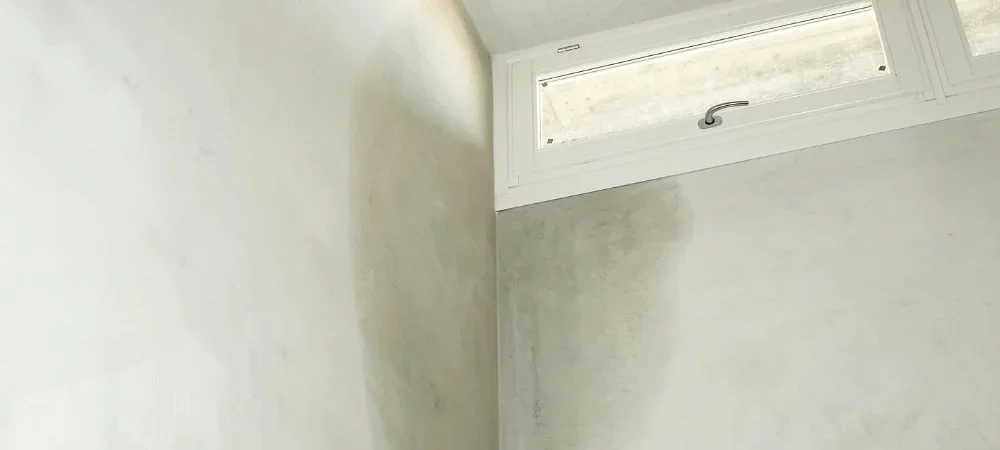
Bottom line up front: A wall can feel cold and clammy to the touch while showing zero visible moisture — and the reason has almost nothing to do with leaks or rising damp. It’s a surface temperature problem, and until you understand that, every fix you try will miss the mark.
Why Do Walls Feel Damp Even When There’s No Visible Water?
Touch a cold glass of water on a humid summer day and watch droplets form on the outside — you didn’t pour water on the glass, the air did. Your walls work exactly the same way. When a wall’s surface temperature drops below the dew point of the surrounding air, moisture condenses directly onto it, and you can feel that clamminess long before a single visible patch of damp ever appears.
This is the part that trips people up: they’re searching for a source — a pipe, a crack, a leaking roof — when the moisture is literally being manufactured by the air in the room. There’s no external source to find because the wall itself is acting as a cold surface that pulls water vapor out of warm indoor air and deposits it as liquid. That cold, slightly greasy feeling under your palm? That’s condensation in its earliest stage, sometimes called “invisible condensation” because it hasn’t yet accumulated enough to run or stain.
The counterintuitive fact worth knowing here: the dampest-feeling walls are often the ones that dry out the fastest. Because they’re cool and smooth, early-stage condensate can evaporate before it leaves a mark — which is precisely why so many people live with chronically damp-feeling walls for years without ever seeing obvious water damage.
What Is the Dew Point and Why Does It Control Everything?
The dew point is the temperature at which air becomes fully saturated — the point where it can no longer hold any more water vapor and starts depositing that vapor as liquid. Every combination of air temperature and relative humidity has a corresponding dew point, and when any surface in your home drops below that number, moisture condenses on it. It’s physics, not a plumbing failure.
Here’s a practical example: indoor air at 20°C (68°F) with 60% relative humidity has a dew point of roughly 12°C (53.6°F). If your external wall sits at 11°C on a cold morning — which is entirely normal in a poorly insulated room — that wall is below the dew point, and moisture is condensing on its surface right now, even if you can’t see it. You’ll feel the dampness when you press your hand flat against it, but the wall will look perfectly fine from across the room.
Relative humidity matters enormously here, and it changes hourly. Cooking a meal, taking a shower, even breathing in a closed bedroom overnight can push indoor humidity up by 10–15 percentage points, which raises the dew point and means your walls don’t have to be as cold to become damp-feeling. This is why your bedroom wall might feel fine during the day and noticeably clammy first thing in the morning.
Is It Condensation, Rising Damp, or a Leak — How Can You Tell?
This is where most diagnoses go wrong, and it costs people serious money. Rising damp — where groundwater wicks up through masonry — gets blamed constantly, but it’s actually one of the rarer causes of damp walls. A 2011 survey by the Building Research Establishment found that rising damp was confirmed in fewer than 5% of cases where it had been initially diagnosed by a damp-proofing company. Condensation was the real culprit in the vast majority.
The location of the dampness tells you a lot. Rising damp never climbs higher than about 1 metre up a wall, leaves a distinct “tide mark” of salts and staining, and affects the lower section of external walls almost exclusively. Condensation, by contrast, tends to appear higher on walls, especially in corners near ceilings, and on cold external-facing surfaces. A leak from a pipe or roof will typically show a concentrated wet patch that tracks downward.
The simplest DIY test: tape a piece of cling film or foil tightly to the suspect wall, seal all four edges with tape, and leave it for 24 hours. If moisture appears on the room-facing side of the foil, it’s condensation from the air. If moisture appears on the wall-facing side, you have water coming through the wall itself — either rising damp or penetrating damp from outside. It’s a blunt instrument, but it’s free and it genuinely works.
Why Do Some Walls Feel Damper Than Others in the Same House?
Not all walls are thermally equal. An external north-facing wall in a poorly insulated house can sit 4–6°C colder than an internal partition wall in the same room — that temperature gap is often enough to push the external wall below the dew point while the internal wall stays perfectly dry. This explains why one wall in a room feels damp while the others don’t, even though the air humidity is identical throughout.
Thermal bridges are a big part of this. Concrete lintels above windows, wall ties, corners where two external walls meet, and the junction between walls and floors all conduct heat out of the building more efficiently than the surrounding insulated material. These spots are noticeably colder than the rest of the wall, often by 3–5°C, and they become prime condensation sites. Run your hand along the wall beside a window frame on a cold morning and you’ll almost always find it cooler and clammier than the wall surface a metre away.
Wet walls in apartments are particularly common at these thermal bridge points, partly because apartment dwellers often can’t upgrade insulation in shared external walls. The architecture makes certain walls structurally colder and therefore chronically prone to condensation — and no amount of wiping them down will change that without addressing the surface temperature directly.
What Role Does Wall Construction Play in How Damp They Feel?
Solid brick walls — common in pre-1920s housing — are significantly more prone to feeling damp than modern cavity walls, and the reason is thermal mass combined with poor insulation. A 225mm solid brick wall has a U-value of roughly 2.1 W/m²K, meaning it loses heat fast and its internal surface gets cold quickly when outdoor temperatures drop. A modern insulated cavity wall, by comparison, might have a U-value of 0.3 W/m²K — it stays much warmer on the inside and rarely drops below the dew point.
Dense plaster applied directly to cold masonry makes things worse in a specific way: it conducts cold from the wall to the surface efficiently while providing almost no insulating buffer. This is why freshly re-plastered old walls often feel noticeably damper than before they were replastered — the new, dense plaster is in better thermal contact with the cold brickwork behind it. People interpret this as the plastering job causing the damp, but the plaster just removed the slight air gaps that were providing minimal insulation.
Hollow walls and stud partitions with voids can trap moisture-laden air inside the cavity and allow condensation to form on the cold outer skin without ever showing on the interior face — until the problem is severe enough to bleed through. This “interstitial condensation” is genuinely difficult to diagnose and is almost always misattributed to something else in the early stages.
What Are the Early Warning Signs Before Visible Damp Appears?
The damp-feeling wall is itself the earliest warning sign, but there are others that tend to appear before staining or mould becomes visible. Knowing what to look for lets you act when the fix is still cheap and simple rather than structural.
- A slightly musty smell in a room even when it appears clean and dry — that odour is microbial activity from moisture that’s been cycling on and off the wall surface
- Paint or wallpaper that feels slightly soft or spongy when pressed, even without visible bubbling
- A persistent cold spot on a wall that doesn’t warm up even after the room has been heated for several hours
- Fine white powder (efflorescence) forming on brick or plaster surfaces — this is dissolved salts being carried to the surface by migrating moisture
- Window frames or skirting boards near the affected wall showing early signs of swelling or paint lift
The musty smell one is worth paying attention to specifically. Mould requires a surface water activity of around 0.8 or higher to establish itself — which corresponds to a surface relative humidity above about 80%. By the time you can smell that distinctive earthy odour, the wall’s surface has been moist enough to support microbial growth for at least several days, even if it looks bone dry right now.
How Does Room Usage Change How Damp a Wall Feels?
The same wall can feel completely different depending on what’s happening in the room. A bedroom wall that feels fine during the day can become noticeably clammy by morning — not because anything changed structurally, but because two people sleeping in a closed room exhale roughly 1.5 litres of water vapor between them over an eight-hour night. That moisture raises indoor humidity, which raises the dew point, which means the wall doesn’t need to be as cold to feel damp.
Kitchens and bathrooms are obvious high-humidity zones, but the walls that suffer most are often the ones in adjacent rooms, not in the kitchen or bathroom itself. Hot, moisture-laden air travels through gaps around doors, through ceilings, and along floor voids, cooling as it goes. When it reaches a cold wall in the hallway or bedroom next door, it deposits its moisture there — far from the source that created it. This migration effect is why treating only the room with the “damp problem” often doesn’t work.
Furniture placement matters more than most people realise. Pushing a sofa, wardrobe, or bookcase flush against an external wall restricts air circulation and creates a stagnant cold zone behind it. The air trapped between the furniture and the wall becomes saturated much faster than room air, and the wall in that pocket can develop condensation, mould, and a persistently damp feel while the rest of the room stays perfectly fine. A gap of just 50–75mm between furniture and external walls makes a measurable difference.
Does Heating Your Home More Actually Fix Damp-Feeling Walls?
Partly — but not for the reason most people think, and with an important caveat. Heating a room raises the air temperature, which raises the wall’s surface temperature over time, pushing it further above the dew point. That reduces condensation risk. But if you heat the room without ventilating it, you also increase the amount of water vapor the air can hold, and when the heating goes off overnight, the temperature drops sharply while the humidity stays high — meaning the dew point stays elevated and the walls become vulnerable again.
Intermittent heating is actually worse than steady low-level heating for condensation. A room heated to 21°C for six hours and then left cold for eighteen is more likely to have damp-feeling walls than a room held at a constant 16°C. The temperature swings create repeated condensation-and-evaporation cycles that, over time, pump moisture into the wall structure even when the surface appears dry. Background heating — especially in rooms that would otherwise be left cold — is one of the more evidence-backed interventions for chronically damp walls.
“Surface temperature is the single most underappreciated variable in domestic condensation diagnosis. Homeowners focus on humidity because it’s something they can measure with a cheap device, but the wall surface temperature — which they rarely measure — is what actually determines whether condensation forms. A wall that’s 2°C below the dew point will condense moisture regardless of how ‘reasonable’ the indoor humidity looks on a hygrometer.”
Dr. Helen Marsden, Building Physics Consultant and Fellow of the Chartered Institution of Building Services Engineers
What Are the Most Effective Ways to Stop Walls Feeling Damp?
The honest answer is that it depends on whether your problem is a surface temperature issue, a humidity issue, or both — and in most homes with damp-feeling walls, it’s both. That said, the interventions below address the mechanisms that actually cause the problem, not just the symptoms.
- Raise wall surface temperature — This is the root fix. Internal wall insulation (insulated plasterboard, also called “thermal board,” adds as little as 37.5mm but can cut a wall’s U-value significantly), secondary glazing near cold windows, or simply sealing draughts around skirting and window frames all raise wall surface temperature and reduce condensation risk.
- Reduce indoor humidity at source — Vent tumble dryers outside, use extractor fans while cooking and showering, and keep lids on pots. A single pot of boiling water with no lid releases around 300–400ml of water vapor into the air within 20 minutes. These small habits collectively make a large difference.
- Ventilate consistently, not just occasionally — Trickle vents, positive input ventilation (PIV) units, or whole-house mechanical ventilation with heat recovery (MVHR) all reduce indoor humidity while controlling where and how air moves. Opening a window for ten minutes once a day is better than nothing but significantly less effective than background ventilation.
- Address thermal bridges specifically — Cold corners and reveals beside windows benefit from a dab of aerogel-based insulating plaster or a small section of thin thermal board. It looks like overkill to patch-insulate a corner, but thermally these spots can be 6–8°C colder than surrounding surfaces — more than enough to push them below the dew point while the rest of the wall stays fine.
- Use background heating rather than intermittent heating — As noted above, keeping temperatures steadier throughout the day — even at a modest 15–16°C in unused rooms — is more effective at preventing condensation than heating rooms aggressively for short periods.
- Reposition furniture away from external walls — Free-standing storage pushed against cold exterior walls traps stagnant, humid air. Moving furniture even 50–75mm away from external walls noticeably improves air circulation at the cold surface and reduces condensation in that zone.
Pro-Tip: Before spending money on dehumidifiers or anti-damp paint, buy an infrared thermometer (they cost around £15–25) and measure your wall surface temperatures on a cold morning. If any surface reads more than 3–4°C below the room air temperature, you’ve found your condensation risk zone — and the fix is thermal, not chemical.
Does Anti-Damp Paint Actually Work on Walls That Feel Clammy?
Anti-damp or waterproof masonry paints create a barrier that can prevent liquid water from penetrating a wall from outside — but they do almost nothing to address condensation forming on the internal surface. The moisture in surface condensation comes from inside the room, not from outside the wall, so a waterproofing layer on the inside face of the wall doesn’t change the physics at all. You’re painting over a temperature problem.
There’s a specific scenario where anti-damp paint makes things actively worse: if you apply it to a wall that has penetrating damp coming through from outside, you trap the moisture inside the wall structure, which accelerates freeze-thaw damage in the masonry and can push moisture sideways to appear in uncoated areas. It’s a good product used in the right situation — applied to interior walls experiencing condensation is usually not that situation.
Anti-mould paint is a different category and does have genuine value as a secondary measure. It doesn’t stop condensation forming, but it inhibits mould growth on the affected surface — buying you time and reducing health risks while you address the underlying temperature or humidity issue. Think of it as a bandage, not a cure.
Quick Reference: Damp Wall Causes and Fixes at a Glance
| Cause | Key Sign | Primary Fix |
|---|---|---|
| Surface condensation (wall below dew point) | Clammy to touch, no visible staining, worse in mornings and cold weather | Raise wall surface temperature; reduce indoor humidity; improve ventilation |
| Thermal bridge condensation | Cold spots at corners, reveals, or lintels; mould forms in specific patches | Targeted thermal insulation at bridge points; aerogel or thin thermal board |
| Penetrating damp from outside | Damp patch tracks from outside in; worse after rain; foil test shows moisture behind foil | Repair external masonry, pointing, or render; check gutters and flashings |
| Interstitial condensation (inside wall structure) | Wall damp in winter, dries in summer; structural dampness without interior surface condensation | Review insulation and vapour control layers; may need professional assessment |
When Should You Call a Professional About Damp-Feeling Walls?
DIY diagnosis gets you quite far with condensation, but there are situations where calling someone in is the right call — and knowing the difference saves you from either overspending on professionals for a humidity problem you could solve yourself, or underspending on a structural issue that quietly worsens.
Get a professional opinion if: the damp feeling persists year-round regardless of heating and ventilation changes; if you see salt staining (white crystalline deposits) at low levels on external walls, which genuinely can indicate rising damp; if the foil test consistently shows moisture coming through the wall rather than forming on it; or if you’re seeing structural cracking alongside the damp, which might indicate a more serious failure in the building fabric.
One honest nuance worth flagging: the quality of damp-proofing surveyors varies enormously, and some companies have a financial incentive to diagnose rising damp because the chemical injection treatment is expensive. If a surveyor recommends costly treatment without ruling out condensation first — including measuring your indoor humidity and checking your ventilation — get a second opinion. A good surveyor will always want to rule out the simpler causes before recommending structural intervention.
Can a Dehumidifier Solve the Problem of Damp-Feeling Walls?
A dehumidifier reduces indoor relative humidity, which lowers the dew point, which means walls need to be colder before condensation forms on them. So yes, it genuinely helps — but it works on one half of the equation only. It doesn’t raise wall surface temperature, and if you have a cold wall sitting well below your room’s dew point, you might need to run a dehumidifier continuously to keep humidity low enough to compensate. That’s an ongoing cost rather than a solution.
The practical sweet spot for indoor relative humidity is 40–60%. Below 40% and you start getting dry skin, irritated airways, and static electricity. Above 60% and condensation risk increases significantly, especially on cold surfaces. A dehumidifier set to maintain 50–55% is a reasonable approach while you address the thermal issues — treat it as a crutch rather than the final answer.
Placement matters. A dehumidifier sitting in the middle of a room with the door closed will lower humidity in that room effectively but won’t address adjacent rooms or hallways where migrated moisture might be causing damp walls. For widespread condensation across multiple rooms, whole-house ventilation solutions tend to be more cost-effective in the long run than running multiple dehumidifiers.
What Happens to Your Walls If You Ignore the Damp Feeling?
The cycle goes like this: repeated condensation and evaporation gradually introduces more moisture into the wall structure than it would absorb from the air alone. Over months to years, paint begins to bubble and peel, plaster softens and eventually crumbles at the surface, and timber elements embedded in the wall — lintels, floor joist ends, wall plates — begin to accumulate enough moisture to support timber decay. By the time visible mould appears in volume, the wall has typically been in a compromised state for some time.
Mould exposure has real health consequences beyond being unpleasant to look at. Prolonged exposure to elevated indoor mould spore counts has been linked to respiratory symptoms, worsened asthma, and in vulnerable people, more serious fungal health issues. A wall that
Frequently Asked Questions
Why do my walls feel damp but look dry?
Because cool surfaces and humidity can create a damp sensation without visible water.
Can walls feel damp without leaks?
Yes. Moisture often comes from indoor air.
Are damp-feeling walls common in apartments?
Yes, especially on exterior walls and behind furniture.
Is feeling damp the same as condensation?
No. Condensation is visible water; dampness can be subtle.
When should damp-feeling walls be investigated further?
When the sensation is persistent or spreading.