
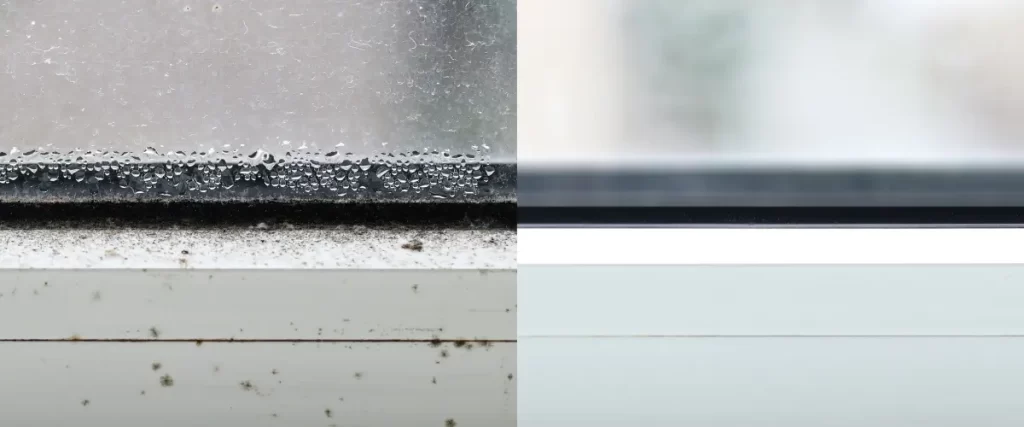
Humidity and condensation are not two names for the same problem — one is invisible air chemistry, the other is its very visible consequence, and mixing them up is exactly why most moisture fixes fail.
That’s the core thesis here. Countless articles treat condensation and humidity as interchangeable terms, slap a dehumidifier recommendation at the end, and call it done. But the relationship between these two things is more interesting — and more actionable — than that. Understanding the mechanism rather than just the symptom is what separates a permanent fix from endlessly wiping down your windows every winter morning.
This article explains how humidity becomes condensation, why the dew point is the number you should actually be watching, and what that means for real decisions in a real home.
What Is the Difference Between Condensation and Humidity?
Humidity is water vapor suspended in air — it’s gaseous, invisible, and completely harmless on its own. Condensation is what happens when that vapor hits a surface cold enough to force it back into liquid form. One is a state of air; the other is a phase transition.
Think of it this way: high humidity loads the gun, and a cold surface pulls the trigger. You can have 70% relative humidity in a room and see zero condensation if every surface stays above a certain temperature threshold. You can also have moderate humidity — say, 50% — and still get condensation on a single-pane window on a -10°C night. The surface temperature is doing most of the work here, and most people never think about that.
Relative humidity (RH) is always expressed as a percentage of how much water vapor the air is holding relative to the maximum it could hold at that temperature. Warm air holds more moisture than cold air — this is not just trivia, it’s the entire engine behind why condensation happens at all.
How Does Humidity Actually Turn Into Condensation?
The mechanism is called reaching the dew point. Every combination of temperature and humidity has a dew point — the exact temperature at which air becomes fully saturated (100% RH) and can no longer hold its moisture as vapor. Drop below that temperature on any surface, and condensation appears.
Here’s a concrete example. Say your living room air is 20°C with 60% relative humidity. That air has a dew point of roughly 12°C. Any surface in that room colder than 12°C will collect condensation — a glass of ice water, a poorly insulated exterior wall, the inside of a window frame. The air temperature didn’t change. The humidity didn’t change. Only the surface temperature dropped below the dew point.
This is why the dew point is far more useful than relative humidity alone as a diagnostic tool. Relative humidity shifts constantly with air temperature — the same mass of water vapor will show as 35% RH at 25°C but 70% RH at 12°C. The dew point stays constant as long as the moisture content of the air doesn’t change. It’s the actual number that predicts where condensation will land.
“Most homeowners focus on relative humidity as their primary metric, but dew point is far more predictive of condensation risk. A dew point above 13°C indoors typically signals that condensation problems are imminent on any surface that’s thermally bridging with the exterior — and that’s where the real damage starts.”
Dr. Rachel Holt, Building Physics Consultant and Certified Indoor Environmental Professional
Why Does This Distinction Matter for Your Home?
Treating a condensation problem as purely a humidity problem — and only a humidity problem — leads to a specific kind of expensive mistake. You buy a dehumidifier, you run it constantly, your electricity bill climbs, and yet the condensation on your north-facing bedroom window persists every cold morning. That’s not a failure of the dehumidifier. That’s a thermal problem wearing a moisture disguise.
The distinction matters because the two problems have different fixes. High ambient humidity calls for ventilation, dehumidification, or moisture source reduction — cooking, showers, drying laundry indoors. Condensation on a specific surface usually calls for raising that surface temperature through better insulation, draft-sealing, or secondary glazing. Sometimes you need both interventions, but often you only need one of them.
Getting this wrong doesn’t just waste money. Persistent condensation feeds mold, which colonizes not just visible surfaces but also ceilings, insulation cavities, and structural timbers before you ever notice it. A surface that looks like a simple condensation problem may be hiding microbial growth after as little as 24–48 hours of sustained wetness.
What Are the Different Types of Condensation and How Do They Relate to Humidity?
Not all condensation behaves the same way, and matching the right humidity intervention to the right condensation type is where the real expertise lies. There are three main types worth understanding.
Surface condensation is the most visible — water droplets on windows, mirrors, tiles, or cold pipes. It happens when a surface temperature drops below the dew point of the surrounding air. This is almost always a combination of high indoor humidity and poor thermal performance of that surface.
Interstitial condensation is the dangerous one most people never see coming. It occurs inside a wall, floor, or roof construction when warm, moist air migrates through the structure and hits a cold layer — typically near the outer surface. The vapor condenses inside the building fabric. This can rot timber, corrode metal fixings, and collapse insulation performance, all invisibly. It’s entirely driven by the vapor pressure difference that high indoor humidity creates.
Reverse condensation is counterintuitive: in hot climates or during summer, the moisture drive can flip, pushing warm humid outdoor air into cooler, air-conditioned interiors. The same physics apply — dew point meets cold surface — but the direction is reversed. This is why vapor barriers installed on the wrong side of a wall in one climate can actively accelerate moisture damage in another.
What Are the Main Sources of Indoor Humidity That Drive Condensation?
Humidity doesn’t appear from nowhere. Every moisture source inside your home adds to the vapor load in the air, and understanding where it’s coming from tells you where to intervene first. Some sources are obvious; a few are genuinely surprising.
- Cooking: Boiling a pot of pasta releases roughly 600ml of water vapor into the air. Cooking three meals a day without extraction ventilation adds significant moisture load daily.
- Showering and bathing: A 10-minute shower generates approximately 200–300ml of water vapor. Without adequate extraction, this disperses through the entire home within 30 minutes.
- Breathing and perspiration: A single sleeping adult exhales roughly 40ml of water vapor per hour. A family of four generates up to 1.5 liters of moisture per night just from respiration — this is why bedroom windows are almost always the first to show condensation.
- Drying laundry indoors: A single load of wet laundry releases approximately 2 liters of water into the air as it dries. This is one of the largest single moisture events in a typical household and is still badly underestimated.
- New construction and recent renovation: Fresh concrete, plaster, and timber can release hundreds of liters of moisture as they cure. New-build homes often have elevated humidity levels for 12–18 months after construction for this reason alone.
What Relative Humidity Level Triggers Condensation Risk?
There’s no single universal threshold — it always depends on surface temperature — but some practical benchmarks exist that work well for most temperate climates. The table below shows the approximate dew point temperatures produced by common indoor conditions, and what that means for condensation risk on typical surfaces.
| Indoor Air Temp | Relative Humidity | Approximate Dew Point | Condensation Risk |
|---|---|---|---|
| 20°C (68°F) | 40% | 6°C (43°F) | Low — most insulated surfaces safe |
| 20°C (68°F) | 60% | 12°C (54°F) | Moderate — cold window panes at risk |
| 20°C (68°F) | 70% | 14°C (57°F) | High — uninsulated surfaces and walls at risk |
| 22°C (72°F) | 65% | 15°C (59°F) | High — widespread surface condensation likely |
The practical takeaway: keeping indoor RH between 40–55% at typical living temperatures keeps most surfaces safely above the dew point without tipping into the dry-air discomfort zone. Below 40% and you’ll notice it in your skin and airways; above 55% and you’re consistently pushing toward condensation territory.
That said, exact targets depend on your climate, your building envelope quality, and the season. A 50% RH indoors is perfectly fine in a well-insulated modern home but will cause chronic condensation in a 1930s solid-wall house with cold spots throughout.
How Do You Diagnose Whether Your Problem Is Humidity or Condensation (or Both)?
The single most useful tool for this diagnosis is a hygrometer with a dew point display — they cost between $15 and $40 and will tell you more about your home’s moisture situation than a week of guessing. Measure your indoor RH and temperature, then check the dew point reading against the surface temperatures in problem areas.
A non-contact infrared thermometer (also cheap, typically $20–$30) lets you scan surface temperatures throughout your home. Point it at your window frames, external walls, and any corners where condensation or mold appears. If those surface temperatures are consistently below your indoor dew point, you have a thermal problem — the humidity may be contributing but it’s not the root cause.
There’s a diagnostic pattern that experienced surveyors recognize immediately: if condensation only appears on specific surfaces (north-facing walls, single-pane windows, uninsulated pipes) while the rest of the room is dry, that’s a thermal bridge problem. If condensation appears broadly — on multiple surfaces, in multiple rooms — the ambient humidity is almost certainly too high and ventilation is the first fix to reach for.
Pro-Tip: Before buying a dehumidifier, spend two days tracking your indoor dew point with a cheap hygrometer. If your dew point consistently sits below 10°C, you almost certainly don’t have a humidity problem — you have a cold surface problem. Dehumidifying further will only make the air uncomfortably dry without solving the condensation.
What Are the Health and Structural Consequences of Getting This Wrong?
Sustained condensation — the kind that recurs every day on the same surfaces — creates persistent wetness. Persistent wetness at temperatures between 5°C and 25°C is exactly the growth window for Cladosporium, Aspergillus, and Stachybotrys — the mold species most commonly found in residential buildings. Some of these species produce mycotoxins that affect respiratory health, particularly in children, the elderly, and anyone with asthma or compromised immunity.
Structurally, the damage compounds over time in ways that are expensive to reverse. Timber softens and rots when moisture content exceeds roughly 20%. Metal window frames corrode. Plaster salts migrate and surface — those white tide marks you sometimes see on walls are often efflorescence caused by moisture cycling through the masonry. Insulation that becomes saturated with condensed moisture loses much of its thermal resistance, which makes cold surfaces colder, which drives more condensation — a self-reinforcing cycle.
High ambient humidity also has health effects independent of condensation. Air above 60% RH creates favorable conditions for dust mites, which thrive at humidities between 70–80% and are a primary trigger for allergic rhinitis and asthma. Dry air below 30% RH, meanwhile, desiccates nasal mucous membranes and reduces their effectiveness as a pathogen barrier. The 40–55% RH window isn’t just an engineering preference — it’s where the biological balance tips toward healthier outcomes.
How Do You Fix Condensation Without Making Humidity Worse (and Vice Versa)?
The interventions work in a specific order of priority, and jumping to the expensive fix first is a common and costly mistake.
- Reduce moisture at source: Use extractor fans during and for 15–20 minutes after cooking and showering. Dry laundry outdoors or in a vented tumble dryer. A single behavioral change here can drop indoor RH by 5–10 percentage points.
- Improve ventilation: Trickle vents in window frames, positive input ventilation (PIV) systems, and mechanical ventilation with heat recovery (MVHR) all dilute indoor moisture with drier outdoor air. Background ventilation is the highest-leverage intervention in most homes.
- Raise surface temperatures: Secondary glazing, draught-proofing, and adding insulation to cold spots reduces the temperature differential that triggers condensation. Even a 2–3°C rise in surface temperature can push a surface above the dew point.
- Use dehumidification strategically: A dehumidifier is most effective in enclosed spaces with limited air exchange — a basement, a utility room, a poorly ventilated bathroom. Running one in an open-plan living area with good ventilation is often redundant and expensive.
- Monitor rather than guess: Place hygrometers in problem rooms and track readings over a week. Patterns matter — condensation appearing after a shower but clearing by mid-morning is different from all-day dampness, and they require different responses.
Does Outdoor Humidity Affect Indoor Condensation?
Outdoor humidity matters, but not always in the direction people expect. In cold climates during winter, outdoor air is actually very dry in absolute terms — cold air holds very little moisture regardless of its relative humidity. When that cold outdoor air infiltrates a warm building, it gets heated and its relative humidity drops sharply, sometimes creating overly dry indoor conditions rather than contributing to high humidity.
The real outdoor humidity risk happens in summer or in mild, humid climates. Warm outdoor air carries far more moisture in absolute terms than cold air. When this air enters a cooled building — or contacts cold water pipes — it deposits that moisture as condensation. This is why pipe sweating in summer looks identical to pipe sweating in winter but requires a different fix: it’s not a heating or insulation issue, it’s a ventilation and vapor barrier issue.
Opening windows to reduce indoor humidity works well when outdoor absolute humidity is lower than indoor. Open the windows in the morning in summer, when overnight cooling has dropped outdoor moisture content, and you get genuine ventilation benefit. Open them on a warm, humid afternoon and you may be actively importing moisture. This is a nuance worth sitting with, because the advice “open a window” is both correct and context-dependent.
What Role Does Air Circulation Play in the Condensation-Humidity Relationship?
Stagnant air dramatically accelerates condensation on cold surfaces. When air isn’t moving, the layer of air immediately adjacent to a cold surface cools down and its relative humidity rises locally — even if the ambient room humidity is moderate. This boundary layer effect is why condensation appears in corners, behind furniture pushed against exterior walls, and in rooms with poor air circulation, even when the rest of the home seems fine.
Keeping furniture 50–75mm away from exterior walls, ensuring radiators are not obstructed by curtains that trap heat away from the glass, and using ceiling fans on low in winter to push warm stratified air back down toward living level — these all reduce condensation risk without changing the room’s actual humidity level. You’re just preventing cold surface microclimates from forming.
This is the counterintuitive insight that most moisture guides entirely skip: you can have a room at perfectly acceptable 50% RH and still get mold behind a wardrobe because the airflow to that corner is zero and the wall behind it is cold. Humidity control and air movement are both part of the solution, but they’re not the same lever.
Conclusion
Once you understand that humidity is a property of air and condensation is a property of surfaces, the whole landscape of home moisture management becomes clearer — and the fixes become cheaper, because you stop treating the wrong problem. As buildings get more airtight in pursuit of energy efficiency, this relationship between vapor load and surface temperature becomes even more critical to manage. Tighter buildings hold more moisture with less natural dilution, and the margin for error gets smaller. Getting fluent in the humidity-to-condensation mechanism now is exactly the kind of knowledge that pays off the longer you live in — or maintain — a building.
Frequently Asked Questions
Is condensation the same as humidity?
No. Humidity is moisture in the air, condensation is liquid water on surfaces.
Can you have humidity without condensation?
Yes. Moisture can stay in the air without forming droplets.
Can condensation happen with low humidity?
Yes, if surfaces are cold enough. Even at 40% humidity, condensation can form on extremely cold windows or poorly insulated walls. The key factor is the temperature difference between the air and the surface.
Which causes mold more, humidity or condensation?
Both contribute, especially when they occur repeatedly. Humidity above 60% provides the moisture mold needs to grow, while condensation creates the wet surfaces where mold spores can take hold. Areas with both high humidity and frequent condensation are at highest risk.
Why is condensation more visible in winter?
Because cold surfaces make moisture condense more easily. Winter creates larger temperature differences between warm indoor air and cold windows or exterior walls. This temperature gap causes moisture to condense at much lower humidity levels than in summer.