
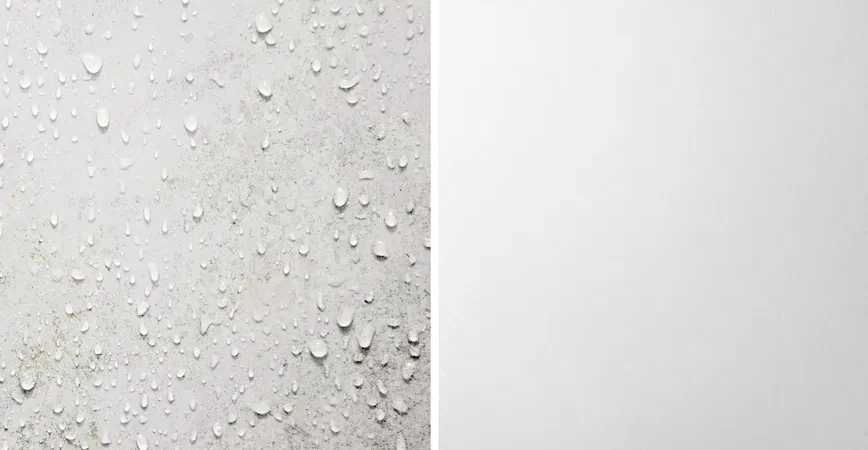
Walls sweat for one reason: warm, moist air is hitting a surface cold enough to trigger condensation. That’s the physics. But here’s what almost every article on this topic gets completely wrong — they treat condensation on walls as a ventilation problem when, in a huge number of homes, it’s actually a thermal bridging problem. Fix the airflow all you want; if you’ve got a cold spot in your wall structure, you’ll still wake up to damp patches every winter morning.
What Actually Causes Condensation on Walls (It’s Not Just Humidity)
The basic mechanism goes like this: air holds moisture in vapour form, but only up to a point. That point — the dew point — drops sharply when air touches a cold surface. At roughly 60–65% relative humidity indoors, a wall surface only needs to be a few degrees below room temperature to trigger condensation. Most people assume their walls are uniformly the same temperature. They’re not, and that gap is where the problem lives.
Thermal bridging is the underreported culprit. A thermal bridge is any point in your wall construction where a more conductive material — a steel stud, a concrete lintel, a poorly insulated window reveal — bypasses the insulation layer and creates a cold strip on the interior surface. That strip can sit at 12°C while the rest of your wall sits at 18°C. In a room with 65% relative humidity, that cold strip will condense. The rest of the wall stays dry, so you never connect the dots.
External walls on north-facing elevations are the classic example. They get almost no solar gain, they’re exposed to cold winds, and they typically have lower surface temperatures than south-facing walls by 3–5°C. That difference is usually enough to push them below the dew point for several months of the year.
Is Condensation on Walls Normal or a Sign of a Serious Problem?
Short answer: it depends — and that honest nuance matters here. Occasional surface condensation on an exterior wall during a cold snap, particularly in a bathroom or kitchen, is common and doesn’t automatically signal structural failure. But persistent dampness, or condensation that appears in rooms you wouldn’t expect — a hallway, a living room, a bedroom corner — is telling you something specific about your building fabric.
The tipping point is duration. Surface moisture that evaporates by mid-morning when the heating kicks in is low-risk. Moisture that sits on a wall surface for four or more hours creates the conditions mold spores need to germinate — they need sustained humidity above 70% at the surface level for roughly 24–48 hours to establish. So a wall that stays wet through the morning into the afternoon is genuinely problematic.
There’s also interstitial condensation to consider — moisture that condenses inside your wall structure, invisible from either side. This is arguably more damaging than surface condensation because you won’t spot it until you’ve got rot in your timber frame, saturated insulation, or mold blooming through your plasterboard. It forms when warm, humid indoor air migrates through the wall and hits cold layers before it reaches the outside. Older homes without vapour control layers are especially vulnerable.
How Do You Tell the Difference Between Condensation and Rising Damp?
This is one of the most misdiagnosed problems in residential buildings, and getting it wrong is expensive. Rising damp — groundwater wicking up through masonry — affects the lower 1 metre of a wall and leaves a distinctive tide mark with white salt deposits (efflorescence) as the water evaporates and leaves minerals behind. Condensation doesn’t do that. It appears where the surface is coldest, which is often higher up near the ceiling line or in corners where two cold surfaces meet.
A simple tissue paper test can give you a clue. Hold a piece of tissue flat against the wall for 30 seconds. If the tissue picks up moisture and the wall surface itself feels cold, that’s classic surface condensation. If the wall feels cold but the moisture seems to be coming from within the wall rather than forming on it, you’re dealing with something that penetrates from outside — either rising damp or penetrating damp from a failing render, gutter, or flashing.
Penetrating damp tends to track along specific pathways and correlate with rainfall — you’ll notice it gets worse after heavy rain, not during cold dry spells. Condensation is the opposite: it peaks during cold, still, dry weather when your heating is on and ventilation is poor.
“The majority of damp complaints we investigate turn out to be condensation, not rising or penetrating damp. The thermal performance of the wall is almost always implicated — specifically, surface temperatures that consistently fall below the indoor dew point. People spend money on chemical damp-proof courses when what they actually need is improved insulation or better heating distribution to those cold surfaces.”
Dr. Helen Marsh, Building Physics Consultant, CIBSE Member
Which Walls in Your Home Are Most at Risk of Condensation?
Not all walls are equal, and understanding which ones are structurally prone to condensation saves you a lot of guesswork. External walls are obviously higher risk than internal partition walls, but within that category, position and construction matter enormously.
Here’s a breakdown of the highest-risk situations:
- North-facing external walls — minimal solar gain, consistently lower surface temperatures, especially in rooms that are underheated or sparsely furnished
- Walls adjacent to unheated spaces — garages, loft voids, unused spare rooms, or the party wall in a semi-detached home where one side is vacant
- Walls behind large pieces of furniture — a sofa or wardrobe pushed flush against an external wall blocks heat reaching the surface and cuts off airflow, dropping the surface temperature by up to 4°C
- Corners where two external walls meet — corner junctions have twice the exposure and the cold air pooling effect significantly reduces surface temperatures
- Walls with steel lintels or concrete elements — these conduct heat out of the building far faster than the surrounding masonry, creating a cold strip that’s invisible until it shows up as a damp patch
Condensation in corners is particularly common precisely because of that cold pooling effect — the geometry of a corner creates a micro-climate that’s reliably colder and less ventilated than the rest of the room.
What Does Hidden Moisture Inside Walls Actually Look Like?
The counterintuitive fact here is that the most damaging condensation is often the kind you can’t see at all. Interstitial condensation — moisture forming within the wall assembly rather than on the surface — can saturate insulation, rot timber, and corrode metal fixings for months or years before any visible sign appears on the interior surface.
By the time you see a damp stain spreading from behind a skirting board or plasterboard that feels soft and spongy when pressed, the damage inside the wall cavity is often already significant. Saturated mineral wool insulation, for example, loses up to 50% of its thermal resistance — meaning the wall that was supposed to be keeping you warm is now actively making the condensation problem worse by reducing its own insulating performance.
Signs of hidden moisture in walls include paint that bubbles or peels without an obvious external source, a persistent musty smell even after cleaning, plaster that sounds hollow when tapped (it’s delaminating from the backing), and black mold appearing in patches that don’t match where any visible surface condensation has occurred. That last one is a genuine red flag — mold that doesn’t track with visible dampness is almost always interstitial in origin.
What Indoor Humidity Level Triggers Wall Condensation?
The relationship between indoor humidity and wall condensation isn’t a fixed threshold — it shifts depending on the surface temperature of your walls. This is why the standard advice to “keep humidity below 60%” is only half the picture. At 18°C room temperature, a wall surface at 12°C will condense at just 60% relative humidity. But if that same wall surface is at 14°C, you’d need humidity to hit nearly 70% before condensation forms.
Here’s how the relationship stacks up across common conditions:
| Room Temp (°C) | Wall Surface Temp (°C) | Humidity Level That Triggers Condensation |
|---|---|---|
| 20°C | 12°C | ~57% RH |
| 20°C | 15°C | ~72% RH |
| 18°C | 10°C | ~53% RH |
What this table shows is that a poorly insulated wall in an averagely heated UK home can condense even when indoor humidity is at a seemingly reasonable 55–57%. You’re not failing at humidity management — your wall is simply too cold for the dew point you’re living at. That’s a building problem, not a behaviour problem.
How to Fix Condensation on Walls Without Expensive Renovations
There’s a logical sequence to tackling wall condensation, and most people skip straight to the expensive end. Starting with heating and airflow costs nothing or almost nothing, and in many cases it’s genuinely sufficient — especially if the condensation is minor and limited to one or two specific rooms.
Work through this order before spending money:
- Heat the room consistently, not in bursts. Intermittent heating cycles create dramatic temperature swings that repeatedly push wall surfaces below the dew point. A lower, steadier temperature — say 17°C rather than blasting to 22°C for two hours — keeps wall surfaces warmer on average and reduces condensation risk substantially.
- Pull furniture away from external walls. Even a 50mm gap between the back of a sofa or wardrobe and an external wall dramatically improves airflow across the wall surface, raising its temperature and allowing any moisture to evaporate rather than accumulate.
- Ventilate at source. Kitchen extraction fans should exhaust to outside (not into a loft space), and bathroom extractor fans should run for at least 20 minutes after use. Every litre of water vapour you remove at source is a litre that doesn’t migrate to your coldest walls.
- Use a hygrometer to find the problem rooms. A cheap hygrometer (under £15) placed in each room for a week gives you a humidity map of your home. You’ll almost certainly find that one or two rooms are running 10–15% higher humidity than others — and those are your condensation risk rooms.
- Add internal wall insulation to chronic cold walls. Insulated plasterboard (PIR-backed) applied to an external wall can raise the interior surface temperature by 4–6°C — often enough to eliminate condensation entirely. It’s not cheap, but it addresses the root cause rather than managing symptoms.
- Install trickle ventilators or a whole-house MVHR system for persistent problems. Mechanical Ventilation with Heat Recovery moves stale, humid air out while recovering up to 85% of the heat from it. For homes with chronic condensation across multiple rooms, it’s the most effective single intervention.
Pro-Tip: Before spending anything on a dehumidifier, check whether your condensation is limited to one or two specific walls rather than spread throughout the room. A dehumidifier lowers overall room humidity but doesn’t raise the surface temperature of a cold wall — so if thermal bridging is the issue, you’ll reduce condensation slightly but you won’t eliminate it. A targeted insulation fix to that specific wall will outperform a dehumidifier running 24/7.
Does Condensation on Walls Always Lead to Mold?
Not automatically — but the margin between “fine” and “mold problem” is smaller than most people realise. Mold needs four things to grow: a surface, organic matter (virtually everything qualifies, including dust and paint), temperatures above roughly 5°C, and sustained relative humidity above 70% at the surface level. A wall that’s briefly damp in the morning and dry by 10am probably won’t grow mold. A wall that stays damp for 6+ hours a day during a cold month almost certainly will.
The species that colonise condensation-damp walls first are usually Cladosporium and Penicillium — both appear as dark green or black spotting and both produce allergens that affect respiratory health, particularly in children and people with asthma. By the time you can see a patch of mold that’s 10cm across, there’s typically significant invisible hyphal growth beneath the paint surface. Cleaning the visible mold without fixing the moisture source just delays the inevitable by a few weeks.
Bedrooms are a particularly high-risk space for this cycle. We generate roughly 1 litre of moisture per person per night through breathing and perspiration, often with windows closed and doors shut. That’s why condensation in bedrooms tends to be more persistent and more likely to lead to mold than condensation in rooms that are aired during the day.
Can Anti-Condensation Paint Actually Prevent Wall Condensation?
Anti-condensation paints are one of the most misunderstood products on the market. They work by incorporating micro-encapsulated phase-change materials or highly insulating additives that raise the thermal resistance of the paint layer slightly — enough to push the wall surface temperature up by 1–2°C in mild cases. For walls that are borderline cold, that 1–2°C can be enough to stay above the dew point. For walls that are significantly cold, it achieves almost nothing.
Think of it this way: if your wall surface is sitting at 12°C and your dew point is 14°C, anti-condensation paint might genuinely help. If your wall surface is at 8°C and your dew point is 14°C, it’s a cosmetic fix on a structural problem. The packaging rarely tells you which scenario you’re in, which is why so many people buy it, apply it correctly, and still see condensation return within one winter season.
Where these paints do add real value is as a mold inhibitor. Most formulations contain a fungicidal additive that slows mold growth even in conditions where some surface moisture is present. So if you’ve addressed the main source of condensation but have a residual damp wall that you’re managing rather than fully solving, anti-condensation paint with a mold-resistant additive is a genuinely useful secondary layer of protection.
How Do You Permanently Solve Condensation on External Walls?
Permanent solutions address either the humidity load, the wall surface temperature, or both — and the right approach depends on the root cause. A real-world scenario that illustrates this well: imagine a 1960s semi-detached house with a north-facing bedroom that gets condensation every winter along the chimney breast wall. The occupants run an extractor fan, keep the heating on a timer, and wipe down the wall weekly. Nothing works. The chimney breast is an uninsulated masonry mass that sits several degrees colder than the rest of the room all winter. No amount of ventilation fixes that — only insulating the chimney breast (from the inside with bonded insulated plasterboard or from the outside if planning allows) will change the surface temperature sufficiently.
For homes with widespread condensation across multiple rooms, the calculation shifts. Here, the issue is often a high baseline humidity driven by inadequate whole-house ventilation. Older homes that have been draught-proofed without adding controlled ventilation are particularly prone — they’re tight enough to trap moisture but not insulated enough to keep walls warm. A whole-house mechanical ventilation system or, at minimum, humidity-triggered extractor fans in each high-moisture room will make a measurable difference to the whole-house dew point.
External wall insulation — cladding the outside of the building — is the gold standard for masonry homes because it wraps the entire thermal mass in insulation, eliminates most thermal bridges, and dramatically raises interior surface temperatures. It’s significant investment, but it typically removes condensation problems entirely while also cutting heating bills by 20–35%.
When Should You Call a Professional About Wall Condensation?
There’s a clear line between DIY-manageable condensation and situations that warrant a professional building assessment. If you’ve implemented the basics — improved ventilation, adjusted furniture, maintained consistent heating — and you’re still seeing persistent damp patches or mold returning within weeks of cleaning, the problem is almost certainly structural and needs diagnosis before treatment.
A professional building surveyor or thermographic survey is worth the cost when:
- Damp patches appear on internal walls with no adjacent external exposure (this suggests interstitial condensation or a plumbing leak)
- Mold covers more than 1 square metre of a wall surface — this level of growth indicates a sustained, significant moisture source
- Plaster is crumbling, hollow-sounding when tapped, or visibly separating from the wall
- You’re planning internal insulation and want to avoid creating an interstitial condensation risk by getting the vapour control layer positioning wrong
- A landlord or previous occupant has treated the problem cosmetically and you suspect hidden structural damage
A thermal imaging camera used by a qualified surveyor can map wall surface temperatures across an entire elevation in minutes, identifying thermal bridges and cold spots invisible to the naked eye. It’s one of the most underused diagnostic tools in residential damp investigation — and it’s far more informative than the “tap and check if it feels cold” method that most people rely on.
Understanding condensation on walls properly — as a thermal problem with a humidity dimension, rather than purely a moisture problem — changes the whole approach. The walls that give you trouble every winter aren’t failing because you cook too much pasta. They’re failing because something in the building fabric is creating a cold surface that the physics of your indoor climate will always exploit. Fix the surface temperature, and the condensation follows.
Frequently Asked Questions
Why does condensation form on walls?
Because warm, moist indoor air meets cold wall surfaces.
Can condensation happen without leaks?
Yes. Condensation does not require leaks or water damage.
Is condensation on walls common in apartments?
Yes. Exterior walls and limited airflow make it common.
Why is condensation worse behind furniture?
Furniture blocks airflow and slows drying.
Does wall condensation always indicate a problem?
No. It becomes a concern only when it is persistent or widespread.