
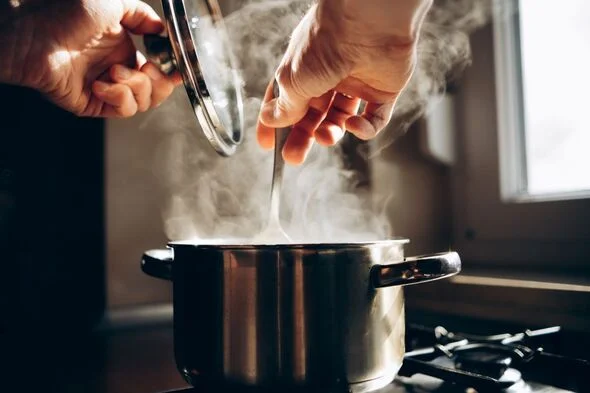
Here’s what nobody tells you about condensation after cooking: the windows aren’t the problem. They’re just where the problem becomes visible.
Every time you boil pasta, fry onions, or simmer a pot of soup, you’re releasing water vapor into your kitchen air. That vapor has to go somewhere. When it hits a cold surface — a window, a tile wall, a glass splashback — it turns back into liquid water. That’s condensation, and it’s basic physics working exactly as it should.
The real issue most articles get wrong is this: they focus on where the condensation appears and not on how much is appearing and how long it stays. Those two factors are what separate harmless cooking fog from a slow-building moisture problem that damages your home over months and years.
What Actually Causes Condensation After Cooking?
Warm air holds more moisture than cold air — that’s the core principle at work here. When you cook, you’re doing two things simultaneously: heating the air and loading it with water vapor from boiling, steaming, and frying.
The moment that warm, humid air contacts a surface cooler than its dew point temperature, the vapor condenses into droplets. Your windows are usually the first place you’ll see this because glass loses heat faster than insulated walls, making it the coldest surface in the room.
A typical pot of boiling water releases roughly 2 to 3 milliliters of water vapor per minute into the air. Cook a full pasta dinner for 20 minutes and you’ve added somewhere between 40 and 60ml of moisture to your kitchen — before accounting for any steam from sauces or the oven. That adds up faster than most people realize.
Why Do Windows Fog Up Specifically During Cooking?
Glass is a thermal conductor with very little insulation value. Even double-glazed windows are significantly colder on their interior surface than the surrounding air during winter or in cool weather. That temperature gap is exactly what triggers visible condensation.
Single-pane windows are especially vulnerable — their interior surface can sit at 5 to 10°C even when your kitchen air is at 20°C. If your kitchen humidity spikes above 60% during cooking (which it easily can), the dew point rises high enough that condensation forms on almost any glass surface in the room.
There’s also a spatial component people overlook. If your kitchen connects to a hallway, living room, or dining area without a door, that moist cooking air travels freely. In those cases, condensation may appear there instead of in the kitchen. The moisture migrates to wherever the coldest surfaces are, not necessarily the room where it was created.
When Is Condensation After Cooking Normal vs. a Warning Sign?
This is where the nuance really matters — and honestly, it depends on how long the condensation sticks around. A light fogging on the windows that clears within 20 to 30 minutes of finishing cooking is normal. Your kitchen produced humidity, the glass caught it, and the air eventually dried out.
What’s not normal is condensation that takes hours to clear, water that runs in streaks down the glass and pools on the sill, or moisture appearing on walls and ceilings rather than just windows. Those patterns suggest your ventilation isn’t coping with the moisture load — and that excess humidity is being absorbed into building materials instead of being expelled.
Relative humidity in a kitchen during cooking can hit 80 to 90%. For reference, mold can begin developing on surfaces when humidity stays above 60% for extended periods. The distinction between “normal condensation” and “problem condensation” isn’t the presence of moisture — it’s whether that moisture is being managed or accumulating.
“Kitchens are the single largest point-source of indoor moisture in most homes. The issue isn’t the steam itself — it’s dwell time. Moisture that clears quickly isn’t causing damage. Moisture that lingers in fabrics, grout, and wall cavities is where the real risk compounds over time.”
Dr. Patricia Holmgren, Building Science Consultant and Indoor Air Quality Specialist
How Much Moisture Does Cooking Actually Add to Your Air?
Most people genuinely underestimate how moisture-intensive cooking is. It’s not just steam — it’s the cumulative vapor from every stage of preparing a meal. Here’s a rough breakdown of common cooking activities and how much water vapor they release into your kitchen air.
| Cooking Activity | Approximate Moisture Released | Typical Duration |
|---|---|---|
| Boiling pasta (open pot) | 60–90ml per 20 min | 15–20 minutes |
| Frying on high heat | 30–50ml per session | 5–15 minutes |
| Oven roasting (door closed) | 20–40ml (escapes when opened) | 45–90 minutes |
| Simmering sauces | 10–20ml per 10 min | 10–60+ minutes |
A full cooked dinner — say, pasta with sauce and a side vegetable — can release 150 to 250ml of water vapor total into your kitchen. That’s roughly a cup of water dispersed into the air of a single room. Spread across a small kitchen, that’s a meaningful humidity spike in a short window of time.
The counterintuitive part? Oven cooking with the door closed is one of the lower continuous moisture sources — but the moment you open the oven door, a burst of humid hot air is released directly into the room. It’s not the roasting that causes the window to fog; it’s the moment you check on the food.
Does Ventilation Actually Solve Condensation After Cooking?
Yes — but only if the ventilation is actually moving the air out of the building, not just recirculating it. This is probably the most common mistake homeowners make. A recirculating extractor hood filters grease particles and odors but does nothing for humidity. The moisture goes straight back into the kitchen air.
A ducted extractor hood vented to the outside is far more effective — it physically removes humid air from the kitchen before it can settle on surfaces. Research on domestic ventilation suggests that an extractor running at 200 to 300 cubic meters per hour can reduce cooking-related humidity peaks by 40 to 60% compared to cooking without any extraction.
Opening a window also works, but less efficiently than most people assume. A single open window creates limited air movement unless there’s a cross-ventilation path — a second open window or door on the opposite side of the room. Without that cross-flow, you’re mostly just slightly diluting the humid air rather than expelling it.
Pro-Tip: Run your extractor fan for at least 15 minutes after you finish cooking, not just during. The residual moisture in walls, countertops, and air takes time to clear — stopping the fan the moment the stove goes off leaves that moisture to settle wherever it can.
Why Your Windows Show It But Other Surfaces Don’t (At First)
Glass doesn’t absorb moisture — it only reflects it back as visible droplets. That’s actually why windows are the best early-warning system in your home. When you see condensation on glass, the moisture is sitting on the surface where you can see it, wipe it away, and deal with it.
Your walls, plaster, and window frames are doing something more worrying: absorbing that same moisture invisibly. Porous materials like plaster and wood soak up vapor without showing obvious surface wetness until the absorption is significant. By the time you see paint bubbling, plaster crumbling, or window frames warping, the moisture has been accumulating inside those materials for months.
This is the observation that reshapes how you should think about condensation after cooking: the windows aren’t the victim — they’re the messenger. If your windows are consistently heavily fogged every time you cook, the question isn’t how to stop the glass from fogging. It’s how much of that moisture load is going into your walls instead.
What Role Does Kitchen Size and Layout Play?
A small galley kitchen concentrates moisture in a tight space, which is why fogging tends to be more dramatic and persistent there than in an open-plan kitchen. The same amount of cooking vapor in a 6 square meter kitchen versus a 15 square meter open-plan space produces very different humidity levels — the smaller space saturates faster.
Open-plan kitchens have the opposite problem: moisture disperses across a larger volume, so the kitchen windows may barely fog, but moisture travels further into the living space. Soft furnishings — sofas, curtains, rugs — absorb that wandering humidity. You might not see condensation, but the moisture load is still landing somewhere.
Layout also affects where you should position your extractor fan relative to the cooktop. An extractor mounted more than 75 centimeters above the hob captures significantly less vapor than one at 65 centimeters — the steam has spread and diluted before it reaches the hood. Precise positioning matters more than most people think.
Does the Outside Temperature Affect How Much Condensation You Get?
Significantly, yes. Condensation after cooking is almost always worse in cold weather, and the reason is straightforward: colder outside air means colder window glass, which means a bigger temperature gap between the interior glass surface and the humid kitchen air. That larger gap makes condensation form more readily and in greater quantities.
In warmer months, window surfaces stay closer to room temperature, and the dew point of even moderately humid kitchen air stays below the glass surface temperature. The moisture is still there in the air — you just don’t see it forming on the glass as dramatically. This leads people to believe cooking produces less moisture in summer, when it produces exactly the same amount.
Here’s an honest nuance worth knowing: if you’ve recently upgraded your windows to better-insulated double or triple glazing, you might actually see less condensation on the glass itself — but that doesn’t necessarily mean your kitchen is drier. It means the glass is warmer and the vapor is staying in the air instead, potentially landing on colder spots elsewhere, like external wall corners or inside wall cavities.
5 Practical Steps to Reduce Condensation After Cooking
Getting condensation under control during cooking is a combination of reducing moisture at the source, moving moisture out quickly, and ensuring surfaces don’t stay cold enough to trigger condensation longer than necessary. These five steps work systematically through all three approaches.
- Use lids on pots whenever possible. A lid traps the majority of steam inside the pot rather than releasing it into the kitchen. For a boiling pasta pot, this single habit can reduce moisture release by 50 to 70% — and it also speeds up cooking time, so it’s a double win.
- Switch on extractor fans before you start cooking, not after. Running the fan 2 to 3 minutes before you generate steam creates an established airflow that draws moisture out more efficiently. Starting the fan mid-cook means you’re already playing catch-up with humidity that’s already in the air.
- Check that your extractor hood is ducted to the outside, not recirculating. This genuinely matters. A recirculating filter hood does nothing for kitchen humidity — it only removes grease and odors. If you have a recirculating model, supplement it with an open window or a wall-mounted ventilation unit.
- Heat the kitchen slightly before cooking in cold weather. Warming the room before you start raises the temperature of cold surfaces — including window glass — which lifts the threshold at which condensation forms. It won’t eliminate condensation entirely, but it can meaningfully reduce how heavily windows fog.
- Wipe window sills dry after cooking and leave the fan running for 15 minutes post-cooking. Water pooling on sills absorbs into wood and sealant, causing long-term damage. Wiping takes 30 seconds and prevents weeks of accumulated moisture damage. Continuing to run ventilation after cooking clears the residual humid air that would otherwise settle on walls and frames.
Which Cooking Methods Produce the Most Condensation?
Not all cooking is equal from a moisture perspective, and knowing which methods are high-impact helps you prioritize when to be especially careful about ventilation.
- Open-pot boiling — highest moisture output per minute; pasta, rice, and vegetable boiling are the biggest contributors to window fogging in most kitchens
- Pressure cooking — counterintuitively low during cooking, but the steam release valve at the end expels a significant burst of vapor; worth ventilating well during depressurization
- High-heat frying and stir-frying — produces a mix of steam and aerosolized fat particles; the steam contributes to condensation, and the grease sticks to windows and walls making cleaning harder
- Slow cooker use — lower heat but extended duration; running a slow cooker for 6 to 8 hours without a tight lid can release as much moisture as a full boil session in a fraction of the time
- Microwave cooking — minimal external moisture release; steam stays contained inside the appliance, making it the lowest-impact cooking method from a condensation perspective
Can Condensation After Cooking Lead to Mold?
It can — but the path from cooking condensation to mold growth isn’t as direct as people fear. Condensation on glass isn’t the risk. Glass doesn’t support mold growth. The risk is when that moisture migrates to organic materials — wooden window frames, silicone sealant, grout, plaster — and stays wet consistently over time.
Mold spores need three things: moisture, organic material, and time. A kitchen that experiences heavy condensation after every cooking session, with inadequate ventilation and no drying between meals, creates those conditions methodically. The silicone sealant around your window frame turning black is the first visible warning that mold has established itself in a moisture-rich environment.
Sporadic condensation that clears quickly isn’t going to cause mold. Daily heavy condensation that leaves surfaces damp for hours, particularly in corners and around frames, is a different situation entirely. The intervention point is your ventilation routine — get that right, and the condensation becomes a non-event rather than a slow deterioration of your kitchen’s fabric.
Does a Dehumidifier Help With Cooking Condensation?
A dehumidifier can reduce overall kitchen humidity, but it’s not the right first-line tool for managing condensation after cooking. Here’s why: dehumidifiers work by pulling moisture out of the air after it’s already dispersed through the room. An extractor hood removes moisture at the point of generation — right at the stovetop — before it spreads to every surface.
That said, a dehumidifier does have a place in kitchens with poor existing ventilation options — say, a kitchen in a basement or interior apartment with no exterior wall for ducting. In those situations, running a dehumidifier during and after cooking can meaningfully reduce peak humidity levels and the resulting condensation on windows and walls.
A decent kitchen dehumidifier operating at 10 to 12 liters per day capacity can typically manage the moisture from a normal household’s daily cooking. You’d need to empty it regularly, but as a workaround for genuinely difficult ventilation situations, it’s a reasonable option — just don’t treat it as a substitute for source-control ventilation if proper ducted extraction is possible.
What Should You Do If Condensation Keeps Returning After Cooking?
Persistent heavy condensation that returns every single cooking session, despite running ventilation, suggests one of a few underlying issues worth investigating systematically. Start with the most common culprits before assuming something structural is wrong.
Check first that your extractor fan is actually pulling air — hold a tissue near it and see if it’s drawn toward the grille. Fans fail quietly; a motor running but not moving air is common in older units clogged with grease. Clean or replace the fan, and check that the ductwork hasn’t been blocked or compressed behind a cupboard or wall refit.
If the ventilation is working correctly and condensation is still excessive, consider the combined moisture load from other sources — a tumble dryer venting indoors, a slow cooker running elsewhere, or multiple people showering close to cooking time can all push whole-home humidity to a level where cooking vapor tips it over into visible and persistent condensation. Managing moisture is a whole-home problem, not just a kitchen problem.
Cooking will always produce condensation after cooking under the right conditions. The goal isn’t to eliminate it — it’s to understand when it becomes a signal worth acting on. Kitchens that stay consistently within 50 to 60% relative humidity even during cooking, with condensation clearing within 20 to 30 minutes of finishing, are performing exactly as they should. Kitchens that stay above 70% for hours after the stove goes off are telling you something your ventilation system needs to hear.
Frequently Asked Questions
Why do my windows fog after cooking?
Because warm, humid air condenses on cool glass.
Is condensation after cooking normal?
Yes, especially after boiling or steaming.
Why does it appear in other rooms?
Because moist air travels before condensing.
Can cooking condensation cause mold?
Only if moisture persists repeatedly.