
Bottom line, right up front: Your air conditioner removes humidity as a side effect of cooling — not as its primary job — and that distinction explains almost every humidity problem homeowners run into.
That gap between what AC actually does and what people assume it does is where the trouble starts. People set the thermostat lower, the house feels clammy, and they blame the humidity level — when the real culprit is how the system is sized and cycled. Understanding the mechanism, not just the symptom, is what lets you fix it for good.
Does Air Conditioning Actually Remove Humidity?
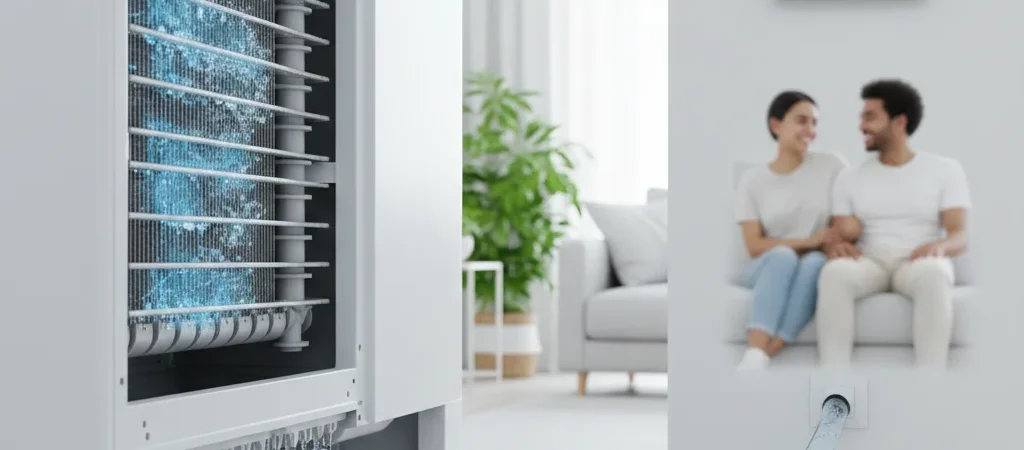
Yes — but only while it’s running, and only under the right conditions. Here’s the physics: warm air passes over the AC’s evaporator coil, which is colder than the dew point of that air. Moisture condenses on the coil surface, drips into a drain pan, and exits through a condensate line. It’s the same reason a cold glass of water “sweats” on a summer day.
That dehumidification only happens when the compressor is actively running — not during the fan-only mode, not during the brief period after the compressor shuts off. A typical central AC system in moderate climate conditions can remove anywhere from 15 to 25 gallons of water from the air per day. That’s a meaningful amount, but it’s tied entirely to runtime.
The catch is that most AC systems are engineered primarily to hit a target temperature, not a target humidity level. Once the thermostat is satisfied, the compressor stops — even if the indoor air is still at 65% relative humidity. Temperature and humidity are two separate variables, and residential AC only controls one of them directly.
Why Is My House Still Humid Even With the AC Running?
This is the question that drives homeowners crazy, and the answer almost always comes back to one word: oversizing. An oversized AC unit cools a space so quickly that it shuts off before it has run long enough to pull significant moisture out of the air. HVAC technicians call this “short cycling,” and it’s one of the most common — and most misdiagnosed — comfort problems in residential buildings.
Picture this: you’re in Georgia in August, the house feels like a sauna even though the thermostat reads 72°F. You check your hygrometer and it says 68% relative humidity. The AC is running, cycling on and off every 6 minutes. The unit is probably a size too large, it’s satisfying the temperature call in under 10 minutes, and it’s never running long enough for the coil to do meaningful dehumidification work. That’s short cycling doing exactly what it does.
There are other contributors too. Leaky ductwork that pulls unconditioned, humid air from an attic or crawlspace can continuously reintroduce moisture faster than the AC can remove it. And frequent door openings in humid climates — a busy household in Florida, for instance — can add more water vapor than a correctly sized AC will offset during normal operation.
What Is the Right Indoor Humidity Level When Using AC?
The target range is 40% to 50% relative humidity indoors during cooling season. Below 40%, you start to feel the effects of dryness — irritated sinuses, static electricity, wood furniture that may begin to crack over time. Above 55%, you’re in territory where dust mites thrive and mold growth becomes a realistic risk on surfaces that stay even slightly cool or damp.
Fifty percent is a reasonable midpoint to aim for, but honesty requires acknowledging this: the “right” number depends on your climate, your home’s construction, how many people live there, and even the season. A well-sealed, modern home in Phoenix will behave very differently from a 1960s ranch in Louisiana. Rigid targets are useful benchmarks, not universal laws.
A basic digital hygrometer — available for under $15 — will tell you where you actually stand. Relying on how the air “feels” is surprisingly unreliable; human perception of humidity is influenced by temperature, air movement, and acclimatization. Measure it, don’t guess.
How AC System Size and Runtime Affect Humidity Control
Here’s the counterintuitive fact that most homeowners never hear from their installer: a slightly undersized AC unit often does a better job of controlling humidity than an oversized one. Longer runtimes mean more contact time between humid air and the cold evaporator coil — which means more condensation, more water removed, lower indoor relative humidity. The unit that runs for 20 continuous minutes is pulling far more moisture per cooling cycle than the one that blasts for 7 minutes and shuts off.
This doesn’t mean you should deliberately undersize your system — an AC that can’t reach your target temperature on the hottest day of the year is a real problem. But it does mean that if you’re replacing a unit, pushing back against an HVAC contractor who wants to “go bigger to be safe” is entirely justified. Manual J load calculations exist for a reason, and they should drive the sizing decision, not guesswork or contractor preference.
Variable-speed or two-stage compressor units sidestep this tradeoff elegantly. By running at lower capacity for longer periods rather than cycling on and off at full blast, they maintain much steadier humidity levels. The upfront cost is higher, but for anyone in a humid climate who struggles with indoor moisture, the difference in comfort is substantial.
“The single biggest humidity mistake I see in residential HVAC is oversizing. Contractors add buffer on top of buffer, the unit short-cycles constantly, and the homeowner wonders why they feel sticky at 72 degrees. Longer runtime is your friend when it comes to dehumidification — a unit that runs slow and steady will always outperform one that blasts on and off all day.”
Dr. Marcus Hale, Mechanical Engineer and Indoor Air Quality Consultant, 20+ years in residential HVAC system design
How Does Thermostat Setting Affect Indoor Humidity?
Setting your thermostat lower doesn’t automatically mean lower humidity — and this surprises a lot of people. If you drop the set point from 74°F to 70°F, the compressor will run more, which does help with dehumidification. But if the system is already oversized, you’re just making it short-cycle at a lower temperature, not extending the runtime in a useful way.
Fan settings matter more than most people realize. Leaving the fan on “ON” rather than “AUTO” keeps air circulating even when the compressor is off — which sounds productive, but actually works against humidity control. When the compressor isn’t running, the moisture that condensed on the coil can re-evaporate and blow back into your living space. “AUTO” is almost always the right setting for humidity management.
Some smart thermostats now include humidity-sensing features that can extend compressor runtime slightly beyond the temperature call — specifically to hit a humidity target. If you’re in a persistently humid climate and your current system is otherwise well-sized, upgrading the thermostat alone can make a measurable difference without touching the AC hardware.
AC and Humidity: What the Numbers Actually Look Like
| Scenario | Typical Indoor RH Result | Main Cause |
|---|---|---|
| Correctly sized AC, sealed home, moderate climate | 45–52% | Normal condensation dehumidification during runtime |
| Oversized AC, short-cycling, humid climate | 58–70% | Insufficient coil contact time to remove moisture |
| Variable-speed AC, well-sealed home, humid climate | 42–50% | Extended low-capacity runtime maximizes dehumidification |
| Standard AC + standalone dehumidifier, humid climate | 45–50% | AC handles temperature; dehumidifier handles residual moisture |
Why Do Some Rooms Stay More Humid Than Others With AC On?
Uneven humidity distribution is one of the most frustrating aspects of central AC systems, and it happens more often than manufacturers or installers like to admit. Rooms furthest from the air handler receive less airflow — and less dehumidified air — so they tend to run higher in humidity even when the rest of the house is comfortable. Basements, back bedrooms, and rooms over garages are common offenders.
There’s also the issue of thermal mass and sun exposure. A west-facing room that bakes in afternoon sun will warm faster than the thermostat can respond, pulling in more latent heat (including moisture) and staying warmer and more humid even as the hallway reads fine. This is closely tied to the relationship between room-by-room humidity variation and how conditioned air is actually distributed through a home — something worth understanding if you’re seeing inconsistent readings from room to room.
Ductwork design is frequently the underlying issue. Undersized supply ducts, ducts with too many bends, or ducts that run through unconditioned attic space all reduce airflow delivery to the rooms that need it most. No AC unit — regardless of how well it’s sized — can compensate for ductwork that’s throttling the airflow before it reaches the space.
What Happens When AC Makes Indoor Humidity Too Low?
It’s less common than excess humidity, but AC systems in dry climates — or during periods of low outdoor humidity — can pull indoor air well below the comfortable range. Below 35% relative humidity, you’ll typically notice it: dry eyes, scratchy throat, skin that feels tight, and a tendency toward static electricity that makes touching doorknobs feel like a minor punishment.
Wood is particularly sensitive to very low humidity. Hardwood floors can gap and creak, wood furniture may develop small cracks along the grain, and musical instruments (especially stringed ones) can warp. If your home has a lot of wood — floors, cabinetry, furniture — keeping humidity from dropping below 40% isn’t just a comfort issue, it’s a preservation issue.
In dry climates, a whole-home humidifier integrated with the HVAC system is the most efficient solution. Portable units work, but they require manual refilling and tend to create localized zones of higher humidity rather than whole-home balance. If your AC is consistently dropping the house below 40%, adding humidity back in rather than dialing back the AC is usually the right move.
Should You Use a Standalone Dehumidifier With Your AC?
In persistently humid climates — the Southeast, Gulf Coast, Pacific Northwest during certain seasons — the answer is often yes, even with a functioning and well-sized AC system. The AC is optimized for temperature; a dedicated dehumidifier is optimized for moisture removal. They work on the same refrigeration principle, but a standalone unit runs independently of your temperature needs, which means it keeps pulling moisture even when the AC has satisfied the thermostat.
Whole-home dehumidifiers that integrate directly with the HVAC system are the premium option — they treat all the air, they drain continuously, and they don’t require you to monitor them the way portable units do. Expect to pay $1,200 to $2,500 installed for a quality whole-home unit. That’s a real investment, but for someone who’s been battling 65% indoor humidity and mold issues in closets, it’s often the only thing that actually works.
Portable dehumidifiers are a legitimate middle-ground option for problem rooms — a damp basement, a bathroom with poor ventilation, a back bedroom that never quite feels dry. They’re not a whole-house solution, but they’re effective and relatively inexpensive for targeted use. Size them correctly: a 30-pint unit for a small to medium room, a 50-pint unit for larger spaces or very high humidity conditions.
What Are the Best Ways to Improve Humidity Control With AC?
There’s no single lever to pull — it’s usually a combination of adjustments. Here are the most effective steps, ranked roughly by impact:
- Verify your AC is correctly sized — Get a Manual J calculation done if you haven’t. An oversized unit is the most common root cause of persistent indoor humidity despite AC operation.
- Set the fan to AUTO, not ON — Keeping the fan running continuously between cooling cycles allows re-evaporation of condensate from the coil, effectively raising indoor humidity right after the compressor shuts off.
- Seal the ductwork — Leaky ducts in attics or crawlspaces pull in hot, humid air from unconditioned zones and inject it directly into your distribution system. Duct sealing with mastic sealant (not just tape) is one of the highest-ROI improvements you can make.
- Consider a variable-speed or two-stage system on replacement — If you’re already planning to replace your AC, spending the extra money on a variable-speed unit pays for itself in comfort and humidity control in humid climates.
- Add a whole-home or standalone dehumidifier — If your AC is correctly sized and still can’t keep up with indoor humidity, a dedicated dehumidifier is the right tool for the remaining gap.
- Reduce internal moisture sources — Cooking, showering, houseplants, and even a large number of occupants all add moisture to indoor air. Using exhaust fans consistently and ensuring dryer vents exhaust to the outside can meaningfully reduce the humidity load on your AC system.
How Do You Know If Your AC Is Struggling With Humidity?
The signs are usually pretty clear once you know what to look for. A house that feels muggy even when the temperature is at your set point is the obvious one — but there are subtler indicators that often get missed.
- Condensation forming on windows or cold surfaces like exterior walls and toilet tanks
- A musty smell that you can’t trace to a specific source — this is often early-stage mold growth in places you can’t easily see, like behind drywall or under flooring
- AC compressor cycling on and off more than twice in 10 minutes — this is short cycling, and it’s usually accompanied by poor humidity control
- Hygrometer readings consistently above 55% relative humidity while the AC is operating normally
- Wood floors that feel soft or “springy” in spots — a sign of moisture-related swelling underneath
Pro-Tip: Place an inexpensive hygrometer near your AC return air vent and another at a far point in the house — a back bedroom or basement corner. If the readings differ by more than 10 percentage points regularly, you’ve got an airflow distribution problem, not just a general humidity issue, and the fix is different.
Does Running AC With Windows Open Affect Humidity?
Running AC with windows open is almost always counterproductive from a humidity standpoint — and from an energy standpoint, for that matter. You’re pulling in outdoor air, which in most climates during cooling season is significantly more humid than the air you’re trying to condition. The AC then has to work harder to both cool and dehumidify that fresh load of outdoor air, often without making a dent in the overall indoor humidity level.
The exception is when outdoor temperatures drop significantly at night and outdoor humidity is also low — common in desert climates and at higher elevations. In those conditions, opening windows for natural ventilation at night and closing up during the day can reduce both energy use and indoor humidity simultaneously. That’s a specific scenario, not a general rule.
In most humid climates, treating your home as an envelope — keeping it sealed while the AC operates — is the most effective strategy. Every gap in that envelope, whether it’s an open window, a poorly sealed door, or an attic hatch that doesn’t close tightly, is a path for humid outdoor air to undermine your AC’s dehumidification work.
How Regular AC Maintenance Connects to Humidity Control
A dirty evaporator coil is one of the most overlooked causes of poor humidity control. When the coil is coated with dust and debris, heat transfer is impaired — which means the coil surface doesn’t get as cold, condensation is reduced, and less moisture is removed per runtime hour. A coil that hasn’t been cleaned in several years can lose 20% to 30% of its effective dehumidification capacity without any obvious sign other than elevated indoor humidity.
Clogged condensate drain lines are another maintenance-related humidity problem. If the drain line is blocked and the drain pan fills up, many systems will shut off on a safety float switch — meaning the AC stops running entirely when it most needs to. Regular flushing of the condensate line (a diluted bleach solution works well, roughly 1 cup to 1 gallon of water) keeps this from becoming a problem.
Checking and changing air filters on schedule matters for airflow, which in turn affects how much air contacts the evaporator coil per hour. A choked filter reduces airflow, reduces dehumidification, and in extreme cases can cause the coil to freeze — which ironically means the system is running and consuming power while doing almost nothing useful for temperature or humidity. Filter checks every 30 to 60 days during peak cooling season are worth building into your routine.
Humidity control through your AC system isn’t a set-it-and-forget-it situation — it’s a system that performs well when it’s properly matched to the space, correctly maintained, and understood for what it actually does. As building envelopes get tighter and indoor air quality standards evolve, the conversation is shifting from “does my AC cool?” to “does my AC create a genuinely healthy indoor environment?” That’s a harder question, and it’s one worth asking before the next humidity crisis hits.
Frequently Asked Questions
Can an air conditioner be used as a substitute for a dehumidifier?
While an air conditioner does remove moisture, it is not a direct substitute for a dedicated dehumidifier. An AC unit only dehumidifies while it is actively cooling the air. On days when the temperature is comfortable but the humidity is high (such as a rainy spring day), an AC won’t run long enough to dry the air. In contrast, a dehumidifier operates based on moisture levels regardless of the room temperature.
Why does my house feel humid even when the AC is set to a low temperature?
This is often caused by an “”oversized”” AC system or a fan set to the “”ON”” position instead of “”AUTO.”” An oversized unit cools the room so fast that it doesn’t complete a full dehumidification cycle. Additionally, if your home has air leaks or poor insulation, humid outdoor air may be entering the house faster than the AC can remove it.
What is the ideal humidity level to set for my AC?
For the best balance of comfort, health, and energy efficiency, you should aim for an indoor humidity level between 30% and 50%. If humidity rises above 60%, you increase the risk of mold growth and dust mite infestations. If it falls below 30%, you may experience dry skin, irritated sinuses, and static electricity.
Does running the AC fan on “”ON”” help with humidity?
Actually, it does the opposite. If the fan is set to “”ON,”” it runs continuously even when the cooling compressor is off. This means the fan blows air over the wet evaporator coils, re-evaporating the moisture that was just collected and blowing it back into your living space. Always use the “AUTO” setting to ensure moisture stays in the drain pan.
How much water should an air conditioner drain per day?
In very humid climates, a standard central air conditioning system can remove anywhere from 5 to 20 gallons (19 to 75 liters) of water per day. If you notice that your drain pipe is completely dry during a humid day, it could be a sign that your system’s coils are dirty or that the condensate drain line is clogged.