
Bottom line up front: That musty, damp wall smell you keep chasing isn’t always about visible water or mold colonies — it’s usually about dormant organic compounds locked inside your wall materials that activate the moment humidity rises above a specific threshold. And because the smell appears without any obvious leak or fuzzy growth, most people either panic unnecessarily or ignore something that genuinely needs fixing.
Why Does a Wall Smell Damp When There’s No Mold and No Leak?
Here’s the thing most articles skip entirely: your wall doesn’t need active mold or a dripping pipe to produce a damp smell. The smell itself is mostly chemical, not biological. Plaster, drywall, timber framing, and even the adhesive behind tiles contain organic compounds that have been sitting inert for years — sometimes decades. The moment relative humidity in that wall assembly climbs above roughly 65–70%, those compounds begin off-gassing volatile organic compounds (VOCs) and earthy-smelling metabolites, even if no mold spore has germinated yet.
That’s the real thesis here, and it changes everything about how you respond. You’re not hunting for a leak. You’re not looking for black fuzz. You’re dealing with a humidity-triggered chemistry problem inside the wall itself. Knowing that shifts your entire diagnostic approach.
Think of it like an old book left in a humid garage — it smells musty even if there’s zero visible mold on it. The paper fibers and binding glue are releasing compounds called geosmin and 2-methylisoborneol (2-MIB), the same compounds soil bacteria produce. These chemicals are detectable by the human nose at concentrations as low as 5 parts per trillion. Your nose is essentially a precision instrument picking up chemistry that your eyes can’t see.
What Is Actually Causing the Damp Smell in Your Walls?
The sources of a damp wall smell break down into three distinct categories, and they require different responses. Conflating them is how people end up spending money on the wrong fix. Each one has its own mechanism, its own tell-tale signs, and its own solution path.
The first category is hygroscopic materials off-gassing. Older plaster walls often contain animal hair, lime, and sand — all of which absorb moisture from the air and release it slowly. When ambient humidity spikes, these materials absorb water vapor (not liquid water) and begin releasing the organic compounds bound within them. No leak required. No mold required. Just humidity doing what humidity does to porous old materials.
The second category is microbial activity below the visible threshold. Mold colonies start producing metabolic byproducts — including those distinctive musty VOCs — long before you can see them. A colony needs to reach a certain density before it’s visible to the naked eye, but it’s chemically active from the moment it begins growing. That 2–3 week window between invisible growth and visible growth is exactly when people say “I smell something but there’s nothing there.” There absolutely is something there.
The third category is residual dampness from a resolved issue. If your home ever had a leak that was repaired, or condensation that was addressed, the wall assembly can retain moisture for months — sometimes longer. Drywall paper facing, for instance, can hold enough residual moisture to produce an odor for 6–8 weeks after the source is gone, especially if the wall was never properly dried out. The problem is gone; the smell is just the aftermath.
How Does Humidity Alone Trigger a Damp Smell Without Visible Moisture?
Humidity’s relationship with wall smell is more nuanced than most people realize. It’s not just about how wet the air feels — it’s about the interaction between relative humidity and the specific materials inside your walls. Brick, for example, is extremely hygroscopic and can absorb up to 15% of its weight in water vapor before you’d ever detect visible wetness on its surface. That absorbed moisture doesn’t disappear; it migrates inward and activates the organic material in the mortar and any internal wall linings.
Here’s the counterintuitive part: the smell is often strongest during the drying phase, not the peak-wet phase. As humidity drops and the wall begins to dry out, the off-gassing intensifies because the escaping moisture carries those volatile compounds to the surface faster. So if you notice the smell getting worse after a rainy week finally ends, that’s not a sign things are getting worse — it’s the wall exhaling.
This drying-phase intensification explains a pattern many homeowners find baffling: the smell is barely noticeable in winter, peaks in late spring and early autumn, then fades again. Those shoulder seasons are when outdoor humidity swings widely, and walls repeatedly cycle through absorption and drying. Each drying cycle releases another burst of VOCs. It’s a predictable pattern once you understand the mechanism.
“The human olfactory system is extraordinarily sensitive to geosmin and related microbial metabolites — we’re talking detection at parts-per-trillion levels. A wall material that has experienced repeated wetting cycles will bind these compounds into its structure and release them progressively as it dries, even in the complete absence of active mold growth. The smell is real data; it’s just not always telling you what people assume it’s telling them.”
Dr. Patricia Holst, Environmental Building Scientist and Indoor Air Quality Consultant
Which Types of Walls Are Most Prone to Damp Smell Without Obvious Causes?
Not all walls are equally susceptible. Understanding which wall types carry the highest risk helps you prioritize where to investigate. Some materials are essentially smell reservoirs waiting for the right humidity conditions to activate.
| Wall Type | Why It Smells Without Visible Moisture | Smell Risk Level |
|---|---|---|
| Lime plaster (pre-1960s) | High organic content; absorbs and releases VOCs with humidity swings | High |
| Standard drywall (paper-faced) | Paper facing is an ideal mold substrate; produces odor before visible growth | High |
| Brick with sand-lime mortar | Extremely hygroscopic; stores moisture deep in the assembly | Medium-High |
| Concrete block | Less organic content, but mineral off-gassing occurs with heavy moisture cycling | Medium |
Older homes built before the 1960s tend to have the most persistent damp wall smell issues, and it’s not because they’re worse homes — it’s because lime plaster and the organic binders used in older construction are incredibly good at holding VOCs. Those walls have had decades to accumulate compounds. A spike in humidity essentially turns them into slow-release odor diffusers.
Drywall, on the other hand, is the biggest offender in modern construction. The paper facing is genuinely excellent mold food, and because drywall is relatively thin and often butted up against vapor barriers, any moisture that gets in tends to stay concentrated at the paper layer. That creates the ideal microclimate for sub-visible microbial activity — exactly the kind that smells but doesn’t show.
How to Tell If Your Damp Wall Smell Is Harmless or a Warning Sign
This is where honest nuance matters, because the answer genuinely depends on the situation. A faint, intermittent musty smell that appears only when outdoor humidity spikes and disappears within a few days is almost certainly hygroscopic off-gassing — annoying but not structurally threatening. A persistent smell that doesn’t correlate with weather patterns, or that is getting progressively stronger over weeks, is a different conversation entirely.
The key distinction is whether the smell is episodic or cumulative. Episodic smells track with humidity events — rainy periods, seasonal transitions, sudden temperature drops. Cumulative smells build over time regardless of conditions outside. If you can’t connect your smell to a weather pattern, you need to check for a damp wall using a proper moisture meter rather than relying on visual inspection alone. Visual checks miss interstitial moisture that sits between wall layers — exactly where the most odor-generating activity happens.
There’s also a simple sniff test that actually works: hold a clean piece of drywall or plaster cut from the suspect area up to your nose after warming it in your hands for 30 seconds. If the smell is dramatically stronger when warm, that’s VOC off-gassing from the material itself. If the smell doesn’t intensify significantly with warmth, you’re more likely dealing with airflow from behind the wall bringing a smell from a concealed source — which is a harder problem to solve.
What Are the Hidden Sources of Damp Smell Inside Walls That Aren’t Mold or Leaks?
Beyond the main categories, there are some genuinely overlooked sources that most diagnostic guides never mention. Here’s a real-world scenario that illustrates the point: a homeowner notices a musty smell in their living room that appears every autumn. They’ve had the roof checked, the plumbing inspected, and a mold test done — all clear. The actual culprit turns out to be a section of wall insulation made from recycled cellulose that was improperly installed in a slightly compressed state, preventing adequate air circulation. Every autumn, when the temperature differential between inside and outside increases, condensation forms on the cold outer face of the insulation, and it starts off-gassing from within a closed wall cavity. No leak. No mold. Just insulation chemistry.
These hidden sources are more common than people think, and they resist conventional diagnosis because they don’t appear on moisture meters (which only read the surface) and don’t show up in air samples taken at room level. The smell is real; the source is just buried in the assembly.
Here are the most frequently overlooked hidden sources:
- Cellulose or fiberglass insulation that has experienced wetting: Once wet, insulation retains moisture for months and begins off-gassing even after the liquid source is resolved
- Old pipe lagging or acoustic insulation: Used extensively from the 1950s through 1980s, these materials are highly hygroscopic and produce intense odors when humidity climbs
- Wall cavities acting as airflow channels: Smells from crawl spaces, roof voids, or basements can travel up through wall cavities and emerge through outlets, switches, or baseboards — making the smell seem to come from the wall itself
- Old wallpaper paste: Pre-1990s wallpaper adhesives often contained starch-based compounds that are essentially a perfect food source for bacteria; even after wallpaper is removed, residue can remain active for years
- Mineral efflorescence in masonry: While not itself organic, salt migration through masonry walls traps organic debris and moisture in a pattern that produces a distinctly earthy, damp smell without any surface wetness
How to Diagnose the Source of a Damp Wall Smell Step by Step
Diagnosis should follow a logical sequence that eliminates possibilities rather than jumping straight to the most expensive or dramatic explanation. Most people skip steps 1 and 2 and go directly to tearing walls open — which is sometimes necessary but often premature.
- Track the smell against weather patterns for 2–3 weeks. Note when it appears, how strong it is, and what the outdoor humidity was that day. A weather-correlated smell is almost always hygroscopic off-gassing rather than an active leak.
- Check your indoor relative humidity. If your home is consistently running above 60% RH, that alone is enough to activate dormant VOC sources in your walls. Get a $15–$25 hygrometer and put it in the affected room for a week before drawing any conclusions.
- Use a pin-type moisture meter on the wall surface. Readings above 17% moisture content in drywall or above 20% in timber framing indicate genuine retained moisture, not just surface humidity response. This test is non-negotiable before you start opening walls.
- Check adjacent spaces — crawl spaces, roof voids, attached garages. Hold a piece of cardboard over electrical outlets and baseboards on the suspect wall. If you feel airflow, you’re likely drawing smell from another area, not from the wall material itself.
- Warm the wall surface gently with a heat gun on low setting (or even a hair dryer) and notice if the smell intensifies. Intensification confirms VOC off-gassing from the wall material. A smell that doesn’t respond to heat suggests the source is air-carried rather than material-bound.
- Consider professional thermal imaging before opening walls. Infrared cameras reveal temperature differentials that indicate moisture pockets inside wall assemblies, helping you open the wall in exactly the right place rather than guessing.
Pro-Tip: Baking soda placed in a breathable cotton bag inside wall cavities (accessible through an outlet box) can act as both a test and a temporary fix — if the bag absorbs a noticeable amount of moisture over 2 weeks (it will feel heavier and may clump), you have confirmed high-humidity conditions inside the wall assembly that are driving your smell problem.
How to Get Rid of Damp Wall Smell When There’s No Leak or Mold to Remove
Removing the smell without removing the source is a losing battle. Air fresheners, scented candles, ozone generators — they mask or temporarily suppress the odor, but the wall continues off-gassing. The only durable fix addresses the mechanism: either reduce the humidity that’s activating the compounds, or remove and replace the material that’s releasing them.
For humidity-driven off-gassing, the target is keeping indoor relative humidity consistently below 55%. At that level, most hygroscopic wall materials stabilize and stop cycling through the absorption-and-release pattern that generates smell. A whole-home dehumidifier is dramatically more effective than room units for this purpose — a single 70-pint room unit can’t compensate for the moisture load that a leaky building envelope introduces into wall assemblies.
For walls where the material itself is compromised — old wallpaper paste residue, wet insulation, paper-faced drywall that has experienced repeated wetting — the fix is replacement, not treatment. Encapsulants and sealant paints can slow VOC release from the surface, but they don’t penetrate deep enough to neutralize compounds 2–3 inches into a plaster or masonry wall. They buy time, they don’t solve the problem.
Can You Permanently Eliminate a Damp Wall Smell in an Old House?
Honestly? In very old homes with lime plaster and deep masonry walls, “permanently eliminate” may be the wrong goal. What you can achieve is “manage effectively so it doesn’t bother anyone.” These walls have decades of accumulated organic compounds in their structure, and no surface treatment reaches all of them. The realistic target is keeping indoor humidity low enough that those compounds don’t activate.
That said, there’s one approach that dramatically improves outcomes in older homes that most guides underestimate: improving wall ventilation from the interior. Adding a thin air gap between the wall surface and an interior lining (sometimes called a “breathing wall” system) allows the wall to exchange moisture with the room air rather than trapping it inside the assembly. This continuous low-level ventilation prevents the humidity buildup that triggers off-gassing, and it’s far less invasive than full wall replacement.
Some older lime plaster walls are actually self-regulating in a way modern drywall isn’t — they absorb and release moisture as part of their design, and when humidity is managed correctly, that cycle happens without generating significant odor. The smell in these homes is often less about the wall being damaged and more about the wall doing exactly what it was designed to do, in conditions it was never designed for (modern sealed, insulated living with year-round heating and limited ventilation).
What Humidity Level Stops Damp Wall Smell From Returning?
The 55% RH threshold mentioned earlier is important, but it comes with a caveat: what matters is wall surface temperature as much as air humidity. A wall that’s significantly colder than room air will develop higher relative humidity at its surface even when room-level RH is at 50%. This is why north-facing walls and exterior corners are almost always the first places damp smell appears — the surface temperature is lowest there, and local relative humidity at the wall face climbs above the room-level reading.
Improving insulation on those cold surfaces is often more effective than trying to lower the whole-home humidity even further. Getting a wall surface to within 3–4°F of room air temperature at its interior face takes the local RH down from a potentially problematic 70–75% to a safe 55% — without running a dehumidifier any harder. It’s a physics solution, not just an HVAC solution.
There’s no single number that works for every wall in every home. A masonry wall in a Victorian terrace needs to be treated differently than a timber-framed wall in a 1970s suburban house, even if the room humidity readings are identical. The wall’s thermal mass, its vapor permeability, and its history of moisture exposure all factor into what humidity level it can tolerate without starting to smell.
When Should You Call a Professional About Damp Wall Smell?
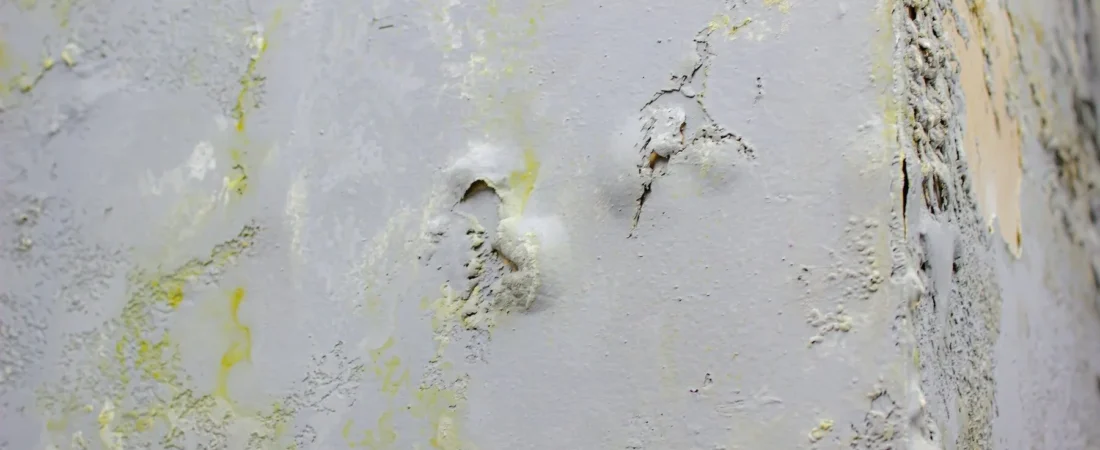
Three situations warrant professional involvement rather than DIY investigation. First, if the smell is concentrated and persistent in one specific area of a wall rather than spread across a general zone — that localization suggests a concealed point source (a slow pipe joint leak, a failed flashing detail) rather than generalized hygroscopic activity. Second, if the smell is accompanied by paint bubbling, wallboard softening, or any visible staining, the moisture levels inside the wall have gone beyond what off-gassing alone would cause. Third, if your moisture meter readings are consistently above 20% on multiple spots across the same wall face, you have genuine retained moisture that needs professional drying equipment, not just dehumidification.
A good building moisture consultant will use a combination of pin moisture meters, thermal imaging, and sometimes endoscopic cameras to diagnose what’s happening inside the wall assembly without unnecessary demolition. That upfront diagnostic cost — typically $200–$500 depending on the scope — almost always saves money compared to opening walls in the wrong place or replacing materials that didn’t actually need replacing.
Don’t wait until structural timber shows distress signs. Repeated moisture cycling degrades wall assembly integrity gradually and silently — by the time you see soft spots in drywall or crumbling mortar, the moisture has been at problematic levels for far longer than the visible damage suggests.
Does Painting Over a Smelly Wall Actually Help?
Sometimes, but not for the reason most people think. Standard paint does almost nothing to seal VOC off-gassing — the molecules are small enough to pass straight through a standard latex film. What painting does do is reduce the moisture permeability of the wall surface, which limits how much humidity the wall absorbs in the first place, which in turn reduces the activation of those odor-producing compounds. The benefit is indirect and depends heavily on using the right product.
For genuinely smelly walls, the products worth using are vapor-retarding paints or shellac-based primers (Zinsser BIN is the most commonly available). Shellac creates a genuine barrier to VOC migration through the surface — it’s what professionals use when encapsulating smoke damage, and it works on musty wall compounds for the same reason. One coat of shellac primer followed by two coats of good latex dramatically reduces surface off-gassing from a compromised wall, even if it doesn’t address what’s happening deeper in the assembly.
The honest limitation: if the wall is still actively taking on moisture from inside the assembly, painting the interior face just traps that moisture between the paint layer and the wall body, which eventually causes the paint to fail and can accelerate the very biological activity you’re trying to prevent. Encapsulation works; encapsulation of a still-wet wall creates a different problem.
The damp wall smell problem is one of those issues that rewards understanding the mechanism over just following a checklist — because the right fix for one wall type in one climate is genuinely wrong for a different wall in a different situation. As building science evolves and more homes are retrofitted with higher insulation levels and tighter envelopes
Frequently Asked Questions
What causes a damp wall smell?
Retained moisture and slow drying inside wall materials.
Does a damp smell always mean mold?
No. Damp smells often appear before mold.
Why does the smell get worse overnight?
Because airflow drops and humidity rises slightly.
Can walls smell damp without leaks?
Yes. Moisture often comes from indoor air.
When should a damp smell be investigated further?
When it is persistent or spreading.