
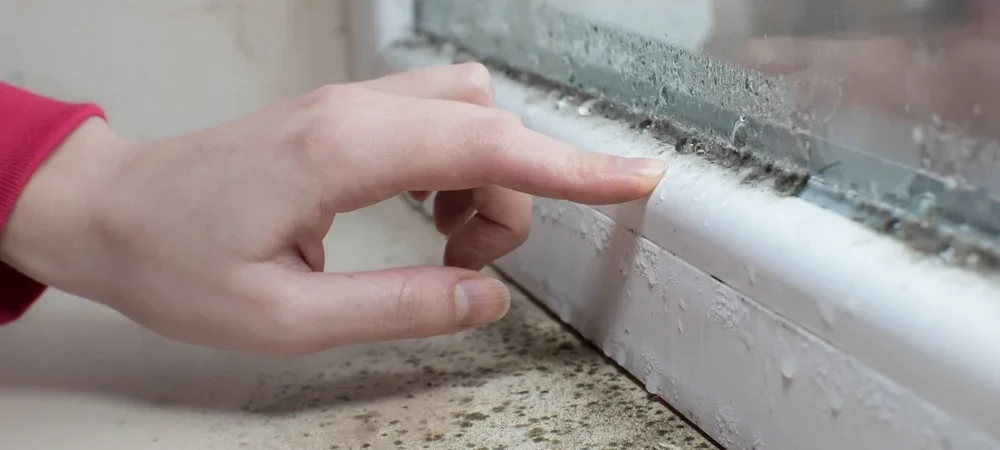
Condensation triggers mold in under 24 to 48 hours — but only if the surface stays wet long enough. That single fact changes how you should think about the whole problem.
Most articles about the condensation and mold connection focus on what mold looks like or how to clean it. That’s treating the symptom. The real issue — the one almost nobody talks about — is frequency. It’s not one big moisture event that causes mold. It’s the same surface getting wet, partially drying, and getting wet again, over and over, until the conditions tip in mold’s favor permanently.
That distinction matters because it completely changes where you should be looking and what you should be fixing.
What Actually Causes Mold to Grow From Condensation?
Mold spores are already in your home — that’s not the problem. The problem is giving them the one thing they need to germinate: sustained surface moisture. Condensation provides exactly that.
When warm, humid air meets a surface that’s colder than the air’s dew point, water vapor converts to liquid water directly on that surface. That’s condensation — not a leak, not a plumbing failure, just physics. You can read more about how that mechanism works differently from ambient humidity in this breakdown of Condensation vs Humidity.
For mold to grow, it needs four things: spores (present), a food source (dust, drywall, paint, wood — all present), a temperature between roughly 40°F and 100°F (almost certainly present), and moisture. Condensation delivers that fourth ingredient directly to surfaces, often where ventilation is poor and drying is slow.
Why Does Repeated Condensation Lead to Mold When a Single Event Doesn’t?
Here’s the part that most explanations skip entirely: a single condensation event rarely causes mold because most surfaces — if given time — will dry out before spores can germinate. The danger is in repetition.
Think about a window in a bedroom. Every cold morning, condensation forms on the glass and the surrounding frame. By noon it’s evaporated — but it hasn’t evaporated completely into thin air. It’s evaporated into the room’s air, into the wall cavity nearby, into the silicone seal, into the wooden frame. Each cycle deposits a small amount of moisture deeper into porous materials. Over weeks, those materials reach equilibrium moisture content levels high enough to support fungal growth, even on days when the surface looks bone dry.
This is the cycle most homeowners miss entirely. They see no wet surface and assume the problem resolved itself. It didn’t — it moved inward.
“Mold colonization is rarely a single-event outcome. What we consistently see in moisture investigations is a pattern of repeated wetting and incomplete drying over a period of weeks. The surface looks fine to the naked eye, but the substrate — particularly in gypsum board and timber — has already reached moisture content levels that are well within the growth range for common indoor molds like Cladosporium and Aspergillus.”
Dr. Patricia Holloway, Indoor Air Quality Specialist and Building Science Consultant, Certified Industrial Hygienist
How Long Does Condensation Need to Sit Before Mold Starts Growing?
The widely cited figure is 24 to 48 hours of continuous surface wetness. That’s accurate, but it’s also a bit misleading when applied to condensation specifically.
Condensation typically doesn’t sit for 48 continuous hours — it forms, partially evaporates, and reforms. So why does mold still develop? Because the clock doesn’t reset every time the surface dries. Porous materials like drywall, grout, timber, and caulk absorb moisture during each wet cycle. Their internal moisture content accumulates. Once a material’s moisture content rises above approximately 19% to 20% by weight — the threshold for wood, and broadly similar for other porous building materials — fungal activity begins, regardless of whether the surface looks wet or not.
The honest nuance here is that this threshold isn’t universal. Denser materials like glass and ceramic tile resist mold growth far better than porous ones, even with frequent condensation. Mold on a window pane itself is rare. Mold on the wooden frame or the drywall below the window? Very common. The material matters as much as the moisture.
Which Areas of a Home Are Most Vulnerable to Condensation-Related Mold?
Not all surfaces in a home are equally at risk, and that’s worth being specific about. The most vulnerable spots share two characteristics: they’re consistently cooler than the surrounding air, and they’re made of or bordered by porous materials.
Condensation in bathrooms is one of the most common entry points — the combination of steam, poor ventilation, and cold tiles or walls creates daily wetting cycles that can establish mold colonies behind tile grout and on ceiling drywall within a few weeks. But bathrooms get most of the attention. The sneakier problem zones are often elsewhere.
Here’s where condensation-related mold tends to establish itself most aggressively:
- Window reveals and sills — especially where timber frames meet single-glazed or poorly sealed units, as condensation channels directly onto wood grain
- External wall corners and thermal bridges — areas where insulation is thinner or absent, creating cold spots below the dew point even when the rest of the wall is fine
- Behind furniture pushed against exterior walls — air circulation is blocked, the surface stays cool and damp, and the problem is invisible until furniture is moved
- Inside built-in wardrobes on exterior walls — a specific variant of the above that catches people off guard because the space feels enclosed and dry
- Around cold water pipes — particularly in summer when air is humid and pipe surfaces stay cool, creating steady drip condensation on surrounding materials
Mold in bedrooms is a textbook example of the furniture-against-wall problem — a single bed pushed to an exterior wall can create a microenvironment with 10°F to 15°F less airflow than the rest of the room, which is often enough to push that surface below the dew point every night.
What Types of Mold Grow From Condensation and How Fast?
Not all mold is the same, and the type that condensation tends to produce is specific enough to be worth knowing. The most common condensation-associated molds are Cladosporium, Penicillium, Aspergillus, and — in more severe or persistent cases — Stachybotrys chartarum (the one commonly called “black mold”).
Cladosporium is typically the first to appear because it’s one of the few molds that can tolerate cooler temperatures — it can grow at surfaces as cold as 39°F. That’s why you’ll often see dark, powdery speckling on cold window frames or bathroom ceilings before any other species appears. Stachybotrys, by contrast, requires prolonged, sustained high moisture — it rarely develops from intermittent condensation alone, which is actually reassuring if you catch the problem at the speckling stage.
Growth rate depends heavily on temperature and the food source available. At 70°F to 80°F on a nutrient-rich surface like unpainted drywall, visible colonies can establish in as little as 3 to 5 days of sustained wetting. On painted surfaces or tile grout, you’re typically looking at 2 to 4 weeks of repeated condensation cycles before growth becomes visible.
| Mold Type | Min. Temperature for Growth | Typical Time to Visible Colony | Common Condensation Surface |
|---|---|---|---|
| Cladosporium | ~39°F (4°C) | 1–2 weeks (repeated cycles) | Window frames, bathroom ceilings |
| Penicillium / Aspergillus | ~50°F (10°C) | 2–3 weeks | Drywall, wallpaper, painted surfaces |
| Stachybotrys chartarum | ~65°F (18°C) | 6–12 weeks (sustained high moisture) | Drywall, ceiling tiles, wood under persistent wetness |
Does Indoor Humidity Level Determine Whether Condensation Leads to Mold?
Yes — and this is where understanding the relationship between surface moisture and air moisture pays off. Condensation forms when a surface’s temperature drops below the dew point of the surrounding air. The dew point is a direct function of relative humidity: the higher the indoor humidity, the higher the dew point, and the warmer the surfaces need to be to avoid condensation.
At 50% relative humidity and a room temperature of 68°F, the dew point is approximately 48°F. Most interior wall surfaces in a heated home stay well above that — so condensation is unlikely. Push indoor humidity to 70%, and the dew point rises to around 57°F. Now exterior walls in colder rooms, window frames, and poorly insulated corners are at genuine risk during winter. The difference between a safe home and a moldy one is often just 10 to 15 percentage points of relative humidity.
Keeping indoor relative humidity between 40% and 50% year-round reduces condensation risk significantly without making the air uncomfortably dry for occupants. That’s the practical target — not zero humidity, which is both impossible and unpleasant, but controlled humidity that keeps surfaces above their local dew point.
Pro-Tip: A $15 hygrometer placed near your most condensation-prone surface — typically an exterior-facing wall or window — gives you more actionable data than one placed in the center of the room. Microclimates near cold surfaces can run 5% to 10% higher relative humidity than the room average, which explains why mold appears in spots that seem well-ventilated from the doorway.
How to Stop Condensation From Creating the Conditions Mold Needs
Stopping mold is really about interrupting the condensation cycle before moisture accumulates in porous materials. There are two levers: reduce the moisture in the air, or raise the temperature of the surfaces that are condensing. Ideally, you work both simultaneously.
Here’s a practical sequence that addresses the actual mechanism rather than just treating surfaces after mold appears:
- Identify your cold spots using an infrared thermometer. Surfaces below the room’s dew point are your mold risk zones. A basic IR thermometer costs around $20 and lets you map every problem surface in minutes — no guesswork required.
- Reduce indoor humidity at the source. Cooking, showering, drying laundry indoors, and breathing all add moisture. Run exhaust fans for at least 20 minutes after showering, use lids while cooking, and vent tumble dryers outside. Each action directly reduces the dew point of your indoor air.
- Improve insulation at thermal bridge points. Cold spots in corners and around windows often exist because insulation is thinner there. Secondary glazing, draft sealing, and interior insulation panels on external wall corners can raise surface temperatures enough to move them above the dew point permanently.
- Increase air circulation to vulnerable surfaces. Pull furniture 2 to 3 inches from exterior walls. Keep wardrobe doors slightly ajar or install louvred panels. Moving warm room air across cold surfaces raises their temperature and speeds drying between condensation events.
- Use a dehumidifier in high-risk rooms. A dehumidifier maintaining 45% to 50% relative humidity eliminates most condensation risk on surfaces that aren’t significantly below room temperature. Size matters: a small 12-pint unit suits a bedroom; a 30- to 50-pint unit is more appropriate for a basement or large living area.
- Treat existing mold before sealing or repainting surfaces. Painting over mold without addressing the moisture source and killing the colony first simply delays the problem by a few weeks. Use a biocidal wash rated for the surface type, allow complete drying, then address the underlying condensation cause before any cosmetic repair.
Can Condensation Cause Mold Inside Walls Without Any Visible Signs?
Yes — and this is probably the most underappreciated risk in the whole topic. Interstitial condensation is the technical term, and it describes condensation that forms not on a wall’s surface but within the wall assembly itself, where warm interior air meets cold materials deeper in the structure.
In a typical stud wall, warm humid air from the living space can diffuse through the drywall into the wall cavity. If the cavity is cold enough — common in poorly insulated exterior walls — that air hits the dew point inside the wall. Moisture deposits on timber studs, insulation batts, and the back face of the inner leaf. None of this is visible from inside the room. The first sign is often a musty smell, an unexplained increase in allergy symptoms, or mold that appears at a baseboard or light switch — the seams where wall materials meet and allow the internal problem to breach the surface.
This is worth knowing because surface-level interventions — anti-mold paint, surface biocides, better bathroom fans — won’t touch interstitial condensation. Addressing it requires either vapour barriers on the warm side of insulation, improved wall insulation to keep the whole assembly warm, or positive pressure ventilation systems that maintain a slight overpressure of filtered, controlled air to prevent uncontrolled infiltration.
Is All Black Mold From Condensation the Same Risk Level?
The short answer is no — and confusing “black mold” as a category with Stachybotrys chartarum specifically causes a lot of unnecessary panic. Cladosporium and some Aspergillus species also present as black or dark green colonies, and they’re far more commonly produced by condensation than Stachybotrys.
Stachybotrys requires cellulose-rich, continuously saturated materials — think drywall that’s been wet for weeks or months, not the occasional condensation patch. That’s not to minimize it; Stachybotrys produces mycotoxins that can affect respiratory health and, in high-exposure situations, are linked to more serious effects. But the black speckling on your bathroom ceiling is statistically far more likely to be Cladosporium, which, while allergenic for sensitive individuals, is considerably less alarming.
If you’re unsure what you’re dealing with — particularly if anyone in the household has unexplained respiratory symptoms — a surface tape lift sample sent to a certified mold testing laboratory costs around $30 to $50 per sample and gives a definitive species identification. That’s worth doing before spending money on remediation protocols designed for the worst-case scenario.
What’s the Difference Between Surface Mold From Condensation and Mold From a Leak?
This matters practically because the fix is completely different. Condensation-related mold tends to be distributed across a broad area — following the pattern of cold surfaces — and it typically appears in predictable locations: corners, external walls, window frames, north-facing rooms that get less solar warming. It’s also usually at or near the room surface rather than hidden behind finishes.
Leak-related mold, by contrast, tends to concentrate in a specific point or track along a path — following the route water has traveled. It’s often found inside wall cavities, beneath flooring, or on ceiling tiles directly below a pipe or roof penetration. The staining pattern is typically water-tide-marked rather than diffuse, and the associated material damage is often more severe because saturation was more complete.
A practical test: run your indoor humidity down to 40% using a dehumidifier for two weeks and see if the mold growth slows or stops expanding at its edges. If it does, condensation is almost certainly the primary driver. If moisture keeps appearing regardless of humidity control, investigate for a hidden leak or ground moisture intrusion — a completely different problem with a completely different solution chain.
How Do You Know If Your Condensation Problem Has Already Led to Mold?
Visual inspection is the starting point, but it’s not always reliable — particularly for early-stage or interstitial growth. There are several diagnostic signals worth paying attention to beyond the obvious dark patches on walls.
A persistent musty or earthy smell in a room — even when there’s no visible mold — is often the first real indicator. That smell comes from microbial volatile organic compounds (MVOCs) that mold produces as it metabolizes, and it’s detectable long before colonies become visible. If a room smells musty after being closed up, take that seriously.
Other indicators include: paint or wallpaper bubbling or lifting at corners, which suggests moisture accumulation behind the surface; timber windowsills or skirting boards that feel soft or spongy to light pressure; and a pattern of worsening allergy or asthma symptoms when occupying a particular room. None of these individually confirm mold, but any combination warrants closer investigation — including pulling furniture away from walls to check what’s behind it.
Conclusion
The condensation and mold connection isn’t really about the water you can see on your windows each morning — it’s about what happens to the materials around those windows over months of repeated wet-dry cycles. Once you shift focus from visible moisture events to cumulative material saturation, the whole problem becomes more solvable because you’re targeting the actual mechanism. Homes that successfully prevent condensation-related mold aren’t necessarily drier in the air — they have surfaces that stay warm enough, or materials that dry fast enough, to never cross the threshold. As building envelopes get tighter for energy efficiency, managing internal humidity and ventilation will only become more consequential, not less.
Frequently Asked Questions
Does condensation cause mold?
Not directly. Mold usually needs repeated condensation over time.
Can mold grow without visible condensation?
Yes. Condensation may occur briefly and evaporate.
Why does mold appear around windows?
Because condensation forms there frequently and dries slowly.
Is condensation alone a problem?
Not usually, unless it is persistent.
Do humidity and condensation both affect mold?
Yes. Mold often develops when both are present repeatedly.