
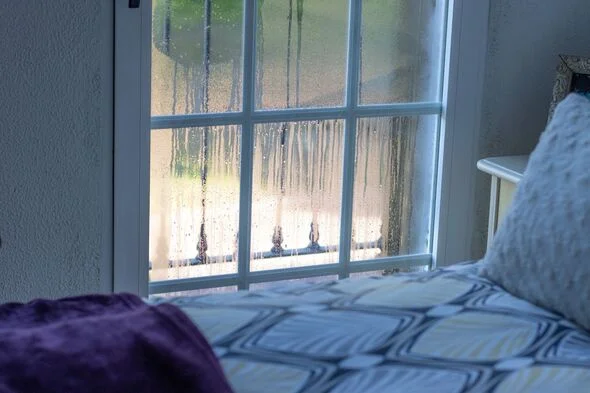
Bottom line: Bedroom condensation isn’t a ventilation failure or a sign your home is falling apart — it’s almost always a humidity problem that happens to peak between midnight and 6 a.m., and fixing it rarely requires what most guides recommend first.
Every morning you wipe down the same windowsill. Maybe you’ve chalked it up to old windows, or cold winters, or just “the way this room is.” But the real driver isn’t the glass — it’s what’s happening inside the room while you sleep. Understanding that distinction changes everything about how you fix it.
What actually causes condensation in the bedroom overnight
Condensation forms the moment warm, moisture-laden air contacts a surface cold enough to push it past its dew point. That surface could be glass, an exterior wall, or even a cold metal curtain rod. The dew point is the temperature at which air can no longer hold its water vapor — and it’s not fixed, it shifts depending on how much moisture is in the air to begin with.
Here’s what makes bedrooms uniquely vulnerable: a single sleeping adult exhales roughly half a liter of water vapor per hour. Two people in a closed room for eight hours of sleep can add over 800ml of moisture to the air without doing anything other than breathing. That’s before you factor in any houseplants on the windowsill, a humidifier running nearby, or a wet towel left on the radiator.
Overnight, your heating system typically drops to its lowest output or switches off entirely. The exterior walls and glass cool down. The dew point closes in on the surface temperature. By 4 a.m., even a room that felt perfectly comfortable at 10 p.m. can have windows streaming with water. This is the core mechanism — and it’s the part most people never hear explained clearly.
Why the bedroom gets condensation when other rooms don’t
Condensation in the bedroom occurring while the rest of the house stays dry is one of the most common patterns — and also one of the most misread. People assume it means the bedroom has a leak, or worse, that mold is coming. Usually, it just means the bedroom is producing far more humidity per square foot than any other room.
Bedrooms are almost always the smallest occupied rooms in a home, and they’re kept closed at night for privacy and warmth. That combination is a humidity trap. You’ve got two people generating moisture in a sealed 150-square-foot box with no fresh air exchange. The living room has no one in it at 3 a.m. The kitchen had moisture earlier but it dispersed. The bedroom just keeps building.
There’s also a thermal asymmetry at play. Bedrooms tend to face north or sit on exterior corners, giving them more exposed wall and less solar gain during the day. That means the surfaces that need to stay above dew point are starting colder than in other rooms. You don’t need much more than 2–3°F of surface temperature difference to tip condensation from “occasional” to “every single morning.”
When bedroom condensation is normal vs. when it signals a real problem
This is the honest nuance most guides skip: sometimes condensation is fine, and sometimes it’s a warning. The difference isn’t how wet the windows look — it’s where the moisture is appearing and how long it sticks around.
Light condensation on window glass that clears within an hour of opening the window or turning the heating on? That’s physics, not failure. Glass is the coldest surface in most rooms and it shows you what the air is doing. Think of it as a free humidity gauge. If it’s gone by mid-morning and the walls and frames are dry, you’re in normal territory for a temperate climate in colder months.
The line gets crossed when you see persistent moisture on walls — especially exterior walls — on window frames rather than just glass, or on ceilings. That suggests the surfaces themselves are cold enough that your room’s average humidity is chronically too high. Mold and humidity follow that pattern closely: mold doesn’t need a dramatic event, just a surface that stays above 70% relative humidity for several days running.
| Condensation Pattern | Likely Cause | Action Needed |
|---|---|---|
| Window glass only, clears by morning | Normal overnight humidity buildup | Improve ventilation slightly |
| Window frames and sills, stays wet | High sustained indoor humidity | Reduce sources, increase airflow |
| Exterior walls or corners | Cold bridging or insulation gap | Investigate wall construction |
The counterintuitive reason warm bedrooms get more condensation
Most people assume a warmer room means less condensation. It’s a reasonable assumption — warm air holds more moisture, so surely a toasty bedroom is safer? Not quite, and this is where the real insight lives.
A warmer room does hold more moisture in the air — but that also means more moisture available to condense the moment any surface dips below dew point. If you heat your bedroom to 72°F but your window glass is still at 45°F because it’s single-glazed and it’s cold outside, the temperature gap is enormous. Warm, humid air hitting that cold glass deposits more water than cool, moderately humid air would. You haven’t reduced condensation risk — you’ve loaded the gun and pointed it at your windowsill.
The actual variable that matters is relative humidity, not temperature alone. Keeping indoor relative humidity between 40–50% during sleeping hours dramatically reduces condensation regardless of room temperature. At 50% relative humidity and 68°F, the dew point sits around 49°F — meaning your glass would need to drop below that to show condensation. At 65% humidity in the same room, the dew point climbs to 55°F, and suddenly even a decent double-glazed window is at risk on a cold night.
“People focus on upgrading their windows when they see bedroom condensation, but that’s treating the symptom. The driving variable is almost always the indoor vapor pressure — which is a function of how much moisture is being generated in the room and how little of it is being exchanged with outside air. Fix the ventilation equation first, and condensation often resolves without touching the windows.”
Dr. Claire Ashworth, Building Physics Consultant and Indoor Air Quality Researcher
How to find out if your bedroom humidity is the real culprit
Before you spend money on anything, spend $15 on a digital hygrometer and put it on your nightstand. Check it right before bed, and again the moment you wake up. If you’re waking to readings above 65% relative humidity, you’ve confirmed the source. If you’re waking to readings below 55% and still seeing heavy condensation, the issue is more likely surface temperature — cold bridging in your walls, poor glazing, or a draft gap that’s cooling the frame faster than the room can compensate.
Run this simple test for three consecutive nights before making any changes. Write down the numbers. You’ll see a pattern immediately: humidity almost always peaks in the early hours of the morning, right when heating is lowest and breath moisture has been accumulating for hours. That data point matters — it tells you whether you need better ventilation, a dehumidifier, or an investigation into your insulation.
One thing worth testing that’s rarely mentioned: crack the bedroom door by two inches rather than keeping it fully shut. In a well-sealed modern home, that small gap allows passive air exchange with drier parts of the house during the night. Several people who’ve tried this report a measurable 5–8% drop in overnight humidity without any other change — simply by interrupting the sealed-room effect that turns the bedroom into a humidity chamber.
Pro-Tip: Place your hygrometer at window height, not at head height. Glass surfaces are colder, so the air immediately adjacent to the window has a lower temperature and higher relative humidity than the middle of the room. A hygrometer at desk level can read 55% while the air at glass level is effectively at 75% — which explains why condensation appears even when your readings seem “fine.”
What actually reduces bedroom condensation (in order of effectiveness)
Not all fixes are equal, and most guides bury the most effective options under a pile of generic advice. Here’s the ranked reality.
- Improve overnight ventilation first. A trickle vent left open — or a window cracked 10mm — allows continuous low-level air exchange that dilutes moisture as it’s produced. This addresses the root cause directly rather than managing symptoms after the fact.
- Use a desiccant dehumidifier overnight if ventilation isn’t possible. Refrigerant dehumidifiers underperform below 60°F — which is precisely the temperature range a cool bedroom hits at night. A desiccant model works effectively down to 35°F and is far better suited to cold sleeping environments.
- Reduce moisture sources before bedtime. Wet laundry in the bedroom, uncovered fish tanks, or even large-leafed houseplants all contribute measurable vapor. Moving a single laundry rack out of the bedroom can reduce overnight humidity by 10–15% on its own.
- Keep the heating on low overnight rather than switching it off entirely. A background temperature of 60–62°F keeps wall and glass surfaces above the dew point more consistently than a room that drops to 52°F at 3 a.m. The energy cost is modest; the condensation reduction is significant.
- Check window and wall seals for cold bridges. A single gap in frame insulation or a thin section of wall with missing cavity fill creates a cold spot that sits well below the rest of the room’s surface temperature. Thermal imaging — available as an add-on through many home energy audits — makes these invisible problems immediately obvious.
Why new windows don’t always solve bedroom condensation
This is the fix most people jump to — and it genuinely helps in some cases, but it’s regularly oversold. Replacing single-glazed windows with double or triple glazing raises the inner pane temperature, which raises the surface dew point threshold and reduces condensation on the glass. That part is real.
What the window companies don’t prominently mention is that better-sealed windows also reduce the natural air infiltration that older, draughty windows provided. An old rattling sash window was leaking warm indoor air and simultaneously letting in dry outdoor air — inefficiently, yes, but effectively as an accidental ventilation system. Install new airtight frames without adding trickle vents, and you may find condensation disappears from the glass only to appear on the walls instead, because the humidity has nowhere to go.
A real-world example: a terraced house bedroom, newly fitted with sealed double-glazing, started showing dark spots in the corners of the exterior wall within one winter. No condensation on the glass anymore — but the humidity that previously escaped through window gaps was now driving moisture deeper into the wall structure. The fix required adding trickle vents to the new frames. The lesson is that you can’t solve a humidity problem by sealing it in.
What bedroom condensation does to your health and home over time
Chronic bedroom condensation is worth taking seriously — not because a damp window is dangerous on its own, but because of what it enables downstream. Persistent surface moisture above 70% relative humidity creates the conditions for mold spore germination within 24–48 hours. Bedroom walls, being less frequently cleaned than kitchen surfaces, are particularly susceptible.
Mold in sleeping environments is more consequential than in other rooms simply because of exposure time. You spend 6–9 hours per night breathing air in that room. Low-level mold spore exposure during sleep has been linked to disrupted sleep quality, morning nasal congestion, and in sensitized individuals, worsening asthma symptoms — even when the mold patch is small enough to be easily overlooked behind a curtain or under a windowsill.
Structurally, repeated wetting and drying of window frames causes timber to expand and contract until the paint cracks, the seal fails, and rot begins. Once a wooden frame starts to rot at the base, it rarely dries out fully — the rot creates a moisture reservoir. At that stage, a surface wipe isn’t enough. You’re looking at frame replacement, which costs considerably more than a dehumidifier or trickle vent would have years earlier.
Specific bedroom scenarios where condensation behaves differently
Condensation doesn’t behave identically in every bedroom, and pretending it does leads to the wrong fixes. A few situations deserve their own treatment.
- Children’s bedrooms: Kids breathe faster than adults and often sleep hotter, meaning they generate more moisture per hour relative to body size. A child’s bedroom with the door closed can accumulate humidity faster than an adult couple’s room of the same size. Adding a small trickle vent or a quiet desiccant dehumidifier set to 50% is often the fastest resolution.
- Ground-floor bedrooms: These can receive moisture wicking up from below as well as from occupants, particularly in older homes without a damp-proof course. Condensation on ground-floor walls may have a component that overnight ventilation alone won’t fully resolve — it needs to be distinguished from rising damp, which has different visual characteristics (tide marks, salting on plaster).
- Attic and loft conversions: Insulation quality varies enormously in converted lofts, and cold bridging through rafters is extremely common. You may see condensation tracking exactly along the ceiling joists — a tell-tale sign the insulation isn’t continuous. This isn’t a humidity management problem; it’s a fabric problem requiring an insulation fix.
- Apartments and flats: Upper-floor apartments lose heat through the roof and gain it from neighbors below, creating unusual temperature gradients. Condensation in a top-floor flat bedroom often appears on the ceiling first rather than the windows — which surprises people, but makes sense given where the coldest surface is.
How to maintain the right humidity in your bedroom long-term
Target indoor relative humidity of 40–55% in your bedroom year-round. Below 40% and you’ll wake with a dry throat; above 55% sustained overnight and condensation risk increases substantially, especially in colder months. That range is achievable without expensive equipment — it mainly requires consistent habits.
Ventilate the room for 10 minutes each morning after waking. Open the window, let the humid overnight air exchange with drier outdoor air. This single habit removes the moisture load from sleeping before it can settle into surfaces. It sounds almost too simple, but a 10-minute morning purge of bedroom air measurably reduces the baseline humidity the room starts with each night.
Avoid drying clothes in the bedroom, don’t store wet sports gear or towels overnight, and keep houseplants in rooms that are better ventilated during the day. If you use a humidifier anywhere in your home for health reasons, make sure it’s not set above 50% and that it has an auto-shutoff. Running a humidifier in the evening in a house where the bedroom already has condensation issues is the kind of well-intentioned action that quietly makes things much worse.
Long-term, the homes that handle bedroom condensation best tend to share one characteristic: they treat ventilation as infrastructure, not an afterthought. Trickle vents, an extractor fan in the adjacent bathroom that runs slightly longer than the standard timer, a whole-house mechanical ventilation system in newer builds — these are the things that keep bedroom humidity under control across every season without requiring daily intervention.
Bedroom condensation is one of those problems that feels like it’ll just resolve itself eventually. It doesn’t. But the good news is that addressing it properly — understanding the overnight humidity buildup, matching the fix to the actual cause, and getting ventilation working as it should — creates a ripple effect. A drier bedroom sleeps better, smells fresher, and costs less to maintain over the years. And once you’ve internalized why it happens, you’ll start reading every cold, wet window as data rather than dread.
Frequently Asked Questions
Why do I get condensation in my bedroom at night?
Condensation forms because moisture from breathing builds up while surfaces cool overnight. Each person releases 1-2 pints of water vapor through respiration and perspiration during sleep, and in a closed bedroom with limited airflow, this moisture accumulates and contacts cold surfaces like windows and exterior walls.
Is condensation in the bedroom normal?
Yes, bedroom condensation is normal, especially during winter months or overnight when temperature differences are greatest. Most homes experience some level of bedroom condensation during cold weather, and it typically evaporates within 2-3 hours after waking when air circulation increases and surfaces warm up.
Why is condensation worse in the morning?
Condensation peaks in the morning because overnight cooling reaches its maximum between 5-7 AM while humidity accumulation is at its highest point. Surface temperatures drop by 15-20°F overnight, and after 7-8 hours of moisture buildup from sleeping occupants, conditions are perfect for condensation formation on cold surfaces.
Can bedroom condensation happen without leaks?
Yes. It usually comes from indoor moisture, not leaks.
Does bedroom condensation increase mold risk?
Only if it’s persistent and keeps surfaces damp for long periods. Occasional morning condensation that evaporates within a few hours poses minimal mold risk, but surfaces that remain wet for more than 48 hours create ideal conditions for mold growth. Areas behind furniture and in corners are most susceptible to prolonged dampness.