
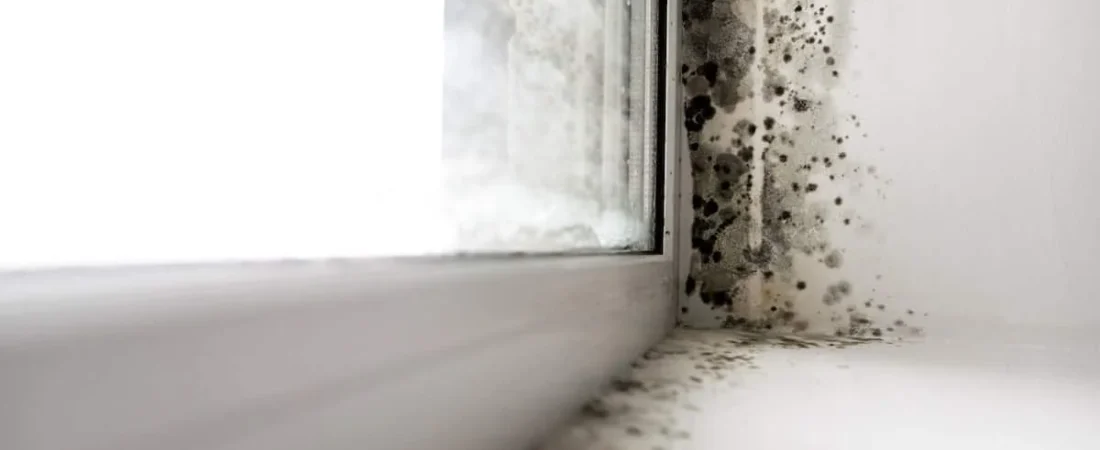
Leak-free apartments grow mold every single day — and the reason almost nobody talks about is that the moisture isn’t coming from the walls. It’s coming from you.
Breathing, cooking, showering, even sleeping — a single person releases roughly a pint of water vapor into the air daily just through respiration. Add a partner, a pet, a pot of pasta, and a morning shower, and you’re pumping several gallons of invisible moisture into a sealed space every week. Mold doesn’t need a burst pipe to thrive. It needs humidity above 60% and a surface to grip, and your apartment hands it both without any drama.
This article exists because most mold advice online treats leaks as the villain and leaves renters confused when black spots appear on a perfectly dry ceiling. The real story is about moisture you generate yourself, building design that traps it, and ventilation systems that move air without actually drying it. That’s the problem worth solving.
What Causes Mold in an Apartment Without Leaks?
Mold spores are always present in indoor air — that’s not a scare tactic, it’s biology. The question is never whether spores exist in your apartment; it’s whether conditions ever tip far enough to let them germinate. For that to happen, spores need a surface, a temperature between roughly 40°F and 100°F, an organic food source (drywall paper, wood, dust, even dead skin cells), and relative humidity above 60% sustained for 24 to 48 hours.
Without a leak, the humidity culprit is almost always what building scientists call “internal moisture loads” — the water vapor generated by occupant activity. A 10-minute shower deposits a measurable amount of moisture on every cool surface in the bathroom within minutes. That moisture doesn’t disappear; it either gets exhausted by a fan, absorbed by materials, or eventually finds a spot cold enough to condense and stay wet long enough for mold to colonize.
There’s also a less obvious mechanism called thermal bridging, where structural elements like concrete beams, metal window frames, or exterior walls conduct cold inward, creating localized cold spots even when the rest of the room feels fine. These cold spots drop surface temperature below the dew point, and condensation forms without a drop of plumbing water involved.
Why Do Corner Walls and Closets Get Mold Even in Dry Apartments?
This one surprises people: corners are almost always colder than flat walls, even in a well-heated room. That’s because two exterior-facing surfaces meet, reducing the insulating effect of interior air movement and creating a spot where surface temperature can be 5–8°F lower than the surrounding wall. Drop the surface temperature enough, and even indoor air at 55% relative humidity can condense there.
Closets compound the problem because they’re typically static air zones. You open the door twice a day, warm humid air drifts in, and then it sits against a cold exterior wall with nowhere to go. The clothes and shoe boxes inside act as reservoirs, holding moisture and providing the organic matter mold needs. It’s a near-perfect incubator that most people don’t think about until they notice a musty smell or spot dark patches on the back wall.
Furniture placement plays into this more than most renters realize. A sofa pushed flush against an exterior wall blocks the warm air circulation that keeps that wall surface above the dew point. Behind that sofa, hidden from view and starved of airflow, you can have sustained condensation and active mold growth for months before anyone notices.
What Are the Hidden Signs of Mold in an Apartment?
Visible black or green patches are the obvious ones. But mold often announces itself through subtler cues that are easy to dismiss as normal apartment living — until the colony is well established.
- Musty smell that comes and goes: A smell that’s worse after the apartment has been closed up overnight is a reliable early indicator. Mold off-gasses compounds called microbial volatile organic compounds (mVOCs), and the odor concentrates when ventilation is low.
- Discoloration under window sills: Often written off as paint aging, dark staining on window sills or the drywall below them is frequently condensation-driven mold. Metal and aluminum frames are especially efficient at bridging cold from outside.
- Warped or bubbling paint: Paint that lifts from drywall without an obvious water source is a sign of moisture migrating through the wall assembly. Mold is often already present in the paper backing of the drywall before the paint shows any symptoms.
- Persistent allergy symptoms indoors: If you feel fine outside but congested, itchy-eyed, or tired at home, mold is worth investigating. Mold spores in indoor air at elevated counts can trigger symptoms well before you see any visible growth.
- Grout lines that darken faster than expected: In a bathroom with poor ventilation, grout goes from clean to dark in a matter of weeks. That’s mold, not just “soap scum,” and it signals that the bathroom humidity is high enough to support growth elsewhere too.
Which Apartments Are Most Vulnerable to Mold Without Any Leaks?
Not all apartments carry equal risk. Building age, construction type, floor position, and even which direction your windows face all shift your baseline vulnerability significantly.
| Apartment Type | Key Risk Factor | Most Likely Mold Location |
|---|---|---|
| Ground-floor unit | Slab or crawl space moisture wicking upward, limited airflow | Baseboards, carpet edges, bathroom walls |
| Top-floor unit | Roof thermal mass, poor attic insulation creating cold ceiling spots | Ceiling corners, bedroom closets |
| Corner unit | Two exterior-facing walls, more thermal bridging surface area | Corner walls, closets on exterior sides |
| Newer airtight construction | Very low air infiltration traps internally generated moisture | Anywhere with reduced airflow — behind furniture, inside cabinets |
Newer buildings actually carry a counterintuitive risk. Tighter construction means less accidental air exchange with the outside, which sounds like a good thing until you realize that old drafty apartments were inadvertently self-venting. Modern airtight builds trap every gram of moisture generated indoors, which is exactly why mechanical ventilation is now code-required in new construction — though whether that ventilation is properly installed and running is another question entirely.
Why Is the Bathroom Fan Probably Not Doing Its Job?
Bathroom exhaust fans are one of the most misunderstood tools in mold prevention. The fan in your apartment bathroom is likely either undersized, vented incorrectly, or so clogged with dust that it’s moving a fraction of its rated airflow. And here’s the thing most people skip: even a perfectly functional fan only helps if you run it long enough.
A standard 10-minute shower generates enough steam to keep bathroom surfaces above the dew point threshold for 20 to 30 minutes after the water stops. Running the fan only while you’re in the shower clears maybe half the problem. The generally accepted rule from HVAC professionals is to run the exhaust fan for at least 20 minutes after the shower ends. Most renters run it for 3 minutes, if at all.
There’s also the question of where the fan actually exhausts to. In some apartment buildings — particularly older ones and those where maintenance has been deferred — bathroom exhaust fans duct directly into the wall cavity or the ceiling plenum instead of outside. You’re not removing moisture; you’re just moving it to a hidden space where it can feed mold undisturbed for years.
“The majority of mold cases I investigate in apartments with no plumbing failures come down to inadequate ventilation combined with occupant moisture loads that the building’s design never anticipated. People aren’t doing anything wrong — they’re just living in spaces that weren’t built to handle it. The fix is almost always mechanical, not behavioral.”
Dr. Patricia Hale, Certified Industrial Hygienist and Indoor Air Quality Consultant
How Does Cooking Without a Range Hood Contribute to Mold?
Cooking is one of the most underrated contributors to indoor moisture in apartments. Boiling a pot of pasta releases steam equivalent to adding roughly 1–2 cups of water directly into the air of your kitchen. Do that daily in a small apartment with no range hood or a recirculating hood that filters odors but doesn’t exhaust outside, and you’re adding meaningful moisture to the space every single evening.
The moisture doesn’t stay in the kitchen. It migrates with air currents into adjacent rooms, settles on cool surfaces, and contributes to the overall relative humidity load of the entire apartment. In a 600 square foot apartment, a 30-minute cooking session can push relative humidity up by 10–15 percentage points in the kitchen and measurably in neighboring rooms. That’s enough to push borderline-humid spaces over the threshold where mold becomes viable.
The honest nuance here is that this matters far more in poorly ventilated apartments than in units with good airflow. If you live in a unit with operable windows on multiple sides and cross-ventilation, the moisture disperses reasonably well in mild weather. But in winter, when windows stay shut for weeks at a time, every cooking session is a compounding moisture event with nowhere to go.
How to Find Mold in an Apartment When You Can’t See It
You smell something. You don’t see anything. Now what? Tracking down hidden mold in an apartment requires a systematic approach because mold often lives where air doesn’t circulate and where you don’t regularly look.
- Check behind and under large furniture against exterior walls. Pull the sofa, bed, and dresser away from exterior-facing walls and inspect the wall surface and the back of the furniture. Dark staining or a powdery texture on the wall is a clear sign.
- Inspect the ceiling of every closet, especially those on exterior walls. Use a flashlight and look specifically at corners and the wall-ceiling junction. Mold here is often gray or black and easy to mistake for shadow.
- Remove the bathroom exhaust fan cover and look inside the duct collar. A musty smell concentrated at the fan opening, or visible dark growth on the fan housing itself, indicates moisture is backing up into the duct rather than being expelled.
- Check inside kitchen and bathroom cabinets, particularly base cabinets. The wall at the back of a base cabinet is often an exterior or plumbing wall that stays cooler than the rest of the room. Look at the cabinet back and the wall surface if the cabinet is open-backed.
- Use a digital hygrometer to map humidity across rooms. An inexpensive hygrometer (typically $10–$20) can reveal that one corner of a bedroom consistently reads 65–70% while the rest of the apartment reads 50%. That hot spot is where mold is most likely to be active.
Pro-Tip: Place a hygrometer inside a closet you suspect for 24 hours without opening the door. Closet relative humidity is often 10–15% higher than the room it’s in due to restricted airflow, and even a “normal” apartment at 55% RH can have closets sitting at 65–70% — firmly in mold-growth territory.
What’s Your Landlord’s Legal Responsibility for Mold in Apartment Without Leaks?
This is where things get genuinely complicated, and where a lot of renters get burned by assuming they have fewer rights than they do. Mold caused by a structural or ventilation deficiency in the building — inadequate exhaust fans, poor insulation causing condensation, a broken HVAC system — is generally considered a landlord’s responsibility under habitability laws in most jurisdictions, regardless of whether a pipe ever burst.
The complication arises when the moisture source is occupant behavior versus building deficiency. A landlord who can demonstrate that you dried laundry indoors without ventilation, ran a humidifier beyond normal levels, or failed to report a slow-dripping faucet that saturated a wall will have more grounds to push back on responsibility. The line between “building problem” and “tenant behavior” is real, and it’s contested in disputes regularly.
If you’re living in an apartment with mold and your landlord is disputing responsibility, document everything with dated photographs, written communication, and ideally a reading from a hygrometer showing chronically elevated humidity. Some states allow rent withholding or repair-and-deduct remedies for uninhabitable conditions including mold, but the specific thresholds vary — consult your local tenant rights organization before acting unilaterally.
How to Fix Mold in an Apartment Without Leaks: What Actually Works
Surface cleaning alone doesn’t solve a mold problem when the root cause is a sustained humidity environment. You can scrub visible mold off grout and repaint a wall, but if you don’t change the conditions that made it possible, the colony re-establishes itself in three to six weeks. The fix has to address the source of moisture, not just the symptom.
Here’s what a real remediation approach looks like for a no-leak apartment mold situation, ordered by priority:
- Get relative humidity below 50% consistently. A standalone dehumidifier is often the fastest tool available to a renter. A 30-pint unit can handle a 500–700 square foot space; size up for larger apartments or those with known moisture issues. Aim for 45–50% RH measured at room level, not just near the thermostat.
- Improve bathroom ventilation behavior immediately. Run the exhaust fan for 20–30 minutes after every shower, every time. If the existing fan is weak, request a replacement from your landlord in writing — this creates a paper trail and, in many cases, gets results.
- Move furniture away from exterior walls by at least 2 inches. This restores airflow behind large furniture and prevents the localized cold-surface condensation zones that invite mold. It feels like a small thing, but it eliminates one of the most common hidden mold sites in apartments.
- Clean mold on hard non-porous surfaces with a solution of 1 cup of bleach to 1 gallon of water. This works on tile, glass, and sealed surfaces. It does not work on drywall, wood, or grout — porous materials that have been mold-colonized beyond the surface need to be replaced, not cleaned.
- Address closet air stagnation with a small USB-powered fan on a timer. Running a low-power fan inside a problem closet for a few hours a day circulates air against the back wall, raises surface temperature slightly, and dramatically reduces mold-favorable conditions. It sounds unconventional, and it works.
Can Air Purifiers Help With Mold in an Apartment?
Air purifiers with HEPA filtration can capture airborne mold spores down to 0.3 microns, which covers the size range of most common mold spores (typically 2–10 microns). That’s genuinely useful for reducing your exposure to spores being shed by an existing colony, and it can meaningfully lower allergy symptoms while you’re addressing the root problem.
What an air purifier cannot do is lower the relative humidity or kill existing mold on surfaces. It’s an exposure-reduction tool, not a remediation tool. The same applies to those small “mold-killing” devices that emit ozone or UV light — they address airborne spores to varying degrees but do nothing about the colony established on your closet wall or behind your dresser.
Think of an air purifier as appropriate while you’re fixing the actual problem — useful, running in parallel, but not the fix itself. A dehumidifier will do more to prevent new mold growth than any air purifier at any price point.
What Humidity Level Prevents Mold in an Apartment?
The target is consistent relative humidity between 40% and 50% across the apartment, including in closets and behind furniture where stagnant air can push local humidity significantly higher than what your main living space shows. Below 40% and you’re into dry air territory where skin, wood furniture, and houseplants suffer. Above 55% consistently, you’re providing conditions where mold can establish itself given enough time.
Seasonal variation matters here. In summer, your primary battle is humidity from outside air and cooking — a dehumidifier does the heavy lifting. In winter, the dynamic shifts: cold outdoor air is inherently dry, but sealed apartments trap internally generated moisture while cold exterior walls create condensation zones. You might actually see lower whole-room humidity readings in winter while simultaneously having more mold because the moisture is concentrating at cold surfaces rather than being distributed in the air.
A surface thermometer (infrared or contact type, available for under $20) lets you check whether any walls in your apartment are consistently below the dew point for your indoor air conditions. If your apartment is at 65°F and 55% relative humidity, the dew point is around 48°F — any surface at or below that temperature will have condensation, and therefore mold risk, regardless of what the air in the center of the room reads.
When to Call a Professional for Apartment Mold Without Leaks
Not every mold situation is DIY-appropriate, and knowing when to escalate is worth being clear about. A small surface colony on bathroom tile — under 10 square feet — that you can clean and prevent from returning by fixing ventilation is within reach for most renters. Anything larger, anything inside wall cavities, anything affecting the HVAC system, or any mold growth that keeps returning within weeks of cleaning despite your humidity controls belongs in professional hands.
A certified industrial hygienist can perform air sampling to determine what species of mold are present and at what concentrations. This matters because while most mold is an irritant, certain species like Stachybotrys chartarum (commonly called “black mold”) produce mycotoxins that warrant more urgent remediation. The color of mold doesn’t reliably identify the species — testing is the only way to know.
If your landlord refuses to act and you believe the mold is a health hazard, most jurisdictions have local housing departments, health departments, or building inspectors who can conduct inspections. A formal written violation against the property carries far more weight than a renter’s complaint alone, and it shifts the legal and financial burden of remediation where it belongs.
Conclusion
Mold in an apartment without leaks is fundamentally a moisture management problem, not a plumbing problem, and that reframe changes everything about how you approach it. The moisture is already in your apartment — it’s in every breath you exhale, every pot you boil, every shower you take. The buildings we live in are getting tighter by the decade, which means internally generated moisture has fewer and fewer accidental escape routes. As construction standards continue prioritizing energy efficiency over passive ventilation, understanding how to actively manage indoor humidity isn’t just a home improvement topic — it’s a basic occupant competency that matters more every year.
Frequently Asked Questions
Can mold really grow without leaks?
Yes. Humidity and condensation alone can support mold growth.
Why does mold keep appearing in the same spot?
Because moisture and airflow patterns remain unchanged.
Does mold without leaks mean hidden water damage?
Not usually. Most cases are caused by indoor conditions.
Can condensation cause mold?
Yes. Repeated condensation can keep surfaces damp enough for mold.
Is mold without leaks common in apartments?
Yes. Apartments often have limited airflow and cold surfaces.
Disclaimer: This article is for informational purposes only and isn’t a substitute for professional mold inspection or remediation advice. Mold problems vary a lot depending on the material affected, the extent of growth, and your specific health situation. Always follow product label instructions when using cleaning chemicals, ensure proper ventilation, and consider consulting a certified mold remediation professional for anything beyond a small, surface-level patch. If you have respiratory conditions, allergies, or a compromised immune system, talk to a doctor before starting any DIY mold removal.