
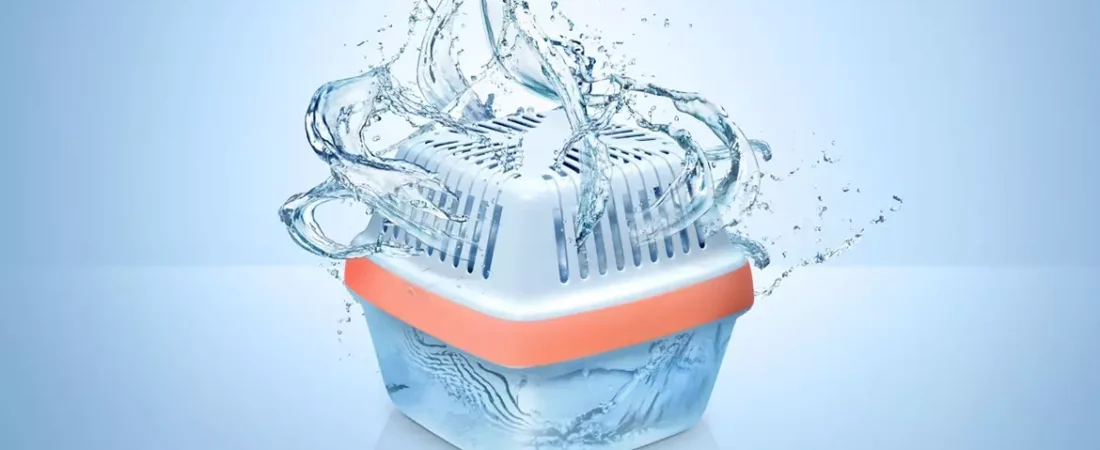
Moisture absorbers are commonly advertised as a simple solution for damp air, condensation, and musty smells. Small containers filled with crystals or pellets promise to “absorb excess moisture” without electricity, noise, or maintenance. For many people dealing with humidity issues, they seem like an easy first step.
But do moisture absorbers actually help reduce indoor humidity, or do they only create the impression of improvement? The answer depends on how they work, where they are used, and what kind of humidity problem exists.
This article explains what moisture absorbers can realistically do, where they make sense, and where their limitations become clear.
What Moisture Absorbers Are Designed to Do
Moisture absorbers usually contain hygroscopic materials, most commonly calcium chloride, which attracts water from the surrounding air. Over time, the absorbed moisture turns into liquid that collects inside the container.
This process is passive and slow. Moisture absorbers do not move air, do not ventilate rooms, and do not actively control humidity levels. Instead, they remove very small amounts of moisture from the immediate area around them.
Understanding this limitation is key to knowing when they help and when they don’t.
Why Moisture Absorbers Feel Effective at First
Many people feel an improvement shortly after placing a moisture absorber in a room. This is usually because:
- odors feel slightly reduced
- surfaces near the absorber dry a bit faster
- collected water gives visible “proof” that something is happening
This visible result can be reassuring. However, the amount of moisture collected is often very small compared to the total moisture present in a room.
As a result, the overall humidity level of the space usually changes very little.
Where Moisture Absorbers Can Actually Help
Moisture absorbers work best in small, enclosed spaces with limited air volume. In these environments, even a small amount of moisture removal can make a noticeable difference.
Typical examples include:
- wardrobes or closets
- storage boxes
- small cabinets
- enclosed storage rooms
In these cases, absorbers can help prevent localized dampness and reduce musty odors.
Why Moisture Absorbers Struggle in Living Spaces
In bedrooms, living rooms, or bathrooms, moisture absorbers are usually overwhelmed by the amount of moisture produced daily. Breathing, showering, cooking, and general air exchange introduce far more moisture than a passive absorber can handle.
In these spaces, moisture absorbers:
- cannot keep up with humidity production
- do not improve airflow
- do not prevent condensation on walls or windows
They may collect water, but they do not solve the underlying humidity imbalance.
Moisture Absorbers vs Actual Humidity Control
| Aspect | Moisture Absorbers | Effective Humidity Control |
|---|---|---|
| Air movement | None | Active or natural airflow |
| Moisture removal | Very limited | Continuous |
| Impact on whole room | Minimal | Noticeable |
| Best for | Small enclosed spaces | Living areas |
| Long-term effect | Weak | Strong |
This comparison shows that moisture absorbers are support tools, not primary solutions.
The Psychological Effect of “Doing Something”
One reason moisture absorbers remain popular is that they provide a sense of action. Seeing collected water makes it feel like the problem is being addressed.
However, this can also delay more effective solutions. People may rely on absorbers while ignoring ventilation issues, airflow problems, or daily moisture habits that continue to raise humidity levels.
Moisture Absorbers and Mold Prevention
Moisture absorbers are often marketed as mold prevention tools. In reality, they can only help in very specific situations.
They may reduce moisture enough to discourage mold in:
- closed storage spaces
- drawers
- boxes
They are not effective at preventing mold on walls, ceilings, or in rooms where moisture continuously enters the air.
When Moisture Absorbers Are Not Worth Using
Moisture absorbers are usually not effective when:
- humidity problems affect entire rooms
- condensation appears on windows or walls
- damp smells persist despite absorber use
- humidity is seasonal or structural
In these cases, airflow and ventilation matter far more.
When Moisture Absorbers Make Sense
They can be useful when:
- the space is small and enclosed
- airflow cannot be improved
- the goal is odor reduction, not humidity control
- they are used as a secondary measure
Used with realistic expectations, they can play a small supporting role.
Why Moisture Absorbers Are Often Overestimated
Marketing often presents moisture absorbers as a “plug-and-play” solution. This oversimplifies indoor humidity problems, which are usually about air exchange, moisture sources, and drying time, not just absorption.
Without addressing how moisture enters and leaves the space, absorbers remain limited.
How This Topic Fits Into Solutions & Prevention
Moisture absorbers sit at the very bottom of the humidity-control hierarchy. They do not replace:
- ventilation
- airflow
- habit changes
- long-term prevention
They are best seen as a supplement, not a solution.
Moisture absorbers do help in very small, enclosed spaces where humidity problems are mild and localized. They can reduce odors and collect visible moisture, which makes them feel effective. However, they do not meaningfully reduce indoor humidity in living spaces and cannot replace proper ventilation or airflow.
Used with realistic expectations, moisture absorbers can support moisture management. Used as a primary solution, they often mask the problem rather than solve it.
Frequently Asked Questions
Do moisture absorbers reduce indoor humidity?
Only slightly, and only in very small spaces.
Are moisture absorbers good for bedrooms?
Usually no. Bedrooms require airflow and ventilation.
Can moisture absorbers prevent mold?
Only in small, enclosed areas—not in rooms.
Are they better than dehumidifiers?
No. They serve completely different purposes.