Your air purifier’s HEPA filter captures 99.97% of particles at 0.3 microns. But what does that actually mean for your indoor air quality? And why 0.3 microns specifically?
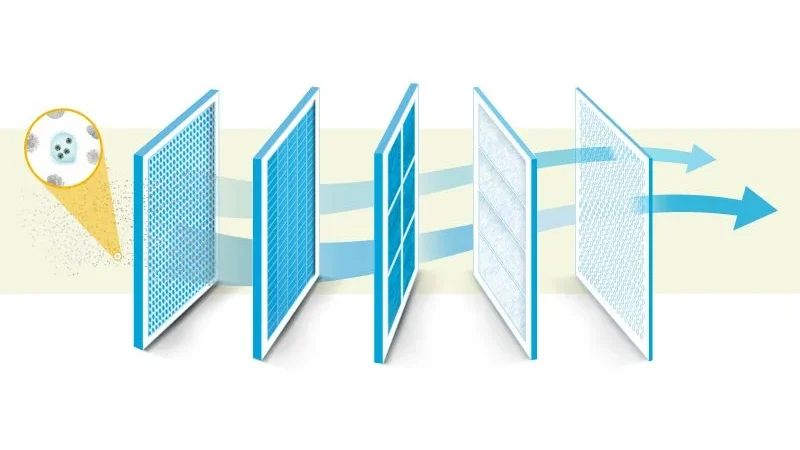
HEPA (High-Efficiency Particulate Air) filtration removes dust, pollen, pet dander, mold spores (2-10µm), bacteria (0.2-2.0µm), and virus carriers (0.02-0.3µm) through mechanical capture—not chemical destruction. The randomly arranged glass or synthetic fibers create a tortuous pathway where three mechanisms work simultaneously: impaction (large particles collide with fibers), interception (medium particles touch fibers), and diffusion (tiny particles zigzag randomly until hitting fibers).
The 0.3-micron specification represents the Most Penetrating Particle Size (MPPS)—the hardest to capture. Larger particles (pollen, dust) are trapped more efficiently through impaction. Smaller particles (smoke, viruses) are captured more efficiently through diffusion. Research confirms HEPA efficiency increases for particles both smaller and larger than 0.3µm, meaning virus-sized particles (0.1µm) are captured at >99.99% efficiency.
But HEPA has critical limitations: no removal of gases, VOCs, or odors. Chemical pollutants pass through mechanical filtration untouched, requiring activated carbon for gaseous contaminant removal.
This guide explains exactly how HEPA filtration improves air quality, reveals what “True HEPA” means versus marketing deceptions like “HEPA-type,” and determines when HEPA alone suffices versus when additional technologies (carbon, UV-C, ionization) provide meaningful benefits.
What Makes a Filter “True HEPA”
Strict standards define HEPA—not all “HEPA” claims are legitimate.
Official HEPA Definition
U.S. Department of Energy (DOE) standard: Must remove ≥99.97% of particles at 0.3 microns in diameter.
European/ISO standard: Must remove ≥99.95% of particles at Most Penetrating Particle Size (MPPS, typically 0.1-0.2µm).
Key distinction: These are minimum efficiency requirements—actual performance often exceeds standards.
Construction Requirements
Material: Densely packed glass or synthetic fibers randomly arranged creating tortuous air pathway Pleating: Multiple folds increasing surface area (reduces pressure drop while maintaining capture) Sealed housing: No air bypass around filter—all air must pass through media
Testing: Each True HEPA filter tested and certified meeting DOE/ISO standards.
The Three Capture Mechanisms Explained
HEPA doesn’t work like a sieve with holes smaller than particles—it uses three simultaneous mechanical processes.
Mechanism 1: Impaction (Large Particles >1µm)
How it works: Large, heavy particles (dust, pollen, mold spores) suspended in airflow have inertia. As airstream curves around filter fibers, particles cannot change direction quickly—they continue straight, collide directly with fibers, and become trapped.
Why it works: Larger particles = more mass = more inertia = less ability to follow airflow contours.
Effectiveness: Increases with particle size and airflow velocity. Faster air = less time for particles to adjust trajectory = more collisions.
Captured particles: Pollen (15-100µm), dust (5-100µm), large mold spores (10-30µm), pet hair fragments, carpet fibers.
Mechanism 2: Interception (Medium Particles 0.3-1µm)
How it works: Medium-sized particles follow airstream closely but pass within one radius of a fiber. When particle edge contacts fiber surface, adhesion forces (van der Waals, electrostatic) trap it permanently.
Why it works: Particles small enough to follow air contours but large enough that airflow brings them close to fibers. Combined with fiber density, high probability of contact.
Effectiveness: Depends on fiber spacing and air velocity. Slower airflow gives particles more time near fibers.
Captured particles: Small mold spores (2-5µm), bacteria (0.5-2µm), dust mite allergens (2-10µm), pet dander (2.5-10µm).
Mechanism 3: Diffusion (Small Particles <0.3µm)
How it works: Ultra-small particles exhibit Brownian motion—collisions with air molecules cause random zigzag movement superimposed on airflow direction. This erratic path dramatically increases probability particle will hit and stick to fiber.
Why it works: Smaller particles = more affected by molecular collisions = more random motion = longer time in filter = more fiber contacts.
Effectiveness: Increases as particles get smaller and airflow slows. Slower air = more time for diffusion to act.
Captured particles: Viruses (0.02-0.3µm), virus-carrying droplet nuclei (0.1-1µm), combustion particles (0.01-0.3µm), smoke (0.1-1µm), bacteria (smallest species 0.2-0.5µm).
Critical insight: Research confirms “the smaller the particle, the higher the removal efficiency due to the diffusion filtration mechanism”—HEPA captures viruses (0.1µm) better than 0.3µm particles.
Why 0.3 Microns Is the Hardest Particle Size
The Most Penetrating Particle Size (MPPS) represents the efficiency valley where all mechanisms are weakest.
The Efficiency Curve
At 0.3µm:
- Too small for impaction to work efficiently
- Too large for strong diffusion effects
- Interception works but at reduced efficiency
Result: 0.3µm particles have highest penetration probability through filter—hence testing at this size ensures capture of all sizes.
Actual MPPS
Research finding: True MPPS is typically 0.1-0.2µm, not 0.3µm. Testing at 0.3µm provides conservative estimate—actual worst-case performance occurs at slightly smaller sizes.
Implication: If HEPA captures 99.97% at 0.3µm (testing size), it captures >99.99% at 0.1µm (true MPPS) where diffusion dominates.
The Efficiency Curve: Better at Extremes
Counter-intuitive reality: HEPA efficiency increases for particles both smaller AND larger than MPPS.
Efficiency by Particle Size
0.01-0.1µm (viruses, combustion particles): 99.99%+ capture via diffusion 0.1-0.2µm (MPPS): 99.95-99.97% capture (lowest efficiency) 0.3µm (testing standard): 99.97% capture (specified minimum) 0.5-1.0µm (bacteria, small allergens): 99.98%+ capture 1-10µm (pollen, mold spores, dander): 99.99%+ capture via impaction >10µm (dust, large particles): Essentially 100% capture
Graph visualization: U-shaped efficiency curve with dip at MPPS (0.1-0.3µm range), rising steeply on both sides.
Research confirmation:“Particles that are larger or smaller are trapped with even higher efficiency” than the 99.97% standard at 0.3µm.
What HEPA Captures (and What It Doesn’t)
Understanding limitations prevents unrealistic expectations.
What HEPA Removes (Particulates)
Allergens:
- Pollen (15-100µm): >99.99%
- Dust mite allergens (2-10µm): 99.99%
- Pet dander (2.5-10µm): 99.99%
- Cockroach particles (5-20µm): >99.99%
Biological:
- Mold spores (2-100µm depending on species): 99.97-99.99%
- Bacteria (0.2-10µm): 99.97-99.99%
- Viruses attached to particles (0.02-0.3µm): >99.99%
Smoke and combustion:
- Tobacco smoke (0.01-1µm): 99.95-99.99%
- Wildfire smoke PM2.5 (0.1-2.5µm): 99.97%+
- Soot and ash (0.01-10µm): 99.97%+
Dust and particles:
- House dust (0.5-100µm): 99.99%+
- Construction dust (1-100µm): 99.99%+
What HEPA DOESN’T Remove
Gases and vapors:
- VOCs (formaldehyde, benzene, toluene): 0% removal
- Odors (cooking, musty, pet): 0% removal
- Ozone: 0% removal
- Carbon monoxide: 0% removal
- Nitrogen dioxide: 0% removal
Why: HEPA is mechanical filtration capturing particles. Gas molecules (0.0001-0.001µm) are far too small—they pass through fiber gaps freely.
Solution:Activated carbon filters required for gases/odors. True indoor air quality improvement requires HEPA + carbon combination.
HEPA vs HEPA-Type vs HEPA-Like: The Marketing Deception
Not all “HEPA” claims are legitimate—manufacturers exploit consumer ignorance.
True HEPA
Definition: Meets DOE standard—removes ≥99.97% at 0.3µm Certification: Tested and verified Labeling: “True HEPA,” “Genuine HEPA,” “HEPA H11-H14” Performance: Reliable, consistent
HEPA-Type / HEPA-Style
Definition: Does NOT meet DOE standard—typically 85-95% efficiency at 0.3µm Certification: None Labeling: “HEPA-type,” “HEPA-style,” “HEPA-like,” “99% HEPA” Performance:Significantly inferior to True HEPA
Research warning:“Key difference is that these ‘HEPA-like’ filters don’t meet the same criteria…which requires filtration efficiency of 99.97%.”
Marketing deception: Manufacturers use “HEPA” terminology hoping consumers assume equivalence. They’re not equivalent.
How to Identify True HEPA
Certification marks: Look for DOE, ISO, or EN standards referenced Specific efficiency claim: “99.97% at 0.3 microns” (exact wording matters) Grade designation: H11, H12, H13, H14 indicates true HEPA Price indicator: True HEPA costs more—$30-100 for replacement filters. <$15 “HEPA-type” are not genuine.
Consumer advice:Avoid any filter not explicitly stating “True HEPA” or “99.97% at 0.3 microns.” Marketing terms like “HEPA-type” are deceptive.
Filter Grades: H11, H12, H13, H14 Explained
European EN 1822 standard classifies HEPA into grades based on efficiency and leak tolerance.
Grade Definitions
H11 (EPA): 95% efficiency at MPPS—technically “Efficient Particulate Air” not HEPA H12 (EPA): 99.5% efficiency at MPPS H13 (True HEPA):99.95% efficiency at MPPS (meets True HEPA standard) H14 (True HEPA):99.995% efficiency at MPPS
ULPA (Ultra-Low Penetration Air):U15: 99.9995% efficiency U16: 99.99995% efficiency U17: 99.999995% efficiency
Which Grade Do You Need?
Residential use:H13 sufficient for virtually all home air quality needs Medical/pharmaceutical: H14 for operating rooms, cleanrooms Research/industrial: U15-U17 for specialized applications (semiconductor, nuclear)
Reality check:“H13 HEPA filters will provide sufficient filtration without unnecessary complexity and expense” for homes and most commercial spaces.
Don’t overspend: H14/ULPA filters cost 2-3x more, create higher pressure drop (reducing airflow), and provide negligible practical benefit over H13 in residential applications.
Pressure Drop: The Trade-Off for High Efficiency
Dense fiber matrix capturing particles also resists airflow—the fundamental limitation of HEPA filtration.
What Is Pressure Drop
Definition: Resistance to airflow measured in inches water column (in. w.g.) or Pascals (Pa).
Typical HEPA pressure drop:
- H13 (clean): 0.25-0.40″ w.g. (60-100 Pa)
- H13 (dirty, end-of-life): 0.50-0.80″ w.g. (125-200 Pa)
Consequence: HVAC blower or air purifier fan must work harder to move air through HEPA—increased energy consumption, reduced airflow, or both.
Managing Pressure Drop
Larger filter surface area: More pleats, deeper filters—spreads airflow across larger area reducing velocity and pressure drop per square inch
Pre-filters: Capture large particles before HEPA, preventing rapid loading and pressure increase
Appropriate fan sizing: Powerful enough to overcome HEPA resistance while delivering target CFM
Regular replacement: Dirty filters create exponentially higher pressure drop—timely replacement maintains performance
Filter Lifespan and Maintenance
HEPA filters have finite life—understanding replacement timing prevents performance degradation.
Replacement Indicators
Time-based: 6-24 months depending on usage and environment
- High-pollution areas (wildfire zones, traffic): 6-12 months
- Normal residential: 12-18 months
- Low-pollution (rural, minimal use): 18-24 months
Performance-based:
- Visibly dirty/discolored
- Reduced airflow from purifier
- Pressure gauge (if equipped) showing high differential
- Air quality monitor showing reduced capture
Why HEPA Filters Aren’t Washable
“True HEPA filters are NOT washable”—washing damages fiber structure and removes electrostatic charges (if present), dramatically reducing efficiency.
Marketing scam: Some manufacturers claim “washable HEPA”—these are HEPA-type (not True HEPA) with reduced efficiency that degrades further after washing.
When Pre-Filters Extend HEPA Life
CDC research:“One or more low-efficiency disposable prefilters…may extend HEPA filter life sometimes at least 25%.”
Pre-Filter Strategy
Placement: Before HEPA filter (air passes through pre-filter first)
Function: Captures large particles (hair, lint, large dust) preventing HEPA loading with easily-captured material
Type: MERV 6-8 typically—captures >90% of particles >10µm while maintaining low pressure drop
Cost benefit: $5-10 pre-filter replaced monthly extends $50-100 HEPA lifespan 25%—saves $12-25/year
Common Implementation
Portable air purifiers: Many quality models include washable pre-filter (mesh or foam) capturing visible particles HVAC systems: MERV 8 furnace filter ahead of HEPA media cabinet performs pre-filtration
True HEPA vs ULPA: When Ultra-Low Penetration Matters
ULPA (99.999%+) exceeds HEPA specifications—but rarely necessary outside specialized applications.
ULPA Advantages
Higher efficiency: 99.999% vs HEPA’s 99.97% at MPPS Regulatory compliance: Some industries (semiconductor, pharmaceutical) require ULPA
ULPA Disadvantages
Higher pressure drop: 50-100% more resistance than HEPA—requires more powerful fans, higher energy costs Higher cost: Filters cost 2-3x HEPA; installation/operation more expensive Diminishing returns: For home IAQ, HEPA capturing 99.97% vs ULPA’s 99.999% makes no practical difference
Research consensus:“HEPA filters combined with additional technologies…offer highly effective…solution…ULPA filters…are often overkill…and do not justify additional costs in most cases.”
Residential verdict: Use True HEPA (H13). ULPA unnecessary expense providing negligible benefit.
HEPA + Activated Carbon: The Complete Solution
HEPA addresses particles; carbon addresses gases—combination required for comprehensive air quality.
Why Both Are Needed
Indoor pollution has two types:
- Particulates (dust, allergens, bacteria, smoke particles): Removed by HEPA
- Gases (VOCs, formaldehyde, odors, NO2, ozone): Removed by activated carbon
Reality: Most indoor air quality concerns involve both—cooking (particles + odors), smoking (particles + gases), off-gassing (minimal particles + VOCs), mold (spores + MVOCs).
Activated Carbon Function
Mechanism: Adsorption—VOCs and gases adhere to massive carbon surface area (1 gram = ~3,000 m² surface area)
Effectiveness: Captures formaldehyde, benzene, toluene, cooking odors, pet odors, smoke gases, ozone, NO2
Limitation:Saturates—once carbon pores filled, stops working. Requires replacement every 6-12 months.
Optimal Configuration
HEPA-first design: Air passes through carbon, then HEPA
- Carbon captures gases
- HEPA captures particles
- Nothing bypasses filtration
Sufficient carbon mass: Minimum 5-10 lbs for residential purifiers—thin carbon “sheets” (<1 lb) provide minimal benefit
HEPA + UV-C or Ionizers: Worth It?
Some purifiers add technologies claiming enhancement—evidence shows mixed value.
UV-C Light
Theory: Ultraviolet-C damages microbial DNA, killing bacteria/viruses
Reality in HEPA systems:Minimal benefit—particles already captured at 99.97%+ by HEPA. UV exposing already-trapped particles provides negligible additional protection.
Better UV use: Upstream of HEPA (air sterilization before filtration), but requires sufficient exposure time most residential units don’t provide.
Downsides: UV degrades HEPA fibers over time, increases energy costs, adds complexity
Verdict:Not worth it in residential HEPA purifiers—HEPA alone captures microbes effectively.
Ionizers
Theory: Charged particles clump together, become easier to capture
Reality:Avoid entirely—ionizers produce ozone (respiratory hazard), cause particles to deposit on surfaces (not capture), and provide minimal efficiency boost while creating health risks.
Research warning: Studies document “dangers of ionizers as they create air pollution” including ozone, secondary PM2.5, and harmful VOCs.
Verdict:Actively harmful—never use ionizers even if built into purifier. Disable if possible.
Comparison Table: HEPA Capabilities and Limitations
| Pollutant Type | Size Range | HEPA Capture Efficiency | Notes |
|---|---|---|---|
| Pollen | 15-100µm | >99.99% | Excellent capture via impaction |
| Dust mite allergens | 2-10µm | 99.99% | Easily captured |
| Pet dander | 2.5-10µm | 99.99% | Highly effective |
| Mold spores | 2-100µm | 99.97-99.99% | Captures all species |
| Bacteria | 0.2-10µm | 99.97-99.99% | Mechanical capture regardless of viability |
| Viruses (attached to particles) | 0.02-0.3µm | >99.99% | Diffusion mechanism highly effective |
| Smoke particles | 0.01-1µm | 99.95-99.99% | PM2.5 well-captured |
| PM2.5 | <2.5µm | 99.97%+ | Meeting EPA/WHO concerns |
| PM10 | <10µm | >99.99% | Easily captured |
| VOCs (formaldehyde, benzene) | Gas molecules | 0% | Require activated carbon |
| Odors (cooking, pet, musty) | Gas molecules | 0% | Require activated carbon |
| Ozone | Gas molecule | 0% | Passes through freely |
| CO, NO2 | Gas molecules | 0% | Not captured by HEPA |
Critical takeaway: HEPA excels at particulates (99.97%+) but provides zero removal of gases/odors requiring carbon supplementation for complete IAQ.
HEPA Delivers on Particle Capture—But Isn’t Magic
HEPA filters genuinely improve indoor air quality by removing 99.97% of particles at 0.3 microns—and even higher efficiency (99.99%+) for both larger particles (pollen, dust, mold) and smaller particles (viruses, smoke) due to complementary capture mechanisms where impaction dominates above 1µm, diffusion dominates below 0.3µm, and interception fills the gap. Research confirms this counter-intuitive reality: “the smaller the particle, the higher the removal efficiency due to the diffusion filtration mechanism,” meaning virus-sized particles (0.1µm) are captured more efficiently than the 0.3µm testing standard. But this mechanical excellence comes with inherent limitations—HEPA provides zero removal of gases, VOCs, and odors that pass through fiber gaps as molecular-sized pollutants, requiring activated carbon for comprehensive air quality addressing both particulate and gaseous contamination.
Your action framework rejects marketing deception. Purchase only True HEPA (H13 minimum) explicitly stating “99.97% at 0.3 microns”—avoid “HEPA-type,” “HEPA-style,” or “99% HEPA” filters that capture only 85-95% of particles with deliberately misleading terminology. For residential use, H13 HEPA suffices; H14 and ULPA cost 2-3x more while providing negligible practical benefit since 99.97% capture already approaches theoretical maximum effectiveness. Prioritize HEPA + activated carbon combination over HEPA alone—particles matter, but so do VOCs from furniture, formaldehyde from materials, cooking odors, and chemical pollutants requiring carbon adsorption that HEPA cannot provide. Skip UV-C additions (minimal benefit since particles already captured) and definitely avoid ionizers (produce harmful ozone while providing questionable improvements).
The informed consumers getting real IAQ improvements from HEPA understand proper sizing (CADR matching room volume for 4-6 air changes hourly), pre-filter use extending HEPA lifespan 25%+ through capturing large particles before HEPA loading, and timely replacement every 12-24 months preventing performance degradation as filters saturate. They recognize that pressure drop inevitably increases as HEPA captures particles—dirty filters create exponentially higher resistance explaining reduced airflow or increased energy consumption signaling replacement need. Most importantly, they evaluate HEPA within context—it excels at documented particulate capture (allergens, mold, bacteria, smoke) while providing zero gas removal, making it part of complete IAQ strategy rather than standalone solution.
Take action correctly this week. If buying air purifier, verify True HEPA certification (99.97% at 0.3µm explicitly stated), confirm activated carbon inclusion with ≥5 lbs media for odor/VOC capture, check CADR provides 4-6 ACH for target room, and avoid ionizer-equipped models. If already owning HEPA purifier, examine filter—if visibly dirty, discolored, or >18 months old, replace immediately since dirty HEPA creates high pressure drop while providing reduced capture. Your goal isn’t theoretical perfection (99.999% ULPA) costing 3x more—it’s proven 99.97% HEPA mechanical capture combined with carbon gaseous removal providing comprehensive improvement addressing actual indoor pollution sources affecting respiratory health without falling for marketing claiming HEPA kills viruses (it captures them), eliminates odors (carbon does this), or needs UV-C enhancement (it doesn’t).
Frequently Asked Questions
Does HEPA filter remove viruses?
Yes—captures virus-carrying particles at >99.99% efficiency. Viruses (0.02-0.3µm) attach to respiratory droplets or travel on dust particles that HEPA captures. Research confirms “diffusion mechanism provides very effective means of removing very small particles, such as viruses” and “the smaller the particle, the higher the removal efficiency.” HEPA doesn’t kill viruses but mechanically traps them preventing circulation. Captured viruses remain in filter harmlessly.
What’s difference between True HEPA and HEPA-type?
True HEPA meets DOE standard (99.97% at 0.3µm); HEPA-type does NOT (typically 85-95% efficiency). HEPA-type is marketing term exploiting consumer confusion—“key difference is these ‘HEPA-like’ filters don’t meet same criteria…which requires 99.97%.” True HEPA costs more ($30-100 replacement) but provides documented performance. HEPA-type (<$15) significantly inferior. Always verify “True HEPA” or “99.97% at 0.3 microns” explicitly stated.
Can HEPA filters be washed and reused?
No—True HEPA filters are NOT washable. Washing damages fiber structure, removes electrostatic charges (if present), and dramatically reduces efficiency. Research states “filters should be inspected and changed…every two to three years” in residential settings, not washed. “Washable HEPA” claims indicate HEPA-type (not True HEPA) with inferior performance further degraded by washing. Budget for replacement filters; don’t attempt washing.
Does HEPA remove odors and VOCs?
No—HEPA captures particles, not gases. VOCs (formaldehyde, benzene), odors (cooking, pet, musty), and gases (ozone, NO2) are molecular-sized passing through HEPA freely. HEPA provides 0% removal of gaseous pollutants. For comprehensive IAQ, use HEPA + activated carbon combination—HEPA captures particles (allergens, mold, bacteria), carbon adsorbs gases/odors. Many quality purifiers integrate both technologies addressing both pollutant types.
How often should HEPA filter be replaced?
Every 12-24 months in residential use; sooner in high-pollution environments (wildfire zones, urban traffic areas). Replace when: visibly dirty/discolored, reduced airflow noted, 18 months elapsed, or air quality monitoring shows decreased effectiveness. Pre-filters extend HEPA life “at least 25%” per CDC research—replace pre-filters monthly, HEPA annually. Don’t exceed 24 months regardless of appearance; internal loading not visible reduces efficiency before external discoloration obvious.