
Bottom Line Up Front: You don’t have to choose between fresh air and a warm apartment. The real problem isn’t ventilation itself — it’s how most people ventilate. Cracking a window wide open in January hemorrhages heat. But doing nothing lets CO2 climb past 1,500 ppm, which is the point where your brain starts operating like it’s running on low battery. There’s a smarter middle path, and most guides never bother to explain it.
Why CO2 Builds Up Faster in Winter Apartments Than You Think
Every breath you exhale dumps roughly 40,000 ppm CO2 into the air around you. In a sealed apartment in January, that CO2 has nowhere to go. Outdoor air is typically around 420 ppm CO2 — your indoor air can hit three to four times that within just a few hours of normal activity in a tightly sealed space.
The reason winter is so much worse than summer isn’t just that windows stay closed. It’s that modern weatherstripping, draft excluders, and insulation upgrades have made apartments genuinely airtight — which is great for your heating bill, terrible for air quality. A well-sealed 600-square-foot apartment with two people cooking dinner can breach 1,000 ppm CO2 in under two hours.
That 1,000 ppm threshold matters because it’s where cognitive effects start showing up in research — reduced concentration, slower decision-making, that vague afternoon fog people chalk up to being tired. You’re not tired. You’re breathing stale air.
What’s the Actual Safe CO2 Level for an Apartment?
The target most indoor air quality professionals work toward is keeping CO2 below 800 ppm — that’s roughly twice outdoor levels and well within the comfort zone for cognitive performance. ASHRAE Standard 62.1 uses CO2 as a proxy for overall ventilation adequacy, and most guidance treats anything above 1,100 ppm as a sign your ventilation is genuinely inadequate.
What surprises people is that 1,100 ppm isn’t some extreme reading — it’s routine in bedrooms with doors closed overnight. A couple sleeping in a 150-square-foot bedroom with the door shut can push CO2 past 2,000 ppm by morning. That explains the heavy, groggy feeling that a full night’s sleep somehow doesn’t fix.
Here’s the nuance that depends heavily on your situation: how quickly CO2 builds up is a function of room volume, number of occupants, and activity level. A solo person reading quietly in a 300-square-foot studio will take much longer to hit problematic levels than two people doing a workout video in the same space. Knowing your specific conditions changes what ventilation strategy actually makes sense for you.
| CO2 Level (ppm) | What It Means | Action Needed |
|---|---|---|
| 400–600 ppm | Excellent — close to outdoor air quality | None |
| 600–1,000 ppm | Acceptable for most activities | Monitor, ventilate periodically |
| 1,000–1,500 ppm | Noticeable cognitive effects begin | Ventilate now |
| Above 1,500 ppm | Significant impairment, fatigue, headaches | Immediate ventilation required |
The Thing Most CO2 Guides Get Wrong About How to Reduce CO2 in Apartments
Almost every article on this topic tells you to “open a window for a few minutes.” That advice isn’t wrong exactly — but it completely misses the mechanism that makes winter ventilation actually efficient. The goal isn’t air exchange for its own sake. It’s targeted air exchange that removes CO2 without stripping the thermal mass from your rooms.
Here’s what most guides skip: CO2 is lighter than you might expect relative to air (it’s close to the same density as air at room temperature), but the mixing dynamics in a room mean it concentrates near breathing height — especially in low-airflow zones like bedrooms and corners. Randomly cracking a window across the apartment doesn’t address the pockets of stale air where you actually spend time.
The underexplored angle is cross-ventilation pulses: short, intentional bursts of airflow designed to flush room air quickly without prolonged heat loss. Physics works in your favor here. Opening two windows on opposite sides of your apartment for just 3–5 minutes creates a pressure differential that exchanges a surprising amount of air — far more efficiently than leaving one window open for an hour. You lose a bit of heat fast, then your radiator or heater recovers it within 15 minutes. Net heat loss is minimal. Net CO2 reduction is significant.
“The thermal penalty of a brief, cross-ventilation flush is often overstated. A 4-minute full exchange drops indoor temperature by 1–2°C in most apartments, and mechanical heating recovers that within 10–15 minutes. Compare that to leaving a window ajar for hours — that’s where you actually lose heat. Short, deliberate purges are genuinely efficient.”
Dr. Elena Marchetti, Indoor Environmental Quality Researcher, Department of Building Science, Politecnico di Milano
How to Reduce CO2 in an Apartment Without Turning It Into an Icebox
The strategy that actually works combines three things: measurement, timed pulses, and targeted airflow. Doing any one of these without the others is where most people get frustrated and give up.
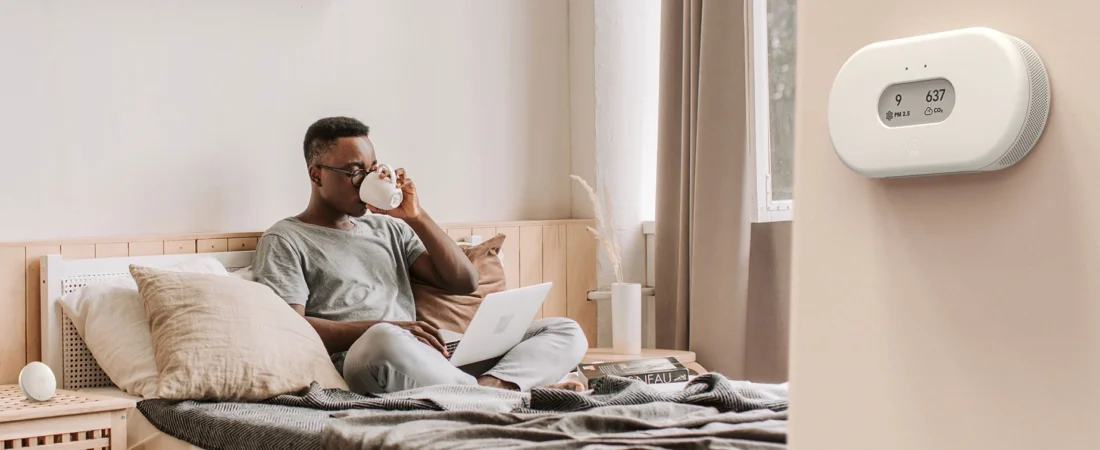
- Get a CO2 monitor and actually use it. You cannot manage what you can’t measure. A decent CO2 monitor costs $40–$80 and will immediately show you when and where your air goes bad. Place it at seated breathing height — not on a high shelf where readings are artificially lower — and check it before you ventilate, not just when you feel stuffy.
- Do timed cross-ventilation pulses, not passive window cracking. Open two windows on opposite sides of your apartment fully for 3–5 minutes. Do this when CO2 hits 900–1,000 ppm, not when it hits 1,500. Prevention is dramatically cheaper in heat terms than recovery. Close everything after the pulse and let your heating system catch up.
- Ventilate your bedroom separately before sleep. CO2 builds fastest in closed bedrooms overnight. A 3-minute bedroom flush right before you go to sleep — window open, door open, creating airflow — can keep levels manageable until 3–4 AM, which covers the deepest sleep stages when air quality matters most for recovery.
- Use your kitchen exhaust fan strategically. Most people run the kitchen fan only while cooking. But a kitchen fan exhausting to the outside creates negative pressure that draws fresh air in through any available gap — window weatherstripping, under doors, mail slots. Running it for 10 minutes after cooking, when CO2 is peaking from the combination of combustion and occupants, can drop levels meaningfully without any window opening.
- Consider a heat recovery ventilator (HRV) or energy recovery ventilator (ERV) if you control your HVAC. This is the permanent fix. An HRV continuously exchanges indoor and outdoor air while recovering 70–90% of the heat from the exhaust stream. It’s expensive to install ($800–$2,500 depending on system), but if you own your unit or have a cooperative landlord, it eliminates the ventilation-vs-heat tradeoff entirely.
Does Opening Windows in Winter Actually Lose That Much Heat?
This is where the math genuinely surprises people. A typical apartment loses heat through its walls, floors, and ceiling continuously — that’s just physics. The additional heat loss from a 4-minute full window flush in a 500-square-foot apartment is roughly equivalent to running a 1,500-watt space heater for 3–4 minutes. Your heating system is likely already running to compensate for ongoing losses, and recovering from a brief flush is within its normal operating range.
Where people go wrong is leaving windows cracked slightly open for hours, thinking this is gentler. It’s not. A 1-centimeter gap in a window creates a slow, continuous heat drain that costs far more over 4 hours than a 5-minute wide-open flush. The counterintuitive truth here is that more open, for less time is thermally more efficient than slightly open for a long time.
That said, this depends on your climate. If you’re in a place where outdoor temperatures regularly hit -15°C or below, even brief flushes carry a steeper thermal cost. In those conditions, you’ll want to lean harder on mechanical solutions — the kitchen exhaust trick, bathroom fans, or an HRV — rather than direct window ventilation.
What About CO2-Absorbing Plants — Do They Actually Help?
Plants absorb CO2. That’s a true statement. But the scale is almost comically insufficient for apartment-level CO2 control. A single adult human at rest exhales roughly 200 liters of CO2 per hour. A medium-sized houseplant absorbs maybe 5 liters per hour under decent light conditions. You’d need somewhere between 40 and 100 plants per person to offset CO2 meaningfully — and in winter, with reduced light, their absorption rate drops further.
Plants are worth having for other reasons — humidity regulation, VOC absorption in small quantities, general wellbeing. But if you’re counting on your snake plant to fix a CO2 problem, it’s not going to happen. Don’t skip ventilation because you have a plant collection.
The one honest caveat: if you have a very large number of actively growing plants under grow lights in a dedicated room, CO2 levels in that specific room can be measurably lower during light hours. It’s not zero effect — it’s just not remotely adequate as a whole-apartment strategy.
Which Rooms Build Up CO2 the Fastest — and Where to Focus First
Not all rooms are equal when it comes to CO2 accumulation. The rate depends on room volume, number of occupants, and — critically — whether the door is open or closed. Understanding which rooms spike first lets you prioritize where and when to ventilate, rather than treating the whole apartment as one unit.
- Bedroom (door closed): The fastest buildup zone, especially overnight. Two adults in a 150-square-foot bedroom with the door closed can push past 1,500 ppm in under 3 hours.
- Home office (door closed, one person working): Often underestimated. A solo worker in a small office hits 1,000 ppm within 90 minutes, and sustained exposure throughout a workday compounds fatigue significantly.
- Living room (open plan): The largest volume, lowest concentration per person. CO2 rises more slowly here — typically 2–3 hours before reaching 1,000 ppm with 2–3 people — but still needs periodic flushing.
- Kitchen during cooking: CO2 spikes fast from gas combustion and occupant activity combined. Always run the exhaust fan during and after cooking, not just to remove cooking odors.
- Bathroom: Short occupancy, and exhaust fans are standard. Not a primary CO2 concern, but running the fan correctly matters for overall apartment airflow dynamics.
Pro-Tip: Keep your bedroom door cracked open at least 2–3 centimeters while sleeping rather than fully closed. This alone — at zero heat cost — can reduce overnight bedroom CO2 accumulation by 20–30% by allowing slow mixing with the larger apartment volume. It’s not as good as ventilation, but it extends the time before a problem develops.
Can Air Purifiers Help Reduce CO2 in an Apartment?
Short answer: no. Air purifiers — even high-end HEPA and activated carbon models — do not remove CO2. This is one of the most persistent misconceptions in the indoor air quality space. HEPA filters capture particulates. Activated carbon captures certain gases, VOCs, and odors. Neither has any meaningful effect on CO2 concentration.
There are experimental direct air capture technologies that do absorb CO2, but they’re not consumer air purifiers, they’re industrial-scale or research equipment. If you see a consumer product claiming to reduce CO2 meaningfully, that claim is doing a lot of work that the physics doesn’t support.
What air purifiers do help with is reducing particulates, allergens, and some chemical off-gassing — all legitimate reasons to run one in winter when windows stay closed. Just don’t mistake cleaner-feeling air for lower CO2. Those are completely different measurements.
How to Set Up a Winter Ventilation Routine That You’ll Actually Stick To
The biggest failure mode with apartment CO2 management isn’t ignorance — people know they should ventilate. It’s that ventilation feels reactive and uncomfortable, so it gets skipped on cold days until the air is noticeably bad, at which point fixing it requires extended exposure to cold. Building a proactive routine around CO2 readings changes this entirely.
A practical setup for a typical one or two-bedroom apartment looks like this: check your CO2 monitor when you wake up and before you start work. If it’s above 800 ppm, do a 3-minute pulse. Do the same before bed in the bedroom specifically. For a home office, set a timer for a 3-minute ventilation break every 90 minutes — this aligns neatly with natural concentration cycles anyway, so you’re not losing work time.
The trick is treating the CO2 reading like you treat your phone battery — not something you ignore until it hits 5%. Once the habit forms, the actual time spent managing ventilation is under 10 minutes per day, and the cognitive and sleep quality difference is something most people notice within the first week.
What If You Can’t Open Windows Due to Noise, Cold, or Landlord Rules?
Apartments near busy roads, in extremely cold climates, or with landlords who’ve restricted window modifications present real constraints. This is where mechanical ventilation becomes non-optional rather than optional. A few options exist depending on your setup and what you’re allowed to modify.
Trickle vents — small, adjustable ventilation gaps built into window frames — are common in European construction and can be retrofitted in some window types. They allow a continuous, low-volume fresh air supply without full window opening, typically losing 15–25% less heat than a cracked window while still providing meaningful air exchange over time.
For apartments where you control nothing, the bathroom exhaust fan becomes your primary tool. Running it for 15 minutes every 2 hours creates continuous negative pressure that draws fresh air in through whatever gaps your building envelope has — and almost every apartment has more gaps than you’d think. It won’t get you to 600 ppm, but it can meaningfully slow the rise to problem levels. Combine that with keeping interior doors open and you’ve created the best passive system available without any modifications.
How to Tell If Your Ventilation Strategy Is Actually Working
Feeling better isn’t a reliable measurement — you adapt to slightly elevated CO2 levels the same way you stop noticing a smell after a few minutes. Accurate feedback requires a CO2 monitor, and knowing how to interpret the readings over time tells you far more than any single measurement.
What you’re looking for is the rate of rise, not just the peak. If your apartment starts at 420 ppm after a morning flush and hits 900 ppm in 4 hours with normal occupancy, your ventilation frequency is about right. If it hits 900 ppm in 90 minutes, you need to ventilate more often or address a specific high-CO2 zone. Most monitors log readings over time — use that data.
A well-functioning winter ventilation strategy should keep daily averages below 800 ppm and peaks below 1,100 ppm even on the coldest days. If you’re consistently seeing 1,200–1,500 ppm despite ventilating, your air exchange rate is still too low, and you need a different strategy — either more frequent pulses, mechanical assist, or addressing specific CO2 hotspots like a closed bedroom or home office.
The real measure of success isn’t what the monitor shows during the 3 minutes after you ventilate. It’s what it shows 2 hours later. That’s the number that reflects your actual indoor air quality — and the air your body is living in every day this winter.
Frequently Asked Questions
How can I reduce CO2 in my apartment without opening windows in winter?
Install ERV/HRV recovering 70-95% heat energy while providing continuous fresh air—reduces bedroom CO2 from 2,500 ppm to <1,000 ppm without energy penalty. Research confirms these systems “capture heat from outgoing air and transfer to incoming air, reducing heating load.” Cost: $3,500-6,500 installed; $70-100/year operating; $300-500/year energy savings (cold climates). Alternatives: Continuous bathroom exhaust (25-30 CFM) + trickle vents (10-15 CFM) + door transfer grilles reducing CO2 to 1,200-1,500 ppm at ~$50-70/month energy cost. Window cracking 1-2″ causes only 2-4°F drop while cutting CO2 65-75% at ~$45/month.
Does cracking a window in winter waste a lot of heat?
Surprisingly minimal with small opening. 1-2 inch crack provides substantial ventilation (15-25 CFM reducing CO2 from 2,500 ppm → 600-900 ppm per research) while causing only 2-4°F steady-state temperature drop in well-insulated apartment—not the perceived 10°F. Energy cost: ~$1.50/night (8 hours) = $45/month. Physics: Small opening limits cold air infiltration rate; room thermal mass and heating system easily compensate. Compare to ERV: $5.67/month operating cost providing whole-apartment ventilation with 85% heat recovery. Window cracking effective interim solution, especially when outdoor temperature >15°F.
Should I get HRV or ERV for winter apartment ventilation?
ERV strongly recommended for most apartments. Both recover heat (70-95% efficient), but ERV additionally recovers ~70% moisture preventing winter desiccation. Previous articles documented cold outdoor air (20°F, 60% RH) contains minimal absolute moisture—when heated to 70°F becomes 3% RH (bone dry) if using HRV. ERV recovers indoor humidity maintaining comfortable 35-45% RH. Exception: If apartment has chronic excess moisture (poor drainage, high occupancy), HRV’s moisture removal beneficial—but fix moisture source first. Research confirms “ERVs prevent over-drying indoor air during colder months” making them superior choice for winter apartment applications.
How much does it cost to run an ERV continuously in winter?
Operating cost: 30-80W fan power = 60W average × 24hr × 365 days = 526 kWh/year × $0.13/kWh = $68/year ($5.67/month) electricity. Energy savings: 85% efficient ERV in cold climate saves $300-500/year in heating costs (recovering heat from exhaust air). Net result: Positive—saves $230-430/year while providing 24/7 fresh air maintaining bedroom CO2 <1,000 ppm. Payback: Entry system ($1,500 installed) pays back in 3.5-6.5 years; premium system ($5,000 installed) in 10-15 years (faster in colder climates with higher heating costs). Comparison: Window cracking achieves similar CO2 reduction at $45/month vs ERV $5.67/month operating.
Can renters install ERV in apartment?
Window-mounted: Yes—completely removable, no landlord permission needed. Install ERV in custom window panel like AC unit—remove when moving. Cost: $800-2,000 equipment + DIY installation. Performance: 40-70 CFM adequate for bedroom CO2 control. Through-wall: Requires landlord approval (4-6″ hole in exterior wall) but reversible when moving (patch hole). Cost: $1,500-3,000 installed. Ducted whole-apartment: Requires landlord approval (invasive renovation). Best for owner-occupied condos. Alternative: Optimize existing systems—continuous bathroom exhaust + trickle vents + door grilles + strategic window cracking provides meaningful improvement without installation.