
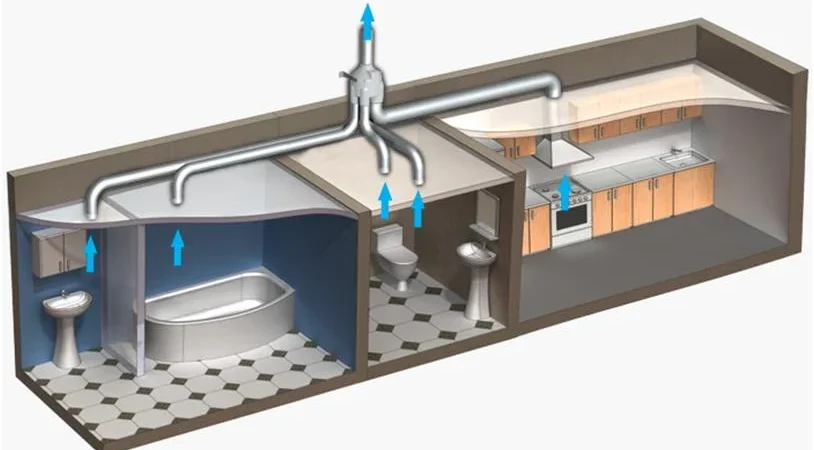
Your landlord installed an exhaust fan running 24/7 in your bathroom. Your upstairs neighbor has a supply ventilator bringing outdoor air into their unit continuously. Your colleague’s older apartment has neither—just windows they occasionally open. Who has adequate ventilation?
ASHRAE Standard 62.2 answers definitively: mechanical ventilation is mandatory for modern airtight apartments to maintain acceptable indoor air quality. The calculation is simple: 7.5 CFM per occupant plus 1% of floor area. An 800 sq ft apartment with 2 occupants requires 23 CFM continuous ventilation—far exceeding what window-opening behavior typically provides. Research confirms apartments built after 1990 are “quite likely to be tight enough to require mechanical ventilation systems” with typical airtightness below 7 ACH50 (air changes per hour at 50 Pascals pressure).
But older apartments present different reality. Pre-1980 construction averages 24 ACH50—so leaky that “infiltration alone” often meets ventilation requirements without mechanical systems. EPA notes U.S. housing stock is “often quite leaky and quite likely to meet requirements on infiltration alone.” The determining factor: building envelope airtightness measured by blower door test—not construction date assumptions. An apartment measuring <3 ACH50 requires full mechanical ventilation; one testing >12 ACH50 may need none as natural infiltration provides adequate air exchange.
This guide explains when mechanical ventilation transitions from optional to mandatory, calculates specific CFM requirements for typical apartment sizes, reveals why 2016 code changes extended ASHRAE 62.2 to multifamily buildings of any height (previous versions limited to 3 stories), and determines which ventilation strategies work for renters versus those requiring building-wide implementation by landlords under habitability codes.
What Is Mechanical Ventilation and Why It Matters
Mechanical ventilation uses fans to intentionally move air in/out of living spaces—distinct from natural ventilation relying on windows and building leakage.
The Three Air Exchange Pathways
Natural infiltration: Outdoor air entering through building envelope gaps—window frames, door seals, wall penetrations, duct leaks. Occurs passively due to pressure differentials (wind, stack effect, HVAC operation).
Natural ventilation: Outdoor air entering through intentionally opened windows and doors. User-controlled but dependent on occupant behavior, weather tolerance, outdoor air quality.
Mechanical ventilation: Outdoor air drawn in or indoor air exhausted by fans operating on schedule or continuously—independent of occupant behavior.
Why Mechanical Ventilation Became Necessary
Energy crisis response: 1970s oil embargo prompted airtight construction reducing energy waste from air leakage.
Unintended consequence: Tighter buildings trapped indoor pollutants—VOCs from furniture/materials, moisture from occupants, cooking emissions, CO2 from respiration.
Health impacts documented: Poor indoor air quality linked to “sick building syndrome” in 1980s—headaches, fatigue, respiratory issues in occupants of tight buildings with inadequate ventilation.
Building science solution:“Build tight, ventilate right”—construct airtight envelopes for energy efficiency, then provide controlled mechanical ventilation for indoor air quality. ASHRAE 62.2 codifies this approach.
ASHRAE 62.2 Requirements for Apartments
The residential ventilation standard defines minimum requirements.
Standard Overview
Full name: ANSI/ASHRAE Standard 62.2-2022, Ventilation and Acceptable Indoor Air Quality in Residential Buildings
Purpose:“Defines minimum requirements for mechanical and natural ventilation systems and building envelope intended to provide acceptable indoor air quality” in residences.
Scope: Applies to “dwelling units in single-family houses and multi-family structures, including manufactured and modular houses”—both new and existing buildings.
2016 extension: Previous versions limited to 3 stories or fewer; ASHRAE 62.2-2016 extended to multifamily buildings of any height, recognizing ventilation needs independent of building height.
Two Component Requirements
Whole-unit ventilation: Continuous or intermittent mechanical ventilation of entire dwelling unit diluting pollutants throughout space.
Local exhaust: Point-source ventilation in bathrooms and kitchens removing moisture and pollutants near generation before dispersing.
The Airtightness Factor: When Natural Infiltration Fails
Building envelope tightness determines mechanical ventilation necessity.
Measuring Airtightness: ACH50
Blower door test: Standard procedure (ASTM E779 or CGSB 149.10) measuring air leakage at 50 Pascals pressure difference.
Result:ACH50 (Air Changes per Hour at 50 Pa)—how many times total building air volume leaks out hourly when pressurized to 50 Pa.
Interpretation:
- ACH50 > 15: Very leaky (typical pre-1970)
- ACH50 10-15: Leaky (1970s-1980s average)
- ACH50 5-10: Moderate (1990s-2000s)
- ACH50 3-5: Tight (2000s-2010s quality construction)
- ACH50 < 3: Very tight (Passive House, modern high-performance)
The Infiltration Credit
ASHRAE 62.2 allowance: If envelope leakage measured, required mechanical ventilation can be reduced by calculating “infiltration credit” (Qinf)—natural air exchange from envelope leakage.
Calculation: Complex formula accounting for climate, building height, local shelter—typically reducing mechanical ventilation requirement 30-70% in leaky buildings.
Maximum credit: For new construction, infiltration credit limited to 2/3 of total required ventilation—at least 1/3 must be mechanical to ensure reliability.
When Infiltration Suffices
Research finding: U.S. housing stock averages ~24 ACH50—so leaky that many older buildings “quite likely to meet requirements on infiltration alone” without mechanical ventilation.
Threshold estimate: Buildings measuring >12-15 ACH50 typically achieve adequate natural air exchange via infiltration/window opening without continuous mechanical systems.
Modern reality: Buildings constructed after 1990 typically measure <7 ACH50—requiring mechanical ventilation as infiltration insufficient.
Calculating Your Apartment’s Required Ventilation Rate
ASHRAE 62.2 formula determines minimum continuous airflow.
Whole-Unit Ventilation Formula
Qtot = 7.5 CFM × (number of bedrooms + 1) + 0.01 × (floor area in sq ft)
Occupant assumption: Number of bedrooms + 1 determines occupants (e.g., 2BR apartment = 3 people assumed).
Example Calculations
Studio apartment (500 sq ft, 0BR):
- Qtot = 7.5 × (0 + 1) + 0.01 × 500
- Qtot = 7.5 + 5 = 12.5 CFM (round to 13 CFM)
1-bedroom apartment (700 sq ft):
- Qtot = 7.5 × (1 + 1) + 0.01 × 700
- Qtot = 15 + 7 = 22 CFM
2-bedroom apartment (1,000 sq ft):
- Qtot = 7.5 × (2 + 1) + 0.01 × 1,000
- Qtot = 22.5 + 10 = 32.5 CFM (round to 33 CFM)
3-bedroom apartment (1,400 sq ft):
- Qtot = 7.5 × (3 + 1) + 0.01 × 1,400
- Qtot = 30 + 14 = 44 CFM
After Infiltration Credit
If blower door test performed: Measured airtightness allows calculating infiltration credit (Qinf) reducing required mechanical ventilation (Qfan).
Qfan = Qtot – Qinf
Example: 1,000 sq ft 2BR apartment
- Qtot = 33 CFM (calculated above)
- Blower door result: 10 ACH50 (moderately leaky)
- Qinf calculated from formula: ~18 CFM credit
- Qfan = 33 – 18 = 15 CFM mechanical ventilation required
Very tight apartment example:
- Same apartment, 3 ACH50 (tight modern construction)
- Qinf: ~5 CFM credit
- Qfan = 33 – 5 = 28 CFM mechanical—most of requirement must be mechanical
Pre-1990 vs Post-1990 Construction: The Airtightness Divide
Construction era predicts ventilation needs.
Pre-1990 Construction Characteristics
Typical airtightness: 15-24 ACH50 average
Reasons for leakiness:
- Single-pane windows with poor seals
- Uninsulated or minimally insulated walls
- No air sealing in construction process
- Older HVAC duct systems with leaks
- Gaps around penetrations (electrical, plumbing)
Ventilation implications: Research notes these buildings “often quite leaky and quite likely to meet requirements on infiltration alone”—no mechanical ventilation needed if occupants occasionally open windows.
Indoor air quality: While leakage provides air exchange, uncontrolled infiltration brings extreme cold/heat, dust, outdoor pollutants—not optimal but prevents severe pollutant buildup.
Post-1990 Construction Characteristics
Typical airtightness: 3-7 ACH50
Reasons for tightness:
- Double or triple-pane windows with quality seals
- Air sealing protocols in construction (caulk, foam, tape)
- Insulated wall cavities
- Sealed HVAC ductwork
- Building codes emphasizing energy efficiency
Ventilation implications: Research confirms post-1990 buildings “quite likely to be tight enough to require mechanical ventilation systems” as infiltration alone insufficient.
Indoor air quality risk: Without mechanical ventilation, tight buildings trap pollutants creating elevated CO2, VOCs, moisture potentially causing mold, discomfort, health effects.
“Build Tight, Ventilate Right” Philosophy Explained
The cornerstone of modern building science.
The Energy Efficiency Imperative
Tight construction benefits:
- Reduced heating/cooling load (less conditioned air escaping)
- Lower energy bills
- Improved thermal comfort (no drafts)
- Better humidity control
- Quieter interiors (sound transmission reduced)
DOE goals: Zero Energy Ready Homes 50% more efficient than 2009 IECC—impossible without tight building envelopes.
The Indoor Air Quality Requirement
Tight buildings need dilution: Building science experts recognized “tight construction only possible with ensured dilution of indoor contaminants”—airtight envelopes without ventilation create uninhabitable environments.
ASHRAE 62.2 enabler: Standard provides “base standard for whole-house and spot ventilation” making tight construction viable—you can build airtight if you ventilate mechanically.
Win-win outcome: Achieve energy efficiency (tight envelope) AND healthy indoor air (mechanical ventilation)—not either/or compromise.
Four Types of Mechanical Ventilation for Apartments
Different strategies suit different needs and budgets.
Type 1: Exhaust-Only Ventilation
How it works: Continuously-running exhaust fan (bathroom, kitchen, or dedicated) removes stale indoor air, creating negative pressure drawing outdoor air through envelope leaks and intentional passive inlets.
Cost:Lowest—simple fan installation ($100-300 equipment, $200-500 labor)
Advantages:
- Simple installation
- Low equipment cost
- Prevents backdrafting into bathrooms
- Familiar technology (enhanced bath fan)
Disadvantages:
- Depressurizes apartment (may cause backdrafting of combustion appliances if present)
- No heat recovery (exhausting conditioned air)
- Brings outdoor air through random pathways (not filtered)
- Can draw air from adjacent apartments in multifamily
Appropriate for: Mild climates, small apartments, budget-constrained situations, buildings without combustion appliances.
Type 2: Supply-Only Ventilation
How it works: Continuously-running supply fan brings outdoor air into apartment (filtered, optionally heated/cooled), creating positive pressure expelling stale air through envelope leaks and intentional exhaust points.
Cost:Low-moderate—$300-800 equipment, $300-700 labor
Advantages:
- Pressurizes apartment (prevents pollutant infiltration from adjacent units, outdoor air)
- Filters incoming air
- Can condition incoming air (heat/cool)
- Positive pressure prevents moisture intrusion into building cavities
Disadvantages:
- No heat recovery
- Increased heating/cooling load (bringing unconditioned outdoor air)
- Can pressurize building envelope causing moisture problems in cold climates
Appropriate for: Apartment buildings where cross-contamination concern (smoking in adjacent units), climates without extreme cold.
Type 3: Balanced Ventilation (ERV/HRV)
How it works: Supply and exhaust fans running simultaneously at equal rates with heat exchanger recovering 60-95% of heat energy and (in ERVs) ~70% of moisture.
Cost:High—$1,200-3,000 equipment, $1,500-4,000 installation (dedicated ductwork)
Advantages:
- Neutral pressure (no depressurization/pressurization issues)
- Heat/moisture recovery (60-95% energy recovered)
- Filtered incoming air
- Predictable, controlled air exchange
- Lowest operating energy cost despite higher upfront
Disadvantages:
- High initial cost
- Requires dedicated ductwork (difficult in existing apartments)
- Maintenance (filters, core cleaning)
- Space requirements (unit installation location)
Appropriate for: New construction, major renovations, climates with extreme temperatures, energy-conscious owners, buildings prioritizing optimal IAQ.
Type 4: Central Building Systems
How it works: Building-wide mechanical ventilation system serving multiple apartments via shared ductwork—supply air to units, exhaust from bathrooms/kitchens.
Control: Managed by building operator—residents have minimal/no control.
Advantages (from building perspective):
- Economies of scale (single large system cheaper than many small)
- Professional maintenance
- Ensures all units receive code-compliant ventilation
Disadvantages (from resident perspective):
- No individual control
- Cross-contamination risk if poorly designed
- Shared system noise
- Malfunction affects multiple units
Prevalence: Common in newer apartment buildings (post-2010) constructed to ASHRAE 62.2 compliance.
Continuous vs Intermittent Operation Requirements
ASHRAE 62.2 allows flexible operation modes.
Continuous Operation
Definition: Ventilation system runs 24/7 at constant airflow matching calculated Qfan.
Example: 1BR apartment requiring 22 CFM installs exhaust fan running continuously at 22 CFM.
Advantages:
- Simplest to implement
- Maintains steady indoor air quality
- No complex controls needed
- “Set and forget” approach
Energy impact: Continuous fan operation (~15-50W) costs $15-50/year electricity.
Intermittent Operation
Definition: Ventilation system runs part-time at higher airflow such that time-averaged CFM equals Qfan.
Formula: Fan must run sufficient minutes per hour delivering higher CFM to average required continuous CFM.
Example: 1BR apartment requiring 22 CFM continuous
- Install 80 CFM exhaust fan
- Calculate runtime: 22/80 = 0.275 (27.5% duty cycle)
- Fan runs 17 minutes per hour at 80 CFM
- Time-averaged: 80 CFM × 0.275 = 22 CFM equivalent
Controller: Timer or smart controller operating fan on schedule.
Advantages:
- Uses existing bathroom/kitchen fan (may already exceed required CFM)
- Lower fan operating hours (reduced wear)
- Flexibility in scheduling (e.g., run during occupied hours)
Disadvantages:
- Indoor air quality fluctuates (degrades when fan off, recovers when on)
- Requires controls (timer, smart switch)
- May not prevent moisture accumulation if off during shower
ASHRAE allowance: Explicitly permits intermittent operation provided time-averaged CFM meets requirement.
Local Exhaust vs Whole-Unit Ventilation
ASHRAE 62.2 specifies both—serving different purposes.
Local Exhaust Requirements
Purpose: Remove moisture and pollutants at source before dispersing throughout apartment.
Bathroom exhaust:
- 50 CFM intermittent (during shower, for ~20 min after), OR
- 20 CFM continuous
Kitchen exhaust:
- 100 CFM intermittent (during cooking), OR
- 5 air changes per hour continuous
Venting requirement: Local exhaust must vent to outdoors—recirculating range hoods do NOT satisfy requirement.
Whole-Unit Ventilation
Purpose: Dilute pollutants throughout living space—furniture off-gassing, CO2 from respiration, general occupant activities.
Rate: Calculated Qfan (after infiltration credit if applicable).
Location: Can be combined with local exhaust (bathroom fan serving dual purpose) OR separate dedicated system.
Important distinction: Bathroom fan running continuously at 20 CFM for local exhaust can ALSO count toward whole-unit requirement if airflow exceeds whole-unit need.
Example: 500 sq ft studio requires 13 CFM whole-unit. Installing bathroom fan running continuously at 20 CFM satisfies BOTH local bathroom requirement (20 CFM continuous) AND whole-unit requirement (13 CFM)—single fan, dual credit.
When Natural Ventilation (Windows) Is Sufficient
Specific conditions allow relying on windows without mechanical systems.
ASHRAE 62.2 Natural Ventilation Alternative
Criteria for compliance without mechanical ventilation:
Ventilation opening area: Windows/doors providing openable area ≥4% of conditioned floor area.
Example: 800 sq ft apartment needs 800 × 0.04 = 32 sq ft openable window area (e.g., four 4ft × 2ft windows).
Distribution: Openings in ≥2 exterior walls (or 1 exterior wall if building height <3 stories).
Climate suitability: Temperate regions where outdoor air temperature/humidity compatible with comfort most of year.
The Behavioral Problem
ASHRAE assumption: Occupants will actually open windows sufficient time to achieve required air exchange.
Reality: Research shows occupants often keep windows closed due to:
- Outdoor temperature extremes (too hot/cold)
- Noise pollution (traffic, neighbors)
- Security concerns (ground floor apartments)
- Outdoor air quality (pollen, pollution, wildfire smoke)
- Insects and pests
- Privacy concerns
Unreliability: Natural ventilation dependent on occupant behavior—inconsistent and unreliable for ensuring minimum air quality.
Expert consensus: While ASHRAE allows natural ventilation compliance, building science community increasingly recommends mechanical ventilation for reliability even when window area sufficient.
The Indoor Air Quality Risk in Under-Ventilated Apartments
Inadequate ventilation creates measurable health impacts.
Elevated CO2 Concentrations
Typical under-ventilated apartment: CO2 rises to 1,500-2,500 ppm overnight (previous articles documented this).
Health effects: Sleep quality degradation, morning headaches, cognitive impairment.
ASHRAE threshold: 1,000 ppm often cited as comfort limit—easily exceeded in tight apartments without mechanical ventilation.
VOC Accumulation
Sources: Off-gassing from furniture, flooring, paint, cleaning products, personal care items.
Concentrations: Indoor VOCs can reach 2-5x outdoor levels in under-ventilated spaces.
Health impacts: Headaches, respiratory irritation, allergic sensitization, potential long-term effects from chronic exposure.
Moisture and Mold
Indoor moisture generation: Cooking, showering, respiration—typical 2-person household generates 8-12 liters water daily.
Without ventilation: Moisture accumulates causing >60% RH—enabling mold growth (previous articles on dust mites, mold).
Consequences: Mold allergens, material damage, musty odors, potential respiratory disease.
Combustion Byproducts (If Applicable)
Gas stoves/appliances: Release NO2, CO, PM2.5 if present in apartment.
Risk multiplier: Unvented gas stoves in tight apartments without local exhaust create dangerous pollutant concentrations.
Research finding: Children in homes with gas stoves and poor ventilation show reduced lung function.
Landlord Responsibilities vs Tenant Options
Legal obligations versus renter-implementable solutions.
Landlord/Building Owner Obligations
New construction: Building codes increasingly require ASHRAE 62.2 compliance—landlord must install mechanical ventilation meeting standard.
Existing buildings: Habitability codes in many jurisdictions require adequate ventilation—though specific CFM requirements may not be cited, landlords must address demonstrated ventilation deficiencies.
Common violations:
- Non-functioning bathroom exhaust fans
- Kitchen exhaust venting to attic instead of outdoors
- Blocked or disconnected ventilation systems
- Buildings marketed as “energy efficient” without compensatory mechanical ventilation
Tenant rights: Document poor indoor air quality (CO2 monitors showing >1,500 ppm, visible mold, persistent odors), request written repairs, escalate to housing authority if unresponsive.
Tenant-Implementable Solutions
Window ventilation: Opening windows strategically (cross-ventilation, at least 30-60 min daily) when outdoor conditions permit.
Portable air purifiers: HEPA filtration reduces particulates (doesn’t provide fresh air exchange but removes some contaminants).
Bathroom/kitchen exhaust use: Run existing fans during and 20-30 min after moisture-generating activities.
Source control: Low-VOC products, minimizing indoor combustion, reducing moisture generation.
Limitation: Tenants cannot install through-wall or ducted mechanical ventilation without landlord permission—limited to behavioral strategies and plug-in equipment.
ASHRAE 62.2-2016 Extension to All Multifamily Heights
Code change expanded scope significantly.
Previous Limitation
Pre-2016 versions: ASHRAE 62.2 limited to “low-rise residential buildings” defined as 3 stories or fewer above grade.
Rationale: Concern that ventilation strategies (exhaust-only, supply-only) might create excessive pressure differentials in tall buildings affecting stack effect.
Gap: Many multifamily buildings 4+ stories had no specific residential ventilation standard applicable—often treated under commercial ASHRAE 62.1 which doesn’t address residential-specific needs.
2016 Expansion
ASHRAE 62.2-2016 scope: Extended to “multifamily buildings of any height”—recognizing ventilation needs independent of building height.
Research note:“2016 version first to include dwelling units in multifamily buildings of any height. Previous versions limited to buildings of three stories or fewer above grade.”
Exclusion maintained: Standard still does NOT regulate common areas (hallways, lobbies, meeting spaces)—those covered by ASHRAE 62.1 commercial standard.
Impact: High-rise apartment buildings (10, 20, 30+ stories) now subject to same whole-unit and local exhaust requirements as single-family homes—requiring mechanical ventilation systems in individual units.
Common Ventilation Mistakes in Apartments
Errors compromising effectiveness.
Mistake 1: Recirculating Range Hoods
Common scenario: Apartment has range hood but it filters and recirculates air back into kitchen—not venting outdoors.
Problem: Removes grease particles but returns moisture, heat, combustion byproducts to space—does NOT satisfy ASHRAE 62.2 local exhaust requirement.
ASHRAE clarity: Kitchen exhaust must vent to outdoors to count toward compliance.
Prevalence: Very common in older apartments where exterior venting impractical/expensive.
Mistake 2: Undersized Bathroom Exhaust
Building code minimum: Many codes require bathroom exhaust but don’t specify CFM—contractors install cheapest fans (30-40 CFM).
ASHRAE requirement:50 CFM intermittent or 20 CFM continuous.
Consequence: Undersized fan doesn’t meet standard, may be insufficient removing shower moisture leading to mold.
Check: Fan should have CFM rating label—verify meets ASHRAE minimum.
Mistake 3: Running Ventilation Only When “Needed”
Common behavior: Only running bathroom fan during shower, kitchen exhaust during cooking.
ASHRAE requirement:Continuous or time-averaged whole-unit ventilation maintaining minimum CFM—not just intermittent source control.
Gap: Apartment may have adequate local exhaust but lack whole-unit ventilation causing pollutant accumulation during non-cooking, non-showering hours (most of day).
Mistake 4: Closed Doors Blocking Airflow
Exhaust-only ventilation requires: Makeup air pathway—if bathroom exhausting air, fresh air must enter apartment somewhere (typically passive inlets or door undercuts).
Tight doors: Weather-stripped exterior door + closed bedroom door can block airflow preventing exhaust fan from operating effectively.
Solution: Door undercuts (¾-1 inch gap) or transfer grilles allowing air movement between rooms when doors closed.
Measuring Effectiveness: How to Know If You Have Enough
Monitoring determines adequacy.
CO2 as Ventilation Indicator
Indoor CO2 monitoring: Install CO2 monitor (Aranet4, Airthings) measuring 24-hour concentrations.
Target levels:
- <1,000 ppm: Adequate ventilation
- 1,000-1,500 ppm: Marginal—consider increasing
- 1,500 ppm: Inadequate—mechanical ventilation needed
Nighttime measurement critical: Bedrooms with closed doors typically show highest CO2—if exceeding 1,200-1,500 ppm overnight, ventilation insufficient.
Humidity as Moisture Control Indicator
Indoor RH monitoring: Hygrometer measuring relative humidity.
Target range: 30-50% RH (per previous articles on dust mites, mold).
Problem indicators:
- RH >60% sustained: Ventilation inadequate removing moisture
- Condensation on windows: Severe ventilation deficiency
- Musty odors, visible mold: Confirms moisture accumulation
Perceived Air Quality
Subjective but useful: Entering apartment after absence—does air feel/smell stale?
Fresh air test: If apartment smells noticeably stale upon return, ventilation likely inadequate even if CO2/humidity acceptable.
Ventilation and Energy Efficiency Balance
Tension between fresh air and energy conservation.
The Energy Cost of Ventilation
Heat loss: Exhausting warm indoor air in winter (or cool in summer) wastes heating/cooling energy.
Magnitude: 800 sq ft apartment requiring 25 CFM continuous ventilation:
- Winter: Exhausting 25 CFM at 70°F, replacing with 25 CFM at 20°F
- Heat loss: ~1,000-1,500 BTU/hour
- Heating cost: $100-300/year depending on fuel, climate
Without heat recovery: This energy cost is pure waste—justifying ERV/HRV investment ($2,000-4,000 installed recovering 60-90% heat).
The Health Cost of Under-Ventilation
False economy: Reducing ventilation to save energy creates IAQ problems costing more in health impacts, missed work, medical expenses than energy savings gained.
Building science consensus:“Build tight, ventilate right”—don’t compromise ventilation for marginal energy savings. Instead, recover energy through HRV/ERV technology while maintaining adequate fresh air.
Optimal Strategy
Tight envelope + mechanical ventilation + heat recovery: Achieves both energy efficiency (minimal envelope leakage + heat recovery) and healthy IAQ (adequate controlled ventilation).
Return on investment: ERV/HRV in cold/hot climates pays back via energy savings (recovered heat/cool) in 5-10 years while providing immediate IAQ benefits.
Frequently Asked Questions
Do apartments need mechanical ventilation?
Modern apartments (post-1990): Yes—mandatory. ASHRAE 62.2 requires continuous mechanical ventilation calculated as 7.5 CFM/occupant + 1% floor area (typical 800 sq ft 2BR = ~25 CFM). Research confirms post-1990 buildings “quite likely tight enough to require mechanical ventilation systems” with typical airtightness <7 ACH50 providing insufficient natural infiltration. Pre-1990 apartments: May meet requirements via infiltration alone if very leaky (>12-15 ACH50)—blower door test determines need. ASHRAE 62.2-2016 extended requirements to multifamily buildings of any height (previous versions limited to 3 stories).
What is ASHRAE 62.2 ventilation requirement for apartments?
Formula: Qtot = 7.5 × (bedrooms + 1) + 0.01 × floor area in CFM continuous. Examples: Studio 500 sq ft: 13 CFM; 1BR 700 sq ft: 22 CFM; 2BR 1,000 sq ft: 33 CFM; 3BR 1,400 sq ft: 44 CFM. Local exhaust additionally required: Bathrooms need 50 CFM intermittent OR 20 CFM continuous; kitchens need 100 CFM intermittent OR 5 ACH continuous—both must vent outdoors. Infiltration credit: If blower door tested, natural leakage reduces mechanical requirement—tight apartments (3 ACH50) need full mechanical; leaky apartments (15 ACH50) may need minimal/none.
Can I use windows instead of mechanical ventilation in apartment?
Technically yes IF: Apartment has openable window area ≥4% of floor area distributed across ≥2 exterior walls AND temperate climate. Practically problematic: Relying on windows requires occupants actually opening them despite cold/heat, noise, security, pollen, pollution concerns. Research shows behavior unreliable for ensuring consistent ventilation. Building science consensus: While ASHRAE allows natural ventilation option, mechanical systems far more reliable maintaining adequate IAQ regardless of occupant behavior or weather. Modern airtight apartments typically cannot achieve required air exchange through realistic window-opening behavior alone—need mechanical ventilation.
Who is responsible for apartment ventilation—landlord or tenant?
Landlord/building owner: Required to provide ASHRAE 62.2-compliant ventilation in new construction per building codes. Existing buildings: Habitability laws require adequate ventilation—landlord must fix non-functioning exhaust fans, blocked systems, demonstrated deficiencies (mold, persistent high CO2). Tenant: Cannot install through-wall/ducted systems without permission—limited to opening windows, running existing fans, portable air purifiers (which don’t provide fresh air exchange). Documentation: Tenants should monitor CO2 (>1,500 ppm indicates inadequacy), document mold/odors, submit written repair requests, escalate to housing authority if landlord unresponsive to legitimate ventilation problems affecting habitability.
How do I know if my apartment has adequate ventilation?
Monitor CO2 levels: Install CO2 monitor (Aranet4 $200, Airthings View Plus $300) measuring 24-hour concentrations. Adequate: <1,000 ppm; Marginal: 1,000-1,500 ppm; Inadequate: >1,500 ppm especially overnight in bedrooms. Check humidity: 30-50% RH indicates adequate moisture removal; >60% sustained or window condensation indicates inadequate ventilation. Subjective test: Does apartment smell stale upon returning after absence? Check systems: Verify bathroom exhaust actually runs, measure airflow with anemometer or tissue test (should pull tissue against grille), confirm kitchen exhaust vents outdoors (not recirculating). Blower door test: Professional test ($200-400) measures airtightness determining if natural infiltration contributes adequate ventilation or mechanical required.