
Your HVAC contractor recommends an ERV for $3,500. Your neighbor just installed an HRV for $2,800. Which provides better fresh air—or are they the same thing with different names?
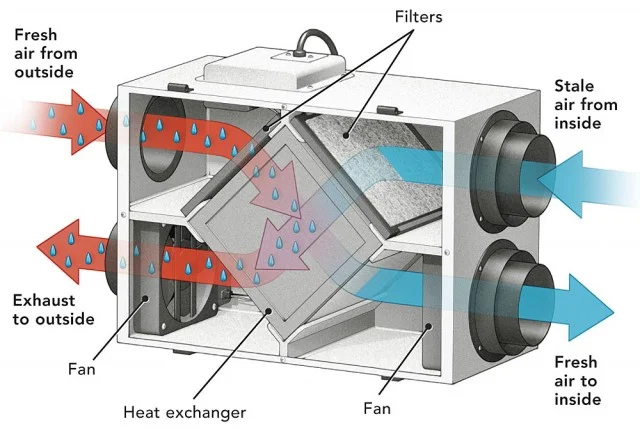
They’re fundamentally different systems solving opposite problems. HRVs transfer only heat between incoming and outgoing air streams using metal plate heat exchangers—recovering 60-95% of thermal energy while allowing moisture to pass through unchanged. ERVs transfer both heat and moisture using specialized membrane cores achieving ~70% humidity recovery alongside heat exchange. Research confirms ERVs are “total enthalpic devices” recovering sensible + latent heat, while HRVs are “sensible only devices” recovering temperature but not moisture.
Climate determines which you need. Cold dry climates (Northern U.S., Canada): Outdoor winter air at 20°F and 60% RH contains almost no absolute moisture—when heated to 70°F indoors, relative humidity drops to 10-15% without moisture recovery. An HRV worsens this by exhausting indoor humidity (from occupants, cooking, showers) while importing bone-dry outdoor air. Hot humid climates (Southeast U.S., Gulf Coast): Summer outdoor air at 90°F and 70% RH contains excessive moisture—an HRV imports all that humidity requiring AC to remove it. Mixed climates: Most regions experience both dry winters and humid summers—making ERVs preferable for year-round comfort maintaining 40-50% RH as experts note “ERVs enable HVAC systems to maintain 40-50% indoor relative humidity essentially in all conditions.”
This guide explains the heat exchanger technologies differentiating ERV from HRV, reveals why building science experts increasingly recommend ERVs for most applications despite higher cost ($500-1,000 premium), and determines the specific scenarios where HRVs remain appropriate (very humid winter occupancy, temperate climates, specific building codes).
How HRV Systems Work: Heat Recovery Only
Heat Recovery Ventilators exchange temperature between air streams without transferring moisture.
The Basic Mechanism
Two separate air streams:
- Stale indoor air (exhaust)—warm in winter (70°F), cool in summer (75°F with AC)
- Fresh outdoor air (supply)—cold in winter (20°F), hot in summer (90°F)
Heat exchanger core: Thin metal plates (aluminum or steel) separate the two airflows—air streams never mix but temperature transfers across plates via conduction.
Winter operation: Warm exhaust air (70°F) transfers heat to cold incoming air (20°F). Fresh air enters home pre-heated to 55-65°F (depending on efficiency) rather than 20°F—reducing heating load.
Summer operation: Cool exhaust air (75°F) absorbs heat from hot incoming air (90°F). Fresh air enters pre-cooled to 80-85°F rather than 90°F—reducing cooling load.
What Crosses the Heat Exchanger
Temperature: YES—transferred efficiently across metal plates
Moisture: NO—water vapor passes through unchanged. If outdoor air is 20°F at 60% RH (absolute moisture content very low), it enters home dry. If outdoor air is 90°F at 80% RH (high absolute moisture), it enters home humid.
Pollutants: NO—separate airstreams prevent exhaust contamination of supply air
Heat Recovery Efficiency
Typical HRV efficiency: 60-75% (basic models) to 80-95% (premium models)
What efficiency means: At 80% efficiency with 20°F outdoor air and 70°F indoor air (50°F difference), incoming air pre-heated to 20 + (50 × 0.80) = 60°F before entering home.
Energy savings: Recovering 80% of heat means HVAC only needs to heat from 60°F to 70°F instead of 20°F to 70°F—80% reduction in heating load for ventilation air.
How ERV Systems Work: Heat Plus Moisture Transfer
Energy Recovery Ventilators exchange both temperature and moisture between air streams.
The Enhanced Mechanism
Same two air streams as HRV—exhaust and supply crossing through core.
Specialized membrane core: Instead of solid metal plates, ERVs use semi-permeable membranes (often polymer-based) allowing both heat and water vapor to transfer between airstreams.
Winter operation:
- Heat transferred as in HRV (cold incoming air pre-heated)
- PLUS moisture transferred from exhaust to supply—humid indoor air transfers water vapor to dry outdoor air before it enters home
Summer operation:
- Heat transferred as in HRV (hot incoming air pre-cooled)
- PLUS moisture transferred from supply to exhaust—humid outdoor air loses moisture to dry exhaust air before entering home
What Crosses the Heat Exchanger
Temperature: YES—transferred via membrane conduction
Moisture: YES—water vapor diffuses through membrane from high-humidity side to low-humidity side following concentration gradient
Pollutants: NO—membranes designed to block particles, gases while allowing H2O molecules through
Total Enthalpy Recovery
ERVs described as “total enthalpic devices”—recovering both:
- Sensible heat (temperature change): 60-85% efficiency typical
- Latent heat (moisture energy): ~70% humidity recovery
Energy benefit: Recovering moisture means less humidification needed in winter, less dehumidification in summer—reducing HVAC latent load beyond sensible heat savings alone.
The Core Difference: Metal Plates vs Membrane Technology
Core technology determines what transfers.
HRV Heat Exchanger: Metal Plates
Construction: Thin aluminum or steel plates stacked with small spacing (0.1-0.5 inches) creating alternating channels for exhaust and supply air.
Heat transfer mechanism: Conduction—exhaust air heats plate, supply air cools same plate from opposite side.
Moisture behavior: Water vapor cannot penetrate metal—humidity passes through unchanged.
Durability: Metal cores very durable, resistant to damage, easy to clean.
Frost risk: In extreme cold (<10°F outdoor air), moisture in exhaust can freeze on cold plates blocking airflow—requires defrost cycle.
ERV Heat Exchanger: Membrane Core
Construction: Polymer membranes (or treated paper in some designs) creating semi-permeable barriers between airstreams.
Heat transfer: Conduction through membrane material
Moisture transfer:Vapor diffusion—water molecules pass through membrane pores following humidity gradient (high to low concentration).
Selectivity: Membranes engineered to allow H2O molecules while blocking pollutants, odors, gases—preventing cross-contamination.
Frost resistance: Modern ERVs use “desiccant-coated membranes” absorbing moisture before it freezes—better frost performance than many HRVs despite handling moisture.
Historical limitation: Older ERVs (pre-2010) had frost problems in extreme cold. Research notes “some people think HRVs are the way to go because older ERVs didn’t have good control over frost forming on core. That’s not the case anymore. ERVs work fine in really cold places now.”
Efficiency Ratings: 60-95% Heat Recovery Explained
Understanding efficiency numbers clarifies realistic expectations.
Sensible Heat Recovery Efficiency
Definition: Percentage of temperature difference recovered.
Formula: Efficiency = (T_supply – T_outdoor) / (T_indoor – T_outdoor)
Example:
- Indoor exhaust: 70°F
- Outdoor supply: 20°F
- Temperature difference: 50°F
- After 80% efficient HRV, supply air: 20 + (50 × 0.80) = 60°F
- Efficiency = (60 – 20) / (70 – 20) = 40/50 = 80%
Latent Heat Recovery (ERV Only)
Humidity transfer efficiency: Typically ~70% for quality ERVs
Meaning: If indoor air is 40% RH and outdoor is 10% RH (30% difference), ERV transfers 70% of that difference—incoming air exits core at ~31% RH instead of 10% RH.
Total Efficiency Range
Basic residential units: 60-70% sensible efficiency Mid-range: 70-85% sensible efficiency
Premium/commercial: 85-95% sensible efficiency
Wikipedia confirms: Heat recovery systems “typically recover about 60-95% of heat in exhaust air” depending on technology and quality.
Manufacturer claims: Some brands (Zehnder) claim “up to 90% efficient in transferring energy” for premium residential models.
Climate Zone Decision Matrix
Climate determines optimal choice—generalized recommendations.
Cold Dry Winter Climates (Zones 6-7)
Characteristics: Winter outdoor air -10°F to 30°F; outdoor RH 50-70% but low absolute moisture when cold
Problem with HRV: Imports dry outdoor air, exports humid indoor air—winter indoor RH drops to 10-20% causing discomfort, static, wood damage, respiratory irritation.
ERV solution: Recovers ~70% of indoor humidity preventing over-drying—maintains 35-45% indoor RH even with continuous ventilation.
Recommendation:ERV strongly preferred unless building has severe moisture problems.
Hot Humid Summer Climates (Zones 1-2)
Characteristics: Summer outdoor air 85-95°F at 70-80% RH—very high absolute moisture
Problem with HRV: Imports all outdoor moisture—AC must remove it creating high latent cooling load and energy costs.
ERV solution: Transfers ~70% of outdoor moisture to exhaust before entering home—reduces AC dehumidification load significantly.
Recommendation:ERV essential for energy efficiency and comfort.
Mixed/Temperate Climates (Zones 3-5)
Characteristics: Cold dry winters, warm humid summers (or hot dry summers depending on region)
HRV performance: May work acceptably if humidity naturally balanced year-round—but rare.
ERV advantage: Handles both seasonal extremes—recovers moisture in winter, rejects moisture in summer.
Recommendation:ERV preferred for year-round optimization unless specific conditions favor HRV.
Hot Dry Climates (Desert Southwest)
Characteristics: Low outdoor humidity year-round (20-40% RH)
Problem with HRV: Exports indoor moisture—making already-dry indoor air even drier.
ERV solution: Retains indoor moisture preventing over-drying—especially important where evaporative cooling used generating minimal indoor humidity.
Recommendation:ERV prevents excessive dryness that HRV would worsen.
Cold Dry Climates: Why ERVs Prevent Winter Desiccation
The physics of cold air humidity explains ERV necessity.
Absolute vs Relative Humidity
Relative humidity (RH): Percentage of maximum moisture air can hold at current temperature.
Absolute humidity: Actual grams of water per cubic meter air—independent of temperature.
Critical concept: Cold air at high RH contains very little absolute moisture. When heated, RH plummets.
The Winter Desiccation Problem
Outdoor conditions: -10°F at 70% RH Absolute moisture: ~0.2 grams H2O/m³
HRV operation:
- Draws in -10°F outdoor air (0.2 g/m³)
- Heats to 70°F via heat recovery and furnace
- At 70°F, that 0.2 g/m³ = ~3% RH (bone dry!)
- Exhausts indoor air at 70°F, 40% RH (3.0 g/m³)—losing moisture
Result: Continuous RH decline despite indoor moisture generation from occupants.
Measured outcome: Homes with HRVs in cold climates often struggle to maintain 20% RH in winter without supplemental humidification.
ERV Solution
ERV operation with same conditions:
- Draws in -10°F outdoor air (0.2 g/m³)
- Membrane transfers moisture from 70°F exhaust (3.0 g/m³) to supply
- At 70% humidity recovery: supply exits core with 0.2 + (3.0 – 0.2) × 0.70 = 2.16 g/m³
- After heating to 70°F: 2.16 g/m³ = ~36% RH—comfortable range
Result: Indoor humidity maintained at habitable levels (35-45%) without supplemental humidification.
Real-world confirmation: User in New Hampshire reports “I definitely need the ERV core in winter, to keep from getting too dry—in fact it gets a little too dry even with ERV core” but “HRV would be much worse” creating uninhabitable conditions.
Hot Humid Climates: ERV vs HRV Summer Performance
Summer moisture management creates opposite challenge.
The Summer Humidity Problem
Outdoor conditions: 90°F at 75% RH Absolute moisture: ~20 grams H2O/m³
HRV operation:
- Draws in 90°F outdoor air (20 g/m³)
- Pre-cools via heat recovery to ~80°F
- Still contains 20 g/m³ moisture—imported unchanged
- AC must remove ~13 g/m³ to reach comfortable 45% RH at 75°F indoors
Energy impact: Dehumidification is most energy-intensive AC function—HRV forces AC to process full outdoor moisture load.
ERV Advantage
ERV operation same conditions:
- Draws in 90°F outdoor air (20 g/m³)
- Membrane transfers moisture to exhaust (indoor at 75°F, 45% RH = 7.5 g/m³)
- At 70% humidity recovery: supply exits with 20 – (20 – 7.5) × 0.70 = 11.25 g/m³
- AC only needs to remove 3.75 g/m³ instead of 13 g/m³—70% reduction in latent load
Energy savings: Research confirms ERVs “help keep humidity out of homes during summer months” and “most energy used in air conditioning comes from removing moisture, so ERV can take burden off AC system and save energy.”
Caveat: ERV Is Not a Dehumidifier
Important clarification: ERV reduces incoming moisture but still adds latent load—incoming air at 11.25 g/m³ is higher than indoor target 7.5 g/m³.
ERV doesn’t dehumidify—it minimizes moisture import compared to HRV importing full outdoor moisture unchanged.
Supplemental dehumidification: Very humid climates may still require dedicated dehumidifier even with ERV—but ERV reduces dehumidifier runtime significantly.
Mixed Climates: The ERV Advantage
Most U.S. regions experience both extremes—ERV handles both.
The Year-Round Challenge
Winter: Outdoor air dry (low absolute moisture)—need to retain indoor humidity Summer: Outdoor air humid (high absolute moisture)—need to reject outdoor moisture
HRV performance:
- Winter: Exports humidity—indoor RH drops
- Summer: Imports humidity—AC overworks
ERV performance:
- Winter: Retains ~70% indoor humidity via moisture recovery
- Summer: Rejects ~70% outdoor humidity before entering
Building Science Expert Consensus
GreenBuildingAdvisor:“You probably need an ERV, not an HRV” for most applications.
Reasoning:“In general, when outdoor air is significantly drier or more humid than indoor air, you should go with ERV.” Most climates experience seasonal humidity swings meeting this criterion.
Exception:“Temperate climate with good air quality and usually have windows open”—ERV/HRV less beneficial overall; if installing system, ERV still preferred.
When HRVs Make Sense (Specific Scenarios)
HRV remains appropriate in limited circumstances.
Scenario 1: Excessive Indoor Humidity Generation
High occupancy: Small airtight apartment with 3-4 people generates substantial indoor moisture from respiration, cooking, showering.
Risk with ERV: Retaining 70% of indoor humidity may cause condensation, mold if generation exceeds removal.
HRV solution: Exhausts moisture efficiently—indoor RH controlled by dumping humidity to exterior.
Example: Research notes “higher density of people in space, more you might need to dry out air with HRV.” Small condos with multiple occupants benefit from HRV’s moisture removal.
Scenario 2: Buildings With Chronic Dampness
Older construction: Pre-1970s homes often have moisture intrusion via foundations, poor drainage, limited vapor barriers.
Problem: Adding ERV retains indoor moisture potentially worsening condensation, mold risks.
HRV benefit:Actively dries indoor air helping manage chronic moisture issues—though addressing root cause (moisture intrusion) is proper solution.
Expert advice: Research confirms “ERVs recommended for homes built prior to 1970s that usually have drier indoor air, because their construction allows humidity to escape outdoors. HRVs good for more airtight newer homes.”
Scenario 3: Cold Climate + Non-Drying Heating
Boiler/radiant heat systems: Don’t dry air like forced-air furnaces—indoor humidity stays higher naturally.
Combination: Cold climate (dry outdoor air) + humid indoor air (from heating type + occupancy) = HRV may prevent over-humidification.
Alternative view: ERV still preferable—simply adjust ventilation rate rather than switching to HRV.
Scenario 4: Building Code Specifications
Some jurisdictions: Specific building codes mandate HRV in certain construction types based on insulation levels, airtightness.
Example: Research notes “Edmonton Climate Zone 7A code specifies HRV required for insulation levels between R50-R60 attic.”
Compliance: If code requires HRV, must install HRV regardless of performance preferences.
High Occupancy Considerations
People generate moisture—impacts system selection.
Moisture Generation Rates
Adults at rest: ~40-50 grams H2O/hour (breathing + perspiration) Cooking: 500-1,500 grams/hour Showering: 400-800 grams/hour
Clothes drying: 1,000-3,000 grams/load if indoor drying rack
Small apartment example: 800 sq ft with 3 occupants
- Occupant moisture: 3 × 50 g/hr × 12 hr/day = 1,800 g/day
- Cooking: 500 g/day
- Showering: 600 g/day
- Total: ~3,000 g/day internal generation
HRV vs ERV Decision
With ERV: System retains ~70% of indoor moisture—if generation exceeds removal via ventilation, RH climbs potentially to uncomfortable/damaging levels (>60%).
With HRV: System dumps moisture—even with high generation, RH controlled by exhaust efficiency.
Calculation needed: Determine if ventilation CFM (at code-required rates) can remove generated moisture maintaining <55% RH:
- If yes: ERV acceptable
- If no: HRV preferred to prevent over-humidification
Alternative: Increase ERV ventilation rate beyond code minimum—but increases energy consumption.
Swappable Cores: Seasonal Flexibility
Some manufacturers offer interchangeable cores—enabling ERV/HRV switching.
The Concept
Dual-core ownership: Purchase both ERV membrane core and HRV metal plate core fitting same housing.
Seasonal swapping: Install ERV core for primary season(s), HRV core when moisture needs reverse.
Real-World Application
New Hampshire user strategy:
- Winter (Oct-May): ERV core—prevents over-drying from cold outdoor air
- Summer (Jun-Sep): ERV core—blocks humid outdoor air
- Spring transition: Brief HRV core usage to dry out accumulated winter moisture before summer
Rationale:“After summer leaves house with more moisture than I’d like, I put in HRV core for few months until humidity inside gets down to where I’d like it, then swap back to ERV for rest of year.”
Is It Worth It?
Benefits: Optimizes performance for extreme seasonal needs
Drawbacks:
- Additional core cost ($300-800)
- Manual swapping effort (requires accessing unit, physical exchange)
- Storage space for unused core
User assessment:“Not sure it’s worth owning both for those few months, but glad to have capability when I do use it.”
Recommendation: Most homeowners don’t need swappable cores—properly-sized ERV handles year-round needs. Consider only if extreme climate variability and high precision humidity requirements.
Installation Costs: $2,500-$6,000 Range
Total project costs including equipment, labor, ductwork.
Equipment Cost
HRV unit: $800-2,000 (basic to premium residential) ERV unit: $1,200-3,000 (premium models $3,000-5,000)
ERV premium: Typically $400-1,000 more than equivalent HRV due to membrane technology.
Installation Labor
Professional HVAC installation: $1,500-3,500 depending on:
- Ductwork requirements (new vs connecting to existing)
- Unit location (basement, attic, closet accessibility)
- Electrical work needed
- Complexity of integration with HVAC system
DIY installation: Possible for mechanically-inclined homeowners but not recommended—proper airflow balancing, duct sizing, control integration require expertise.
Total Project Cost Ranges
Basic HRV installation: $2,500-4,000 Mid-range ERV installation: $3,500-5,500
Premium ERV with dedicated ductwork: $5,000-8,000
Research confirms: Installation “can vary depending on home layout, size, existing HVAC system. Generally ERVs might be slightly more expensive due to additional functionality, but long-term benefits outweigh initial investment.”
Operating Costs: Energy and Maintenance
Ongoing expenses factor into total ownership.
Energy Consumption
Fan power: Typical residential ERV/HRV uses 50-150 watts continuous operation.
Annual energy cost: 100W × 24 hr × 365 days = 876 kWh/year × $0.13/kWh = ~$114/year electricity
Energy savings from heat recovery: Recovering 80% of heat at typical ventilation rates (100 CFM) saves $300-800/year in heating/cooling costs depending on climate.
Net savings: $300-800 savings minus $114 operating cost = $186-686/year net benefit
ERV additional savings: Moisture recovery reduces AC dehumidification load—adding $50-200/year savings in humid climates.
Maintenance Requirements
Filter replacement: Every 3-6 months depending on air quality
- Cost: $20-50 per replacement
- Annual: $40-100
Core cleaning: Every 1-2 years (can extend core life)
- DIY: $0 (vacuum/rinse metal HRV cores; ERV membranes require gentle handling)
- Professional: $100-200
Expected core lifespan:
- HRV metal cores: 10-20 years
- ERV membranes: 10-15 years (older technology 5-10 years)
ASHRAE 62.2 Ventilation Requirements
Building codes reference ASHRAE standards—determining required ventilation rates.
The Standard Formula
ASHRAE 62.2 calculation:
Q = 7.5 CFM/occupant + 3 CFM/100 sq ft floor area
Example 1: 1,500 sq ft house, 4 occupants
- Q = (7.5 × 4) + (3 × 15) = 30 + 45 = 75 CFM continuous
Example 2: 800 sq ft apartment, 2 occupants
- Q = (7.5 × 2) + (3 × 8) = 15 + 24 = 39 CFM continuous
ERV/HRV Sizing
Match ventilation requirement: Unit must deliver rated CFM meeting ASHRAE 62.2 minimum.
Typical residential units: 50-200 CFM capacity
Control strategies:
- Continuous operation at code-required CFM
- Intermittent operation at higher CFM averaging to requirement
- Variable-speed fans adjusting to occupancy/air quality sensors
Integration with Existing HVAC
Installation methods vary by home configuration.
Option 1: Dedicated Ductwork (Preferred)
Separate ERV/HRV ducts: Independent supply/exhaust ductwork not shared with furnace/AC.
Advantages:
- Optimal ERV/HRV performance (no pressure interference)
- Continuous operation independent of heating/cooling calls
- Simpler balancing
Disadvantages:
- Higher installation cost ($1,000-2,000 extra ductwork)
- Space requirements for additional ducts
Expert recommendation:“Best way to install HRV or ERV is separate from forced-air furnace and AC system. Using same ductwork will often change system pressure when furnace and AC switch on, leading to poor operation.”
Option 2: Shared Ductwork
Integration: ERV/HRV connects to existing furnace supply/return ducts.
Advantages:
- Lower installation cost (uses existing ductwork)
- Simpler for retrofit applications
Disadvantages:
- Furnace/AC operation changes pressure affecting ERV/HRV balance
- May require dampers, controls preventing conflicts
- Less optimal performance
When acceptable: Small homes, budget constraints, existing ductwork well-designed.
Controls and Automation
Basic: On/off switch, manual speed control
Intermediate: Timer controls, humidity sensors triggering ventilation
Advanced: Integration with smart thermostats, occupancy sensors, air quality monitors adjusting CFM dynamically
Common Mistakes in System Selection
Avoiding errors ensures optimal performance.
Mistake 1: Choosing HRV Based on Outdated Frost Concerns
Old information: Pre-2010 ERVs had frost issues in extreme cold—led to HRV recommendations for cold climates.
Current reality:“Some people think HRVs way to go because older ERVs didn’t have good frost control. That’s not case anymore. ERVs work fine in really cold places now.”
Modern ERVs: Desiccant-coated membranes, improved defrost controls—superior frost resistance compared to many HRVs.
Recommendation: Don’t avoid ERV due to outdated frost fears.
Mistake 2: Prioritizing Heat Efficiency Over Moisture Management
HRV marketing: Often emphasizes “higher heat recovery efficiency” (85-95% vs ERV’s 75-85%).
Reality check:“What good is high-efficiency ventilation if you end up growing mold or going through 50 liters skin lotion each year?”—moisture management matters more than 5-10% efficiency difference.
Proper priority: Choose system maintaining comfortable, healthy humidity (40-50% RH) even if sacrificing minor efficiency gain.
Mistake 3: Undersizing for Cost Savings
Temptation: Purchase 50 CFM unit when ASHRAE requires 75 CFM to save $500.
Consequence:Inadequate ventilation—fails to meet indoor air quality needs, building code compliance.
Proper approach: Size for actual requirement based on square footage and occupancy—not budget alone.
Mistake 4: Ignoring Climate Reality
Generic recommendations: Installing HRV because contractor unfamiliar with ERVs or has inventory to move.
Climate mismatch: HRV in hot humid climate forces AC to remove all outdoor moisture—negating energy recovery benefits.
Due diligence: Research your specific climate needs—don’t rely solely on contractor recommendation without understanding reasoning.
Frequently Asked Questions
What is the difference between ERV and HRV?
HRVs transfer only heat between incoming and outgoing air using metal plate heat exchangers—recovering 60-95% thermal energy while allowing moisture to pass unchanged. ERVs transfer both heat and moisture using semi-permeable membrane cores achieving ~70% humidity recovery plus heat exchange. Research confirms ERVs are “total enthalpic devices” recovering sensible + latent heat while HRVs are “sensible only devices.” Practical difference: HRV exhausts indoor humidity in winter (drying indoor air) and imports outdoor humidity in summer (increasing AC load); ERV maintains 40-50% indoor RH year-round by recovering/rejecting moisture as needed.
Is ERV better than HRV?
ERV better for most applications per building science consensus. Research states “deciding between ERV and HRV should land on ERV for most people in most places” because outdoor air is significantly drier OR more humid than indoor air in most climates seasonally—making moisture transfer beneficial. ERV prevents winter desiccation (cold outdoor air contains minimal moisture), blocks summer humidity (hot outdoor air overly humid), and enables maintaining 40-50% RH essentially in all conditions. HRV appropriate only in specific scenarios: high indoor humidity generation (small space, many occupants), chronic building dampness, or building code mandate.
Do I need ERV or HRV in cold climate?
ERV strongly recommended for cold climates. Cold outdoor air (e.g., 20°F at 60% RH) contains very low absolute moisture—when heated to 70°F indoors, RH plummets to 10-15% without moisture recovery. HRV exhausts indoor humidity importing bone-dry outdoor air causing excessive dryness (static, respiratory irritation, wood damage). ERV recovers ~70% indoor humidity maintaining comfortable 35-45% RH despite continuous ventilation. User in New Hampshire confirms “definitely need ERV core in winter to keep from getting too dry” while noting HRV would create uninhabitable conditions. Modern ERVs have excellent frost resistance debunking outdated concerns about cold-climate performance.
How much does ERV vs HRV cost?
ERV units cost $400-1,000 more than equivalent HRVs due to membrane technology—ERVs $1,200-3,000 vs HRVs $800-2,000 for residential models. Total installed cost: HRV $2,500-4,000; ERV $3,500-5,500; premium ERV with dedicated ductwork $5,000-8,000. Operating costs similar: Both use 50-150W continuously (~$114/year electricity) while saving $300-800/year in HVAC costs via heat recovery. ERV adds $50-200/year savings in humid climates by reducing AC dehumidification load. Research confirms “ERVs might be slightly more expensive due to additional functionality, but long-term benefits outweigh initial investment” through better humidity control and energy efficiency.
Can ERV work in hot humid climates?
Yes—ERV essential in hot humid climates for energy efficiency and comfort. Summer outdoor air (90°F, 75% RH) contains excessive moisture—HRV imports all outdoor humidity forcing AC to remove it (energy-intensive dehumidification). ERV transfers ~70% outdoor moisture to exhaust before entering home—reducing incoming absolute humidity from 20 g/m³ to ~11 g/m³, cutting AC latent load 70%. Research confirms ERVs “help keep humidity out of homes during summer” and “most AC energy comes from removing moisture, so ERV takes burden off AC saving energy.” Note: ERV doesn’t dehumidify—still adds latent load but minimizes import compared to HRV bringing full outdoor moisture unchanged.