
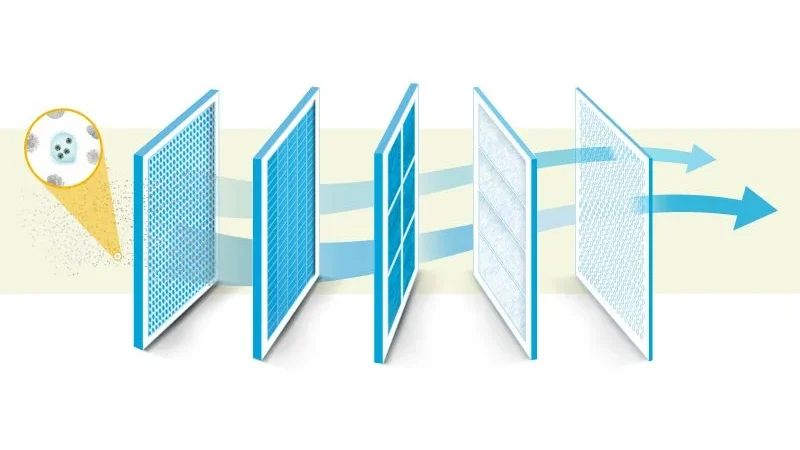
Nine out of ten air purifier buyers think the 99.97% number is the whole story. It isn’t — and that gap in understanding is exactly why so many people buy a HEPA filter, run it for six months, and wonder why their allergies haven’t budged. How HEPA filters improve indoor air quality is not just about a single efficiency rating stamped on a box. It’s about three distinct physical mechanisms working simultaneously, a filter geometry that was originally designed for nuclear facilities, and a counterintuitive truth: the particles most likely to reach your lungs are the ones HEPA filters catch in the most unusual way.
What Does “True HEPA” Actually Mean?
The term “HEPA” stands for High Efficiency Particulate Air, and it’s a performance standard, not a brand or a material. To qualify, a filter must capture at least 99.97% of particles at exactly 0.3 microns in diameter under standardized airflow conditions. That specific size — 0.3 microns — is called the Most Penetrating Particle Size, or MPPS, because it’s the hardest for fiber-based filters to intercept. Everything larger and everything smaller is actually caught more efficiently, which is one of the most misunderstood facts in the entire category.
Here’s what trips people up: 99.97% efficiency sounds like near-perfection, and at the filter media itself, it is. But “true HEPA” is a filter standard, not a whole-system standard. The air purifier housing around that filter, the fan design, the seal between filter and frame — all of that determines whether clean air actually reaches you or sneaks around the edges. A genuine HEPA filter inside a poorly sealed unit can perform far below its rated efficiency in real-world use.
Watch for marketing terms like “HEPA-type,” “HEPA-style,” or “99% HEPA” — none of these meet the actual standard. Only “True HEPA” or “Medical-Grade HEPA” filters are tested to 99.97% at 0.3 microns. The difference in real-world particle capture between a true HEPA and a “HEPA-like” filter can be substantial, especially for the ultrafine particles that cause the most respiratory irritation.
How HEPA Filters Improve Indoor Air Quality: The 3 Capture Mechanisms
This is the part most articles skip past with a single vague sentence, and it’s genuinely fascinating once you understand it. HEPA filters don’t work the way people assume — they’re not sieves that block particles too big to squeeze through the holes. The fiber matrix inside a HEPA filter captures particles using three entirely different physical phenomena, each one dominant at a different particle size range.
The first mechanism is interception. A particle traveling through the filter follows an airstream around a fiber, gets close enough to touch it, and sticks. This works well for mid-sized particles — roughly 1 micron and above — that are small enough to travel with airflow but large enough that they can’t veer far from their path. Think of it like a car that drifts slightly but not enough to miss the guardrail.
The second is impaction. Larger, heavier particles can’t follow the curving airstream around a fiber — their momentum carries them straight into it. Dust, pollen, pet dander, and mold spores are all caught this way. The faster the air moves through the filter, the more effective impaction becomes, which is why higher fan speeds don’t necessarily mean worse filtration for large particles.
The third mechanism — and the one that explains the 0.3-micron MPPS paradox — is diffusion. Particles smaller than about 0.1 microns are so light that Brownian motion (random collisions with gas molecules) causes them to zigzag erratically through the filter rather than follow any predictable path. That random movement dramatically increases the chances they’ll collide with a fiber and stick. So at the truly ultrafine end of the spectrum — the particles most associated with cardiovascular and neurological health effects — HEPA filters actually perform better than their 99.97% floor rating.
The 0.3-micron size is the awkward middle ground where particles are too small for efficient impaction and too large for strong diffusion to take over. That’s why it’s the hardest size to catch — and why it became the benchmark for the standard.
What Particles Does a HEPA Filter Actually Remove From Indoor Air?
Knowing the mechanism matters because it tells you what you’re actually protected against — and what you’re not. HEPA filters capture solid and liquid particles suspended in air. The range includes dust mite debris, pollen (typically 10–100 microns), mold spores (1–30 microns), pet dander (0.5–100 microns), bacteria (0.3–60 microns), and most smoke particles from cooking or wildfires (0.1–1 micron). That coverage is genuinely broad.
Viruses are where it gets more nuanced. Individual virus particles range from about 0.02 to 0.3 microns — right at or below the MPPS range. But viruses don’t typically float through indoor air as naked particles. They travel attached to respiratory droplets, skin cells, or other larger particles, which puts them squarely in HEPA’s effective range. Laboratory studies have shown HEPA filtration reducing airborne virus concentrations by over 99% in controlled settings, though real-world effectiveness depends heavily on room size, air changes per hour, and ventilation patterns.
What HEPA filters cannot remove: gases, volatile organic compounds (VOCs), odors, and radon. These require activated carbon or other chemical filtration. If your indoor air problem is formaldehyde off-gassing from new furniture or cooking fumes, a standalone HEPA filter won’t address that — you need a unit with both HEPA and activated carbon stages working together.
| Particle Type | Typical Size Range | HEPA Capture Effectiveness |
|---|---|---|
| Pollen | 10–100 microns | Excellent (impaction dominant) |
| Mold spores | 1–30 microns | Excellent (impaction + interception) |
| Pet dander | 0.5–100 microns | Excellent across full range |
| Smoke / fine particulate (PM2.5) | 0.1–2.5 microns | Very good (diffusion + interception) |
Why Is 0.3 Microns the Hardest Particle Size for HEPA to Catch?
This question deserves its own section because it’s the counterintuitive heart of HEPA science, and misunderstanding it leads people to wildly wrong conclusions. A lot of people assume that smaller particles are inherently harder to filter — which would mean HEPA filters leak ultrafine particles freely. That’s not what the physics says.
At 0.3 microns, a particle sits in what engineers call the “slip flow” regime — it’s too small to be reliably caught by impaction, and it doesn’t exhibit enough Brownian motion for diffusion to compensate effectively. It’s the particle size where all three mechanisms are operating at their lowest combined efficiency simultaneously. Go smaller, and diffusion kicks in hard. Go larger, and impaction and interception take over. At exactly 0.3 microns, you’re in the valley between two hills of efficiency.
This is actually good news for health, not bad news. The particles most associated with deep lung penetration and systemic inflammation — ultrafine particles below 0.1 microns — are caught more efficiently than the 99.97% standard implies, thanks to diffusion. The 99.97% figure is a floor, not a ceiling. HEPA filters are better than their rating for the particles that matter most to long-term respiratory health.
“The 0.3-micron benchmark is often misread as evidence that HEPA filters are ‘worst’ at ultrafine particles — that’s backwards. The MPPS is simply the test condition that forces the filter to prove its minimum capability. For sub-0.1-micron particles, where diffusional deposition dominates, well-constructed HEPA media routinely exceeds 99.99% efficiency. The standard is deliberately set at the hardest case.”
Dr. Melissa Cartwright, Ph.D., Environmental Engineering and Indoor Air Quality Research, University of Minnesota
Does HEPA Filtration Actually Reduce Allergy and Asthma Symptoms?
The honest answer is: yes, but with conditions that most marketing materials quietly ignore. Clinical evidence supports HEPA filtration as a meaningful intervention for airborne allergens — multiple randomized controlled trials have found significant reductions in airborne cat allergen, dust mite particles, and pollen concentrations in filtered rooms. Some studies show corresponding improvements in symptom scores and lung function metrics for asthma patients.
The catch is that airborne allergen is only part of the problem. Dust mite allergens, for example, are primarily found in settled dust on mattresses, bedding, and carpets — not floating through the air. A HEPA air purifier in your bedroom will reduce the fraction that becomes airborne, but it won’t touch the reservoir sitting in your mattress. Encasing bedding in allergen-proof covers, vacuuming with a HEPA-equipped vacuum, and controlling humidity (dust mites thrive above 50% relative humidity) are all part of an effective strategy that air filtration alone can’t replace.
For asthma triggered by fine particulate matter — smoke, urban air pollution, cooking aerosols — the evidence is stronger and more direct. A HEPA air purifier in the bedroom, running on a schedule that ensures the room air is cleaned several times per hour, consistently reduces exposure to PM2.5 levels that trigger airway inflammation. That’s a real, measurable benefit.
How Many Air Changes Per Hour Do You Actually Need?
Filter efficiency is only half the equation. A 99.97%-efficient filter running too slowly for your room size will clean air leisurely while you breathe whatever’s currently floating around. The metric that actually determines real-world protection is Air Changes per Hour, or ACH — how many times per hour the entire volume of air in a room passes through the filter.
For general air quality improvement, 2–3 ACH is a reasonable baseline. For allergy or asthma management, 4–6 ACH is the target range used in most clinical settings. To calculate what you need: multiply room length × width × ceiling height to get cubic footage, then divide the purifier’s rated Clean Air Delivery Rate (CADR) in cubic feet per minute by that volume, then multiply by 60. That gives you ACH at that fan speed setting.
Real scenario: you have a 12×15 foot bedroom with 8-foot ceilings — that’s 1,440 cubic feet. An air purifier with a 200 CFM CADR delivers about 8.3 ACH in that room, which is excellent. The same unit in a 25×30 foot open-plan living area (6,000 cubic feet) drops to 2 ACH — adequate for general use but not enough during wildfire smoke events or for someone managing serious asthma.
Pro-Tip: Don’t rely on a manufacturer’s “room size” rating alone — those are typically calculated at 2 ACH, which is the minimum. For allergy or asthma management, look for a purifier rated for a room roughly twice the actual size of the space you’re treating. That gets you closer to the 4–5 ACH range where clinical benefits are most consistently observed.
What Are the Most Common Mistakes People Make With HEPA Filters?
Buying the right filter is step one, but the way most people actually use air purifiers quietly undermines most of the benefit. These are the mistakes that matter most — not theoretical edge cases, but patterns that show up repeatedly in real households.
- Running the unit on low speed continuously instead of high speed intermittently. Low speed is quieter, but it dramatically reduces CADR — often by 40–60% compared to high speed. For rooms where you spend extended time (bedroom, home office), running on high for 30 minutes before occupancy and then dropping to medium is more effective than perpetual low.
- Replacing filters on a calendar schedule instead of based on conditions. During wildfire season, high pollen periods, or after renovation work, a filter can load to its effective limit in a fraction of its typical service life. Judging by time alone means you may be running a clogged, bypassed filter for weeks without knowing it.
- Placing the unit in a corner or against a wall. Air purifiers need intake clearance and unobstructed airflow to clean a room efficiently. Position units at least 18 inches from walls and away from curtains or furniture that block the intake vents. Central placement with clear sightlines across the room improves whole-room mixing significantly.
- Expecting one unit to cover an open-plan space effectively. Manufacturers’ room size ratings assume relatively enclosed spaces. In open-plan layouts, air circulation carries particles throughout a much larger effective volume. Splitting coverage with two smaller units often outperforms a single large unit in the same scenario.
- Using ionizers alongside HEPA without understanding what they add. Some units combine HEPA with an ionizer. Ionizers can cause particles to plate out on walls and surfaces rather than the filter — which removes them from the air but not from the room. For people with respiratory sensitivities, some ionizers also produce trace ozone as a byproduct, which is itself a respiratory irritant. Know what your unit is doing beyond HEPA filtration.
How Does Humidity Affect HEPA Filter Performance and Indoor Air Quality?
This is the intersection that most HEPA articles completely ignore, and it’s particularly relevant if you’re managing humidity alongside air quality. Relative humidity directly affects the behavior of airborne particles and, by extension, how effectively a HEPA filter can capture them. At high humidity levels (above 65–70% RH), hygroscopic particles — those that absorb water vapor — swell in size. This is a two-edged effect.
On one hand, particles that swell become larger and easier to capture by impaction and interception. On the other hand, very high humidity accelerates mold growth on the filter media itself, which can compromise both filtration efficiency and introduce biological contamination as a new indoor air quality problem. A filter that smells musty isn’t just unpleasant — it may be actively dispersing mold fragments into the air it’s supposed to clean.
Low humidity creates a different problem. Dry air (below 30–35% RH) increases static electricity, which causes more particles to accumulate on surfaces rather than remain airborne — meaning the air purifier has fewer particles to capture, but those particles are harder to remove from surfaces by cleaning alone. Maintaining indoor humidity between 40% and 55% RH creates conditions where airborne particle loads are manageable, filter media stays dry and functional, and biological growth is suppressed. Air quality and humidity management aren’t separate concerns — they’re deeply linked.
How Do You Know If Your HEPA Air Purifier Is Actually Working?
This question almost never gets a direct answer, and it should. Symptom improvement is real but slow and subjective — not a reliable near-term feedback mechanism. The most direct way to verify performance is with a consumer-grade air quality monitor that measures PM2.5 (fine particulate matter) concentrations. These devices, available from multiple manufacturers, show real-time particle levels and let you run a simple test: check PM2.5 with the purifier off for 15 minutes, then run it at high speed and watch the concentration drop.
A well-sized, properly functioning HEPA purifier should reduce PM2.5 to below 12 µg/m³ (the EPA’s annual standard for outdoor air, used as a baseline for good indoor air quality) within 30–45 minutes in an appropriately sized room with windows and doors closed. If it takes longer, or if the level doesn’t drop significantly, you either have a room-sizing mismatch, a filter that needs replacement, or a unit with air bypass issues around the filter seal.
Visual inspection of the filter also tells a story. After a few weeks of operation, a true HEPA filter in a typical home should show visible gray or brown discoloration from captured particles — if it looks nearly new, either the air is unusually clean (possible) or air is bypassing the filter (more likely in cheaper units with poor housing seals). A filter that’s heavily loaded and appears dark is doing its job; the question is whether it’s loaded to the point of reduced airflow.
HEPA vs. Other Air Filtration Technologies: What’s Worth Adding?
HEPA is the anchor of any serious indoor air quality strategy, but it doesn’t operate in a vacuum — literally or figuratively. Understanding what each complementary technology adds (and what it doesn’t) helps you build a system that actually addresses your specific air quality issues rather than just accumulating equipment.
- Activated carbon: Essential for VOC, odor, and gas removal. Doesn’t improve particle capture. The amount of carbon matters — thin carbon pre-filters in most consumer units have limited adsorption capacity and saturate quickly in high-VOC environments like new construction or homes with gas cooking.
- UV-C light: Can inactivate pathogens that pass through the light chamber, but effectiveness depends on dwell time and lamp intensity. Most consumer UV-C chambers provide insufficient exposure time at typical airflow rates to deliver meaningful disinfection. It’s not harmful, but it’s rarely the meaningful addition it’s marketed as.
- Electrostatic precipitators: Charge particles so they stick to collector plates. Can be effective but produce ozone as a byproduct and require regular manual cleaning of collector plates to maintain efficiency — something most users neglect, causing sharp performance drop-off over time.
- Pre-filters: Washable or replaceable coarse pre-filters protect the HEPA layer from large particles like hair and large dust clumps, extending HEPA filter life. Cleaning or replacing the pre-filter on schedule is one of the highest-return maintenance actions available and costs almost nothing.
When Should You Replace a HEPA Filter?
Most manufacturer guidance says 12 months, and in a moderate environment with average particle loads, that’s a reasonable starting point. But “average” covers a lot of ground. Households with pets, in areas with high outdoor particulate pollution, near construction activity, or in regions with pronounced wildfire seasons will load filters significantly faster — sometimes two to three times faster than the calendar-based estimate suggests.
The most practical signal for replacement is airflow reduction. As HEPA filters load with captured particles, they develop increased resistance to airflow — your purifier’s fan has to work harder to push the same volume of air through. Some units have filter life indicators that respond to this pressure differential. On units without indicators, check whether the airflow felt coming from the outlet has noticeably decreased at the same fan setting. That’s a more reliable sign than any calendar date.
One important nuance worth knowing: a partially loaded HEPA filter is often more efficient than a brand-new one. Captured particles fill in gaps in the fiber matrix and create additional filtration pathways. Efficiency typically peaks somewhere in the middle of a filter’s service life, then begins to decline as excessive loading restricts airflow below what’s needed for adequate air changes per hour. Replace filters before severe airflow restriction, not before any particle loading occurs.
Air quality isn’t static — it shifts with seasons, with what’s happening outdoors, with what you cook, and with how you ventilate your home. The most forward-looking thing you can do with a HEPA system isn’t just maintaining it; it’s pairing it with a basic particle monitor that shows you what’s actually in your air so you can respond dynamically rather than running on assumptions. The gap between “I have an air purifier” and “I know my indoor air quality” is where most of the real improvement still lives.