
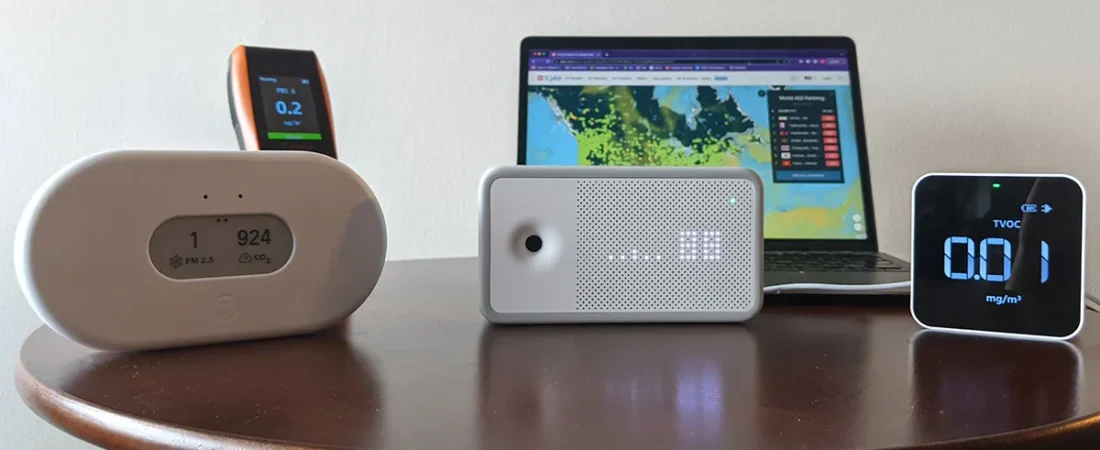
Accurate enough to change your behavior — that’s the real standard a consumer air quality monitor needs to meet, and almost every comparison article misses it entirely. The debate gets framed as “$150 sensor vs. $10,000 lab instrument,” as if the only thing that matters is raw precision. But here’s what that framing ignores: a laboratory-grade measurement sitting in a report you’ll never read does exactly zero work for your lungs. The question worth asking isn’t “how accurate is this device?” It’s “is it accurate enough to tell me when something is wrong?”
Do Indoor Air Quality Monitors Actually Work for Real-World Home Use?
Yes — with a specific caveat that most reviews bury in a footnote. Consumer air quality monitors work reliably for detecting changes and trends, and they work moderately well for giving you a ballpark concentration reading. What they don’t do is give you the kind of measurement certainty a certified industrial hygienist would stake a lawsuit on.
That distinction matters a lot less than it sounds for most households. If your PM2.5 reading spikes from 8 µg/m³ to 140 µg/m³ every evening around 6 PM, you don’t need laboratory confirmation to know something is wrong — you need to figure out that your cast-iron skillet is producing cooking smoke. A $150 device catches that pattern just as well as a $10,000 one.
Where consumer monitors genuinely struggle is at the low-concentration end of the scale and with complex chemical mixtures. A device reading 4 µg/m³ versus 9 µg/m³ of PM2.5 is a difference that may or may not be real, depending on sensor drift, humidity, and particle composition. But both readings are telling you the same actionable thing: your air is currently fine.
What Do Consumer Air Quality Monitors Actually Measure?
Most consumer monitors measure three to six parameters, and understanding what’s behind each number helps you interpret them honestly. PM2.5 and PM10 (particulate matter at 2.5 and 10 microns) are measured using laser particle counters — a tiny laser beam bounces off airborne particles, and the device counts flashes and estimates size. It’s genuinely clever physics, but it assumes all particles have the same density and reflectivity, which they don’t.
CO2 is measured via NDIR (non-dispersive infrared) sensors, which are comparatively reliable and have been used in commercial HVAC systems for decades. TVOC (total volatile organic compounds) readings are the least trustworthy of the bunch — most consumer sensors use a single metal oxide semiconductor that reacts to dozens of different gases simultaneously and reports a combined number that’s nearly impossible to interpret with precision.
Temperature and humidity sensors are generally accurate to within 1–2°F and 2–3% RH respectively, which is good enough for any practical purpose. The honest summary: CO2 and particulate trend data are the most useful outputs from a consumer monitor; TVOC numbers are directional signals at best.
How Accurate Are $150 Sensors Compared to Professional Equipment?
Studies comparing consumer PM2.5 sensors to regulatory-grade reference monitors typically find correlations of 0.70 to 0.90 — meaning consumer devices track real-world changes reasonably well but can misread absolute concentrations by 20–50% depending on conditions. That sounds alarming until you realize what moves the needle: humidity above 70% RH causes optical particle counters to misread because water droplets look like particles. Temperature swings cause sensor drift. High-humidity environments like bathrooms or laundry rooms can make a monitor look like your air quality is catastrophic when it isn’t.
Laboratory reference monitors, by contrast, use gravimetric sampling (physically catching and weighing particles), flame ionization detection for VOCs, and non-dispersive infrared or electrochemical cells calibrated against NIST-traceable standards. They’re big, expensive, require skilled operators, and take hours to generate a single data point. That’s why they live in fixed monitoring stations and industrial settings — not in your living room.
The counterintuitive fact here: a consumer monitor placed in your home gives you continuous 24/7 data, which in many ways is more useful than one highly precise measurement taken on a Tuesday afternoon by a professional. Pollution events are often brief and episodic — a 20-minute cooking session, a neighbor’s diesel truck idling outside, off-gassing from a newly installed floor. Continuous monitoring catches what a single lab visit never would.
“The precision gap between a consumer sensor and a reference monitor is real, but it’s often clinically irrelevant for the decisions a homeowner actually needs to make. If you’re trying to understand whether your ventilation is adequate or whether a renovation is releasing harmful levels of particulates, a well-placed consumer device will give you the directional information you need. The key is understanding what each sensor type is and isn’t capable of measuring.”
Dr. Mariana Fuentes, PhD, Environmental Health Sciences, Certified Industrial Hygienist
Which Pollutants Can Consumer Monitors Reliably Detect?
Not all air quality sensors are created equal, and the reliability varies dramatically by pollutant type. Here’s a realistic breakdown:
| Pollutant | Consumer Monitor Reliability | Practical Usefulness |
|---|---|---|
| PM2.5 / PM10 | Moderate (±20–50% absolute, good relative trends) | High — catches cooking, dust, smoke events clearly |
| CO2 | Good (±50–100 ppm with NDIR sensors) | High — reliable ventilation and occupancy indicator |
| TVOC | Low (single-value blended reading, poor specificity) | Medium — useful as an “alarm” signal, not a precise reading |
| Radon | Low-Moderate (alpha track devices better than ionization) | Medium — use dedicated long-term radon monitor for real data |
Carbon monoxide and formaldehyde are sometimes included in higher-end consumer monitors, but these readings should be treated with significant skepticism unless the device uses electrochemical sensors and has been independently validated. Many budget devices use the same metal oxide semiconductor platform for multiple gases and simply report different labels for what is essentially the same signal.
Radon deserves a special mention because it’s one of the most genuinely dangerous indoor air pollutants — the second leading cause of lung cancer after smoking — yet consumer radon monitors vary wildly in quality. The EPA recommends long-term alpha track detectors for definitive results; short-term consumer electronic radon monitors can give readings that are off by a factor of two or more.
What Consumer Monitors Get Wrong (and Why It’s Not Fatal to Their Usefulness)
Here’s the angle almost nobody talks about: consumer air quality monitors have systematic biases that, once you know about them, actually become manageable. The biggest one is humidity interference with optical particle counters. At relative humidity above 75%, particle counts can inflate by 30–100% because the sensor can’t distinguish between a dust particle and a water droplet. This means your monitor might read a PM2.5 “spike” on a damp, foggy morning that isn’t really there.
Sensor drift is the other underappreciated issue. Metal oxide semiconductor sensors — used for VOC and some gas measurements — are notoriously prone to drift over 6–18 months of use. A reading that was reasonably accurate when the device was new may be significantly off a year later, and most consumer monitors have no self-calibration mechanism for these sensors. CO2 sensors using NDIR technology are better; many have automatic baseline calibration that assumes the lowest reading in a week represents clean outdoor air (~415 ppm), which works fine unless you never open a window.
None of this makes consumer monitors useless. It makes them instruments that reward informed users — people who understand that a TVOC reading of “450 ppb” is more meaningful as a relative number (is it going up or down?) than as an absolute one, and who know to cross-check humidity when they see unexpected PM2.5 spikes.
How Should You Actually Use a Consumer Air Quality Monitor?
The single most effective thing you can do with a consumer monitor is establish a baseline. Spend the first two weeks just watching the data without changing anything. You’ll likely see patterns you had no idea existed — a CO2 climb every night after the family gathers in the living room, a PM2.5 spike every time someone showers (steam carrying aerosolized particles), or a TVOC bump every time the garage door opens.
Then start making one change at a time and watching what happens. Open a window for 30 minutes and watch CO2 drop. Run your kitchen exhaust fan during cooking and watch PM2.5 stay flat instead of spiking. This is where consumer monitors earn their keep — not as precision instruments, but as responsive feedback tools that connect your actions to real outcomes in near real-time.
Placement matters more than most people realize. Putting a monitor next to a window, near a cooking stove, or in a closet will produce misleading data. Place it at breathing height (about 3–4 feet off the ground), in the room where you spend the most time, away from direct airflow sources like vents and fans.
Pro-Tip: If your monitor includes a humidity sensor, cross-reference it whenever you see an unexpected PM2.5 spike. Readings above 75% RH make optical particle sensors unreliable — wait for humidity to drop before assuming you have an air quality problem.
When Do You Actually Need Professional Air Quality Testing?
There are situations where a consumer monitor isn’t sufficient, and being honest about them is more useful than pretending a $200 device can handle everything. If you suspect mold contamination, a consumer monitor won’t detect it — most don’t measure mold spores at all, and the ones that claim to measure “biological particles” are not providing reliable data. You need a professional mold assessment with air sampling analyzed by a certified laboratory.
Asbestos, lead dust, and specific industrial chemicals are completely outside what consumer devices can measure. If you’re renovating a home built before the mid-1980s, or if someone in your household has been diagnosed with an unexplained respiratory condition, professional industrial hygiene testing gives you legally defensible, medically interpretable results that a consumer monitor can’t. The cost — typically $300 to $800 for a targeted professional assessment — is worth it in those specific circumstances.
Radon is the one area where consumer monitoring with the right device is genuinely adequate for initial screening, but confirm anything above 2 pCi/L with a certified lab test before spending money on mitigation. The EPA action level is 4 pCi/L, but many health experts recommend mitigation above 2 pCi/L given radon’s well-established carcinogenicity.
Are Expensive Consumer Monitors Worth the Premium Over Budget Options?
The $80 to $350 consumer monitor market has real quality tiers, and the differences are worth understanding before you spend money. Budget devices under $100 often use a single combined sensor platform for multiple pollutants, have no data logging or app connectivity, and use lower-quality optical components that are more susceptible to humidity interference. They can still be useful, but their limitations accumulate quickly.
Mid-range devices in the $150–$250 range typically include NDIR CO2 sensors (a significant accuracy upgrade over cheaper NDIR alternatives), electrochemical sensors for specific gases rather than a single metal oxide platform, and data logging that lets you review historical trends. This is where the value-to-accuracy ratio peaks for most households.
Devices above $300 often add laser particle counter upgrades, multiple sensors for specific VOCs rather than a blended TVOC reading, and professional-grade data export. These are worth it if you’re managing a specific health condition, running a small business where air quality is a liability concern, or if you’re genuinely curious about the science. For most people monitoring a typical home, the mid-range tier is sufficient.
What Do the Air Quality Numbers on Your Monitor Actually Mean?
Consumer monitors typically display readings on one of two scales: raw numbers in standard units (µg/m³ for particulates, ppm or ppb for gases) or a color-coded AQI-style index. The color coding is more intuitive but often hides the underlying calibration assumptions — a “green” reading on one brand might represent a different absolute concentration than “green” on another brand, because each manufacturer sets their own thresholds.
For PM2.5, the WHO guideline is 15 µg/m³ annual average and 45 µg/m³ for a 24-hour period. The EPA’s 24-hour standard is 35 µg/m³. These are outdoor ambient standards, but they’re a reasonable reference for indoor air too. A monitor consistently showing PM2.5 above 35 µg/m³ indoors is a real signal worth investigating, even accounting for sensor imprecision.
CO2 context is particularly useful: outdoor air runs about 415 ppm; a well-ventilated room stays below 800 ppm; readings above 1,000 ppm indicate inadequate ventilation; readings above 1,500 ppm are associated with measurable cognitive impairment in some studies. These thresholds give you a practical framework for interpreting numbers that might otherwise feel abstract.
Which Features Actually Matter When Choosing an Air Quality Monitor?
Choosing a monitor gets easier once you stop chasing the longest feature list and start thinking about what you actually need to know. Here are the features that make a genuine difference in real-world use:
- NDIR CO2 sensor: This is non-negotiable if CO2 monitoring matters to you. Devices using “equivalent CO2” derived from VOC readings are measuring a proxy, not actual CO2, and the correlation is poor.
- Historical data logging: Real-time readings are useful; trend data over days and weeks is transformative. You can’t identify a pattern from a single number.
- Humidity cross-referencing: Any monitor without a humidity sensor leaves you unable to identify false PM2.5 readings on high-humidity days.
- Third-party validation: Look for devices that have been tested against reference monitors in peer-reviewed or published studies. Some manufacturers publish this data; others don’t, which tells you something.
- Sensor replacement or recalibration options: Sensors drift and degrade. A device that lets you replace sensors or send it for factory recalibration will maintain accuracy far longer than one that doesn’t.
What Are the Biggest Mistakes People Make With Air Quality Monitors?
The most common mistake is treating every number as gospel without understanding what’s driving it. Someone sees a TVOC reading of 800 ppb and panics, not realizing they just cooked dinner and the alcohol from the cooking wine is temporarily spiking the metal oxide sensor. Context eliminates a lot of unnecessary anxiety.
Equally common: buying a monitor, checking it once when it arrives, and then ignoring it. The value of these devices is entirely in longitudinal observation. A single-point reading is almost meaningless; a week of data showing you that CO2 climbs above 1,200 ppm every night your bedroom door is closed is an actionable insight that might genuinely improve your sleep quality.
Here’s a concrete scenario that illustrates this perfectly: a family buys a monitor after one parent develops unexplained headaches. The device shows CO2 levels hitting 1,800 ppm in the home office by midafternoon on days when windows are closed. Opening a window for 20 minutes every two hours brings it below 900 ppm. The headaches largely resolve. No lab equipment needed — just trend data and a willingness to experiment.
What Should You Look for in Air Quality Monitor Reviews Before Buying?
User reviews on retail sites are almost useless for evaluating sensor accuracy — people rate packaging, shipping speed, and whether the app connected easily, not whether the PM2.5 reading correlates with actual particle concentrations. Seek out independent testing from university research groups, environmental consultancies, or publications that actually put devices next to reference monitors and compare outputs.
A few specific things worth checking in any credible review: does the reviewer mention humidity sensitivity? Do they report whether the device was compared against any reference instrument? Do they describe behavior over time, or just out-of-box impressions? Answers to those questions separate genuinely useful evaluations from filler content.
Manufacturer transparency matters too. Companies that publish their sensor specifications, accuracy claims with confidence intervals, and third-party test results are giving you something to hold them accountable to. Companies that just say “advanced sensors” and “lab-grade accuracy” without supporting documentation are hoping you don’t ask follow-up questions.
Do Indoor Air Quality Monitors Work for Specific Health Concerns Like Asthma or Allergies?
For people managing asthma or allergic respiratory conditions, consumer air quality monitors can be genuinely valuable — but the key is matching the right sensor to the right trigger. PM2.5 monitoring is directly relevant to asthma management because fine particles are a well-established asthma trigger. Watching PM2.5 in your home and correlating spikes with symptom flares can help you identify specific sources you’d never have suspected otherwise.
Pollen and mold spore monitoring is a different story. Very few consumer monitors measure these biological particles in any meaningful way. Devices that claim to detect “allergens” are typically using particle count data as a proxy, which has severe limitations — a pollen grain and a dust particle look the same to an optical sensor. For pollen tracking, local outdoor air quality data from certified monitoring stations is more reliable than anything a consumer indoor device can tell you.
The honest nuance here: whether a consumer monitor helps with a specific health condition depends entirely on whether that condition is triggered by something the monitor can actually measure. PM2.5, CO2, and high humidity are well within consumer monitoring capability. Specific allergens, mold spores, bacteria, and ultra-fine particles below 0.3 microns are not.
How Do Consumer Air Quality Monitors Handle Different Sensor Types?
Understanding the sensor technology behind each reading helps you calibrate your trust appropriately. The main sensor types you’ll encounter in consumer devices each have distinct strengths and failure modes:
- Optical particle counters (OPC): Used for PM2.5/PM10. Accurate for relative changes; affected by humidity, particle color, and density variations.
- NDIR (non-dispersive infrared): Used for CO2. Most reliable sensor type in consumer devices; good absolute accuracy, auto-calibrates reliably.
- Metal oxide semiconductor (MOX): Used for TVOC and some gas detection. Reacts to many compounds simultaneously; prone to drift; reading is a blended proxy signal.
- Electrochemical sensors: Used for specific gases like CO, NO2, O3. More specific than MOX sensors; accuracy depends heavily on manufacturing quality and age.
- Capacitive humidity sensors: Used for RH measurement. Generally accurate; can degrade in very high humidity environments over time.
Knowing which sensor type a device uses for each measurement tells you far more about expected accuracy than any marketing claim. A device using NDIR for CO2 and an OPC for PM2.5 is a fundamentally more trustworthy instrument than one using MOX sensors for both, even if the specs sheet looks similar.
The Real Verdict: Should You Buy a Consumer Air Quality Monitor?
Yes — if you’re buying one to understand your home’s air quality patterns, identify pollution sources, and make smarter decisions about ventilation and filtration. No — if you’re expecting precision equivalent to laboratory instrumentation, or if you need legally or medically
Frequently Asked Questions
Are cheap air quality monitors accurate?
Depends on parameter and definition of “accurate.” Research testing found quality models ($150-300) like Temtop M2000, Kaiterra Laser Egg, IQAir AirVisual achieve 70-85% accuracy for PM2.5 vs laboratory equipment—sufficient for residential trend monitoring. Temperature/humidity excellent (±0.3°C, ±2-3% RH). CO2 accurate if calibrated every 6-12 months; drifts ±100-200 ppm without calibration. VOCs show trends not absolutes—can’t measure true concentrations but detect changes reliably. <$80 monitors rarely tested; avoid.
Do air quality monitors need calibration?
Yes, for CO2, VOC, and radon; minimal for PM2.5/temperature/humidity. Experts recommend manual calibration every 6-12 months for CO2 (take monitor outdoors, reset to 420 ppm baseline). VOC and radon similarly require periodic calibration. Auto-calibration can cause errors—assumes monitor regularly exposed to outdoor air; if always indoors, ABC calibrates to wrong baseline creating systematic drift. PM2.5, temperature, humidity sensors maintain factory calibration adequately.
How long do air quality monitors last?
2-3 years before sensor drift makes readings unreliable without professional recalibration (often costs more than new monitor). PM2.5 sensors relatively stable; CO2 and VOC sensors drift significantly after 12-18 months. With proper calibration every 6-12 months, monitors can last 3-5 years, but most consumers never calibrate so effective lifespan shorter. Budget for replacement every 2-3 years or commit to regular manual calibration extending longevity.
What’s the most accurate consumer air quality monitor?
No single “most accurate”—varies by parameter. Research testing: Temtop M2000, PurpleAir (dual PM sensors), Qingping Pro, IQAir AirVisual Pro, Kaiterra Laser Egg all achieved 70-85% accuracy vs laboratory equipment. Airthings View Plus rated highly for ease of use with “high accuracy” though lacks manual calibration. Price doesn’t predict accuracy—$1,000+ Aeroqual performed poorly in testing. Choose based on parameters needed, calibration support, and research validation.
Can air quality monitors detect mold?
Indirectly—not definitively. PM10 sensors detect particles including mold spores, but cannot identify that particles ARE mold vs pollen, dust, other organics. Elevated PM10 in damp environments suggests possible mold, but professional testing required for confirmation. Some monitors have “mold risk” indicators based on temperature/humidity (>60% RH = mold risk), but this indicates favorable conditions, not actual mold presence. For mold detection, hire professionals—consumer monitors insufficient.