
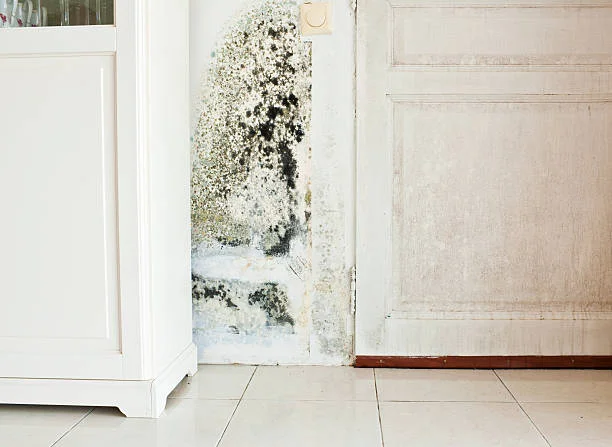
Bottom line up front: Mold behind furniture isn’t an air quality problem — it’s a physics problem. Until you understand what’s actually happening at that cold wall surface, every cleaning product you buy is just buying time.
Specifically, the part most articles skip entirely: the mold isn’t growing because your home is dirty or because moisture seeped through the wall from outside. It’s growing because the wall surface behind your sofa or wardrobe is cold enough to drop below the dew point of your indoor air — and at that exact temperature threshold, water vapor turns to liquid water on the wall. Mold doesn’t need a leak. It just needs that.
That’s the mechanism. Once you see it clearly, the fixes become obvious — and you’ll stop wasting money on things that don’t address the root cause.
Why Does Mold Grow Behind Furniture Specifically?
Furniture pushed against an exterior wall creates a microclimate. The gap between the back of the furniture and the wall — often just 1 to 3 inches — traps a pocket of air that doesn’t circulate with the rest of the room.
Here’s what that means in practice: the rest of your room might be 68°F with 55% relative humidity, which is perfectly fine. But in that stagnant pocket behind your wardrobe, the wall surface temperature could easily be 5 to 10°F colder than the room air — especially on north-facing exterior walls in winter. At 58°F wall surface temperature with the same moisture content in the trapped air, you’ve likely crossed the dew point. Condensation forms. Mold follows within 24 to 48 hours of sustained moisture.
The furniture itself makes things worse by acting as insulation — it keeps warm room air from reaching the wall and raising the surface temperature back up. You’ve essentially built a cold, dark, still, damp chamber. Mold didn’t stumble in by accident; you created ideal conditions for it.
What Is the Dew Point and Why Does It Matter Here?
The dew point is the temperature at which air can no longer hold all the water vapor it contains — so it dumps the excess as liquid water on whatever cold surface is nearby. Think of a cold glass of water on a humid day, beaded with condensation. Your wall is that glass.
At 68°F indoors and 50% relative humidity, the dew point is roughly 48°F. At 60% relative humidity, it jumps to around 54°F. That difference matters enormously — because a wall surface that’s perfectly fine at 50% RH can start collecting moisture the moment you nudge your indoor humidity up by 10 percentage points. The wall didn’t change. Your air did.
This is the counterintuitive part that most mold guides bury or ignore entirely: you can have a mold problem specifically behind your furniture even when the rest of your home feels and measures completely normal. The problem is localized physics, not a whole-home humidity failure.
“People focus on average room humidity, but mold doesn’t care about averages. It cares about the temperature of the surface it’s sitting on relative to the dew point of the air directly touching it. A piece of furniture blocking airflow to a cold exterior wall creates microclimatic conditions that are completely invisible until the mold appears.”
Dr. Sarah Colburn, Building Science Consultant and Indoor Environmental Quality Specialist
What Conditions Behind Furniture Actually Trigger Mold Growth?
Mold needs four things: a surface to grow on, a temperature it can tolerate, organic material to feed on, and moisture. The first three are almost always present behind furniture — wall paint contains organic compounds, temperatures behind furniture rarely get extreme, and the back panels of wooden furniture are basically a buffet. Moisture is the only variable you can actually control.
The threshold most building scientists use is a surface relative humidity above 80% sustained for more than 12 hours. That’s much lower than most people assume — you don’t need dripping walls. A surface that’s just slightly cooler than the dew point of your indoor air will sit at 80–100% RH even when the room itself measures a comfortable 55%.
Practically speaking, exterior wall surfaces in a poorly insulated home can drop to 50–55°F during cold weather. If your indoor air hits 65% relative humidity — common during cooking, showering, or a run of cloudy wet days — you’ve crossed into mold-risk territory behind any furniture touching that wall. The conditions are common. The awareness isn’t.
| Indoor Temp | Indoor RH | Approximate Dew Point | Mold Risk if Wall Surface Drops 8°F |
|---|---|---|---|
| 68°F (20°C) | 50% | ~48°F (9°C) | Low — surface stays above dew point |
| 68°F (20°C) | 60% | ~54°F (12°C) | Moderate — borderline condensation risk |
| 68°F (20°C) | 70% | ~58°F (14°C) | High — condensation likely on cold wall |
How Do You Know If You Have Mold Behind Furniture Without Moving Everything?
The honest answer: you often can’t know for certain without moving the furniture. But there are reliable early signals that should prompt you to check before the problem becomes expensive.
A musty smell that’s stronger in one corner of a room — and disappears when you move to the center — is one of the clearest signs. Mold produces microbial volatile organic compounds (MVOCs) as metabolic byproducts, and those compounds smell distinctly earthy or damp even in small concentrations. If you catch it in a specific zone, trust your nose over your eyes.
Other signals worth taking seriously:
- Dark or discolored patches visible at the edges of furniture legs or the bottom corners of walls near the floor
- Paint that looks slightly raised, bubbled, or chalky along the baseboard behind a sofa or wardrobe
- Allergy or respiratory symptoms that improve noticeably when you spend time away from home
- Condensation regularly visible on windows on the same wall as your furniture placement
- The wall feeling noticeably cooler to the touch than interior walls when you reach behind the furniture
You can also use a cheap infrared thermometer to check wall surface temperatures without moving anything. Slide your arm behind the furniture, aim the thermometer at the wall, and compare the reading to your room air temperature. A difference of more than 5–6°F on an exterior wall is worth acting on — that gap shrinks your safety margin considerably when indoor humidity rises. This is exactly the same physics at work behind your furniture as in poorly ventilated closets.
How Do You Actually Remove Mold Behind Furniture Safely?
Pull the furniture out completely first — don’t just peer around the edge. You need to see the full extent of the growth before doing anything else, and disturbing mold in a tight, unventilated space without proper airflow can disperse spores through the room.
Open a window and set up a fan to push air out of the room (not into it) before you start. Wear an N95 respirator — not a dust mask — gloves, and old clothes you can wash immediately. For surface mold on painted drywall that covers less than 10 square feet, you can handle this yourself. Larger infestations, any mold that’s penetrated the drywall paper, or colonies on bare concrete should involve a professional.
Here’s the removal process that actually works:
- Photograph and document the extent of growth before touching anything — useful for insurance or landlord conversations.
- Mist the mold lightly with water before scrubbing to prevent dry spores from becoming airborne.
- Scrub with a solution of 1 cup of bleach per gallon of water on non-porous surfaces like painted walls or concrete, working with a stiff brush and keeping the area wet.
- For the back panel of wooden furniture, use undiluted white vinegar (5% acidity) instead — bleach doesn’t penetrate porous wood effectively and can damage the material.
- Allow the surface to dry completely — at least 24 to 48 hours with ventilation — before returning furniture to the wall.
- Seal painted walls with a mold-resistant primer before repainting — regular paint applied over a cleaned mold spot will often re-colonize within weeks if the underlying conditions haven’t changed.
One honest nuance here: if you’ve had repeated mold growth in the same spot despite cleaning it correctly, the problem is the conditions — not the cleaning technique. No amount of scrubbing permanently solves a physics problem.
What’s the Right Way to Prevent Mold Behind Furniture Long-Term?
The gap is the single most effective passive intervention. Pull furniture at least 2 inches away from exterior walls — 3 to 4 inches is better — and you allow room air to circulate behind it, warming the wall surface and keeping it above the dew point. This sounds almost too simple, and it is simple, but it works because it directly addresses the mechanism: trapped stagnant air.
Controlling indoor humidity is the other half of the equation. Keeping your home below 50% relative humidity year-round dramatically reduces the dew point of your indoor air, which means wall surfaces need to get much colder before condensation can form. High Humidity Symptoms — persistent condensation on windows, a perpetually damp feeling, frequent allergy flares — are your early warning system that conditions are trending toward the danger zone.
To actually measure what you’re working with, you need a hygrometer — not guesswork. Learn How to Measure Indoor Humidity accurately and place sensors in the rooms where you have furniture against exterior walls, not just in central hallways where readings tend to be optimistically low.
Pro-Tip: Place a small wireless hygrometer sensor behind a piece of furniture on an exterior wall and leave it for 48 hours during cold weather. Compare its humidity reading to the main room reading — a difference of 10 percentage points or more tells you that microclimate is high-risk, and you need either better airflow, lower whole-room humidity, or both.
Does Insulating the Wall Behind Furniture Actually Help?
Yes — and this is the underused solution that almost no mold article mentions because it requires a bit more effort. Adding insulation to the interior side of an exterior wall raises the surface temperature of that wall, which means it stays above the dew point even in cold weather. The physics are direct and reliable.
You don’t need to renovate. Rigid foam insulation board — even a half-inch layer adhered to the wall behind where furniture will sit — can raise the surface temperature by 4 to 6°F in a typical home, which is often enough to eliminate the condensation problem entirely. This approach works particularly well in older apartments and homes where wall insulation is minimal or absent. A real-world scenario: a Victorian terrace house with solid brick exterior walls and no cavity for insulation is a classic mold-behind-furniture trap. The walls are inherently cold, and no amount of ventilating the gap will fully compensate. A thin layer of interior rigid foam is often the most practical long-term fix available to the occupant.
The catch — and it’s worth acknowledging — is that adding interior insulation moves the condensation plane inward. Done incorrectly without a proper vapor barrier, you can create a new moisture problem inside the wall assembly. If you’re insulating more than a small patch, it’s worth consulting a building professional about vapor barrier placement for your specific climate zone.
Are Some Types of Furniture More Likely to Cause Mold Problems?
Solid-backed furniture with no ventilation gaps is significantly more problematic than open-backed or slatted designs. A solid MDF-backed wardrobe essentially seals the air pocket behind it — nothing moves, nothing dries, and any moisture that forms stays put. Open-backed bookshelves, by contrast, allow enough airflow that the wall behind them rarely develops the same stagnant microclimate.
Material matters too. The back panels of flat-pack furniture are typically raw or lightly finished MDF or particle board — highly absorbent and an excellent food source for mold. Once mold colonizes the back panel, the furniture itself becomes a reservoir, and cleaning the wall does only half the job.
Upholstered sofas against exterior walls are a special case. The foam and fabric retain moisture far longer than a hard surface, and the mold that develops inside upholstery is effectively impossible to fully remediate without replacing the piece. If your sofa is against an exterior wall in a humid room, that wall should have at minimum a 3-inch gap and ideally some kind of airflow behind it.
Can a Dehumidifier Alone Solve Mold Behind Furniture?
A dehumidifier helps — sometimes a lot — but it’s doing something subtler than most people expect. It doesn’t dry the wall behind your furniture. It reduces the moisture content of the room air, which lowers the dew point, which means the wall surface has to get colder before condensation can form. You’re adjusting the threshold, not eliminating the temperature differential that creates the problem.
For homes where the exterior wall gets genuinely cold — below 45°F surface temperature during winter — even well-maintained indoor humidity of 45% can produce a dew point close to that threshold. In those cases, a dehumidifier helps but won’t fully solve the problem on its own. You still need the airflow gap or the added insulation to raise that wall surface temperature.
That said, for homes in mild climates where the issue is primarily seasonal humidity spikes rather than extreme wall coldness, a whole-room dehumidifier maintaining 45–50% RH often eliminates mold behind furniture entirely. The key is to actually measure the humidity where the problem is — not in the middle of the room — before assuming the dehumidifier is doing its job in that specific corner.
What If Mold Behind Furniture Keeps Coming Back?
Recurring mold in the same spot is telling you something hasn’t changed about the underlying conditions. The three most common reasons for repeat growth are: the humidity is still too high, the furniture gap is still too small, or the wall surface temperature is still cold enough to generate condensation under normal indoor conditions. Cleaning without addressing one of these is a cycle, not a solution.
Start by measuring the wall surface temperature with an infrared thermometer and comparing it to the room dew point. If there’s less than a 4°F safety margin, condensation will form again as soon as the weather gets cold. That tells you insulation or airflow is the missing fix.
If the surface temperature margin looks adequate but mold still returns, check whether your furniture gap is actually allowing air movement or just technically existing. A heavy sofa an inch from the wall with its back flush against the baseboard creates nearly the same trapped-air pocket as no gap at all. Furniture risers — simple rubber or wooden blocks that elevate and offset the furniture — are an inexpensive way to create a true airflow gap without moving the furniture permanently.
The long-term insight worth sitting with: buildings that were built before central heating were designed around different airflow patterns and had much lower indoor humidity levels because windows leaked and air exchanged constantly. Modern insulated, sealed homes are dramatically more energy-efficient — and dramatically more likely to trap moisture. Mold behind furniture is, in part, the unintended consequence of building better. The solution isn’t to make your home leakier; it’s to manage the moisture that now stays inside it.
Frequently Asked Questions
Can I paint over mold?
No. Mold will eat through the paint or grow underneath it, eventually causing the paint to bubble and peel.
Does a dehumidifier solve the problem?
A dehumidifier helps by lowering ambient moisture levels, but it won’t eliminate the problem completely without proper furniture spacing. Without the 2-inch rule, air behind wardrobes remains stagnant and can still reach dew point temperatures. Dehumidifiers work best when combined with improved airflow and furniture positioning.
How do I know if the mold is gone?
The Smell Test is the most reliable indicator. If the room still smells earthy or musty after cleaning, there’s likely mold inside the wall or furniture backing.
Disclaimer: This article is for informational purposes only and isn’t a substitute for professional mold inspection or remediation advice. Mold problems vary a lot depending on the material affected, the extent of growth, and your specific health situation. Always follow product label instructions when using cleaning chemicals, ensure proper ventilation, and consider consulting a certified mold remediation professional for anything beyond a small, surface-level patch. If you have respiratory conditions, allergies, or a compromised immune system, talk to a doctor before starting any DIY mold removal.