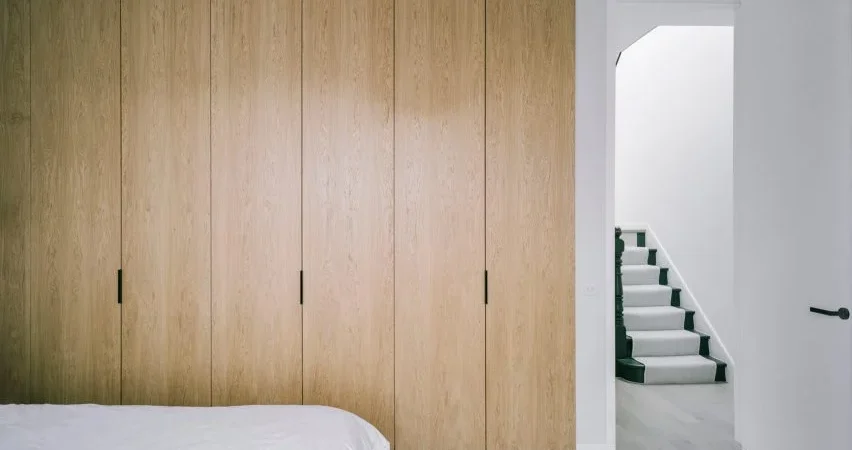
Pull a wardrobe six inches from the wall and you might find something that looks like a building problem — dark patches, fuzzy mould, paint bubbling off the plaster. But here’s what almost nobody says out loud: in the majority of cases, the wall itself isn’t the source of the moisture. You are. More precisely, the warm, humid air you exhale, cook with, and shower into the house every single day is migrating to that cold, unventilated surface behind the furniture and condensing there. Understanding that distinction changes everything about how you fix it.
What Are Damp Walls Behind a Wardrobe and Why Does Everyone Misdiagnose Them?
The standard assumption is that damp walls behind a wardrobe signal a leak — a broken pipe, a cracked render, rising damp creeping up from the foundations. Builders get called. Expensive surveys get commissioned. Sometimes the wardrobe gets ripped out, the plaster gets hacked off, and the actual problem is never addressed because it was never found. Damp walls have multiple causes, and conflating them is a very expensive mistake.
The real culprit behind most wardrobe-related damp is interstitial condensation — water vapour that has travelled through or along a wall and hit a cold enough surface to turn liquid. An external wall behind a wardrobe is both cold (because it’s losing heat to the outside) and unventilated (because the wardrobe is sitting right against it). That combination is almost a perfect recipe for condensation, independent of whether your roof leaks or your damp course is intact.
The counterintuitive fact that most articles skip over entirely: moving the wardrobe away from the wall by just 50mm (about two inches) can cut moisture accumulation on that surface by more than half — not because you’ve changed the wall, but because you’ve re-introduced airflow that allows the surface temperature to rise slightly and prevents vapour from stagnating. You haven’t fixed humidity. You’ve just stopped providing the conditions for condensation to dominate.
Why Does Condensation Form Behind Wardrobes Specifically?
Warm air holds moisture. Cold surfaces cause that air to release its moisture as liquid water. The technical threshold where this happens is called the dew point, and on an uninsulated external wall in a typical UK home, that surface can sit at 8–12°C during winter — well below the dew point of normal indoor air sitting at 20°C and 60% relative humidity.
Now block that wall with a wardrobe pushed flush against it. Air circulation stops. The small pocket of air trapped between the wardrobe and the wall cools down gradually, its relative humidity climbs toward 100%, and condensation forms on the wall face, the back of the wardrobe, and anything stored inside. Over weeks, you get mould — typically Cladosporium or Aspergillus, both of which thrive on the damp organic material in plaster dust, wallpaper paste, and MDF furniture.
What makes this location particularly bad is thermal bridging. Many external walls have structural elements — concrete lintels, steel ties, mortar joints — that conduct heat outward faster than the surrounding masonry. The wall surface directly behind a wardrobe, never warmed by radiators or sunlight, can be 4–6°C colder than the rest of the room. That small temperature difference matters enormously when you’re right on the edge of the dew point.
Is the Moisture Coming From Inside or Outside the Building?
This is the question that determines every subsequent decision, and most people get the answer wrong on first inspection. Penetrating damp from outside tends to appear in specific patterns: horizontal staining at height corresponding to a failing external detail, damp patches that follow the mortar joints, or wet areas that appear or worsen directly after heavy rainfall. Condensation behind a wardrobe almost never follows rainfall — it’s usually worse in winter and better in summer, worse in the morning and better by afternoon.
A simple test: tape a piece of aluminium foil — about 30cm square — directly onto the suspect wall section, seal all four edges with tape, and leave it for 24–48 hours. When you remove it, check which side is wet. Moisture on the room-facing side of the foil means condensation (water formed from indoor air hitting the cold foil). Moisture on the wall-facing side means water is coming through the wall from outside. It’s not a definitive lab test, but it’s directionally accurate and costs nothing.
Honest nuance: sometimes it’s both. A wall with minor penetrating damp that keeps the surface just slightly wetter than normal will dramatically lower the threshold for condensation to occur, making a moderate condensation problem into a severe one. Treating only the condensation side while ignoring a hairline crack in the external render will produce frustratingly slow improvement.
What Are the Specific Conditions That Make a Wall Behind a Wardrobe Vulnerable?
Not every wardrobe against every wall causes this problem. The ones that do tend to share a recognisable cluster of conditions, and knowing what they are lets you assess your own situation accurately rather than guessing.
- External wall placement. Internal walls rarely get cold enough to hit the dew point under normal living conditions. The risk is almost exclusively on external walls — particularly north-facing ones that receive little solar gain throughout the day.
- No cavity insulation or poor thermal performance. Solid brick walls, older cavity walls with failed or absent insulation, and single-skin constructions lose heat to the outside faster, keeping the internal wall surface colder.
- Wardrobe pushed flush to the wall. Zero gap means zero airflow. Even a 40–50mm standoff creates enough circulation to reduce surface moisture dramatically by allowing some heat exchange with room air.
- Indoor relative humidity above 60%. Once you’re regularly above this threshold, condensation on cold surfaces becomes nearly unavoidable in poorly ventilated spaces. A family of four generates roughly 10–12 litres of water vapour indoors per day through breathing, cooking, bathing, and drying clothes.
- Inadequate whole-home ventilation. Trickle vents sealed shut, extractor fans that don’t work, and a habit of keeping all windows closed during winter create a building that traps moisture inside with no exit route.
How Does Airflow (Or the Lack of It) Physically Create Damp on a Wall?
Airflow does two things that matter here. First, it carries warm air from the heated room space to the cold wall surface, which raises the surface temperature by even a few degrees — often enough to stay above the dew point. Second, it dilutes the humid air near the wall with drier air from the rest of the room, which lowers the local relative humidity before it can hit 100%.
Block that airflow with a wardrobe and neither thing happens. The trapped air cools to match the wall temperature. The moisture in that trapped air has nowhere to go but the wall surface. It’s essentially the same physics that causes condensation on a cold glass of water on a warm day — except instead of a glass, you have three square metres of plaster that’s been absorbing and releasing moisture slowly for years.
What people consistently underestimate is how fast this cycle degrades the wall. Each wet-dry cycle slightly weakens the bond between plaster and masonry. Salts from the masonry migrate to the surface during the wet phase and crystallise during the dry phase — a process called efflorescence — which physically breaks down plaster from the inside. After a few seasons, you’re not just dealing with a damp patch. You’ve got structurally weakened plaster that will need replastering even after the moisture problem is solved.
What Does Mould Behind a Wardrobe Actually Tell You About the Problem?
Mould growth is not the problem — it’s the symptom, and it’s also a useful diagnostic tool if you pay attention to where exactly it appears. Mould growing uniformly across the entire back wall surface, and also on the back panel of the wardrobe, almost always indicates condensation-driven damp. The distribution is too even for a leak, which would show a point source or follow gravity downward.
Mould in the corners — especially low corners — can indicate one of two things: corner areas are thermal bridges (two external surfaces meeting means double the heat loss), or there’s a rising damp issue being amplified by condensation. The tell is height: rising damp rarely climbs above 1–1.2 metres from floor level. Mould appearing at 1.5 metres or higher in a corner is almost certainly condensation.
“The wardrobe doesn’t cause the moisture problem — it just hides it long enough for it to become a serious one. By the time most people pull the furniture out, the mould colony is months old and the plaster has often started to delaminate. The mechanism is always the same: a cold surface, stagnant air, and indoor relative humidity that’s been running too high for too long. Fix the airflow first, then address the humidity source, and you’ll rarely need to touch the wall itself.”
Dr. Patricia Henshaw, Building Pathologist and lecturer in moisture-related building failure, School of the Built Environment
What’s the Difference Between Condensation Damp and Penetrating Damp Behind Furniture?
The distinction matters practically because the fixes are almost completely different. Condensation damp is solved through a combination of improved ventilation, reduced indoor humidity, and sometimes warming the wall surface with insulation. Penetrating damp is solved by finding and repairing the external defect — a cracked render, a failed window seal, blocked cavity drainage, a missing roof flashing above a bay window.
| Feature | Condensation Damp | Penetrating Damp |
|---|---|---|
| Pattern on wall | Diffuse, widespread, often with mould | Defined patch, follows water path |
| Seasonal variation | Worse in winter, especially mornings | Worse after or during rainfall |
| Salt deposits | White fluffy efflorescence | Tide marks, brown staining |
| Primary fix | Ventilation, humidity control, insulation | External repair to building fabric |
A real-world scenario worth picturing: imagine a bedroom in an older terraced house, north-facing, with a fitted wardrobe that runs floor to ceiling and wall to wall. The wardrobe was built flush to the external wall with no back panel gap. After several winters, the owners notice a musty smell and eventually spot black speckling on the back panel of the wardrobe. They call a damp surveyor expecting bad news about the building. The surveyor’s actual recommendation? Remove the fitted wardrobe back panels, install a 50mm batten framework to hold the wardrobe off the wall, fit a low-energy extractor running on a humidistat, and run a dehumidifier through the first winter to dry out the plaster. Total cost: a fraction of what a wall injection or re-rendering would have been. The wall itself was structurally fine.
How Do You Reduce Indoor Humidity to Protect Walls Behind Furniture?
Reducing indoor humidity is less about buying equipment and more about understanding where your moisture is coming from. The big sources — cooking, showering, and drying clothes indoors — are each responsible for 1–3 litres of water vapour per episode. Running an extractor fan only while you’re in the shower and turning it off the moment you leave doesn’t work; post-shower steam can take 20–30 minutes to fully clear, so the fan needs to run on a timer for at least that long afterward.
Cooking with lids on pots reduces vapour generation significantly. Drying clothes on a rack in a closed bedroom is arguably the single worst thing most people do for their wall moisture levels — it can push local humidity above 80% for hours. Moving the drying rack to a room with an open window, or switching to a vented tumble dryer, removes that moisture source from the building entirely.
Mechanical ventilation matters more than most people realise. Trickle vents in double-glazed windows, if they exist, are often found in the closed position — people shut them to reduce draughts and then forget they’ve closed off their ventilation. Opening them, particularly in bedrooms overnight, provides a passive route for moist air to escape.
Pro-Tip: Place a cheap hygrometer (under £15) inside the wardrobe itself, not just in the room. Humidity inside a closed wardrobe against a cold external wall can run 10–15 percentage points higher than the room reading — which is exactly the threshold difference that separates a dry surface from an actively moulding one.
Does Wall Insulation Actually Solve Damp Behind a Wardrobe?
Internal wall insulation — adding a layer of insulated plasterboard or a thin thermal coating to the inside face of an external wall — addresses condensation damp by raising the wall surface temperature above the dew point. It’s one of the most reliable permanent fixes for cold-wall condensation, but it comes with a serious caveat that most people don’t anticipate.
Adding insulation to the inside of an external wall pushes the cold zone further into the wall construction — what was previously condensing on the interior surface may now condense within or behind the insulation layer. This is why vapour control layers are a non-negotiable part of any internal insulation job. Without one, you can transform a visible surface mould problem into hidden interstitial condensation inside the wall structure, which is harder to detect and potentially more damaging.
That said, when done correctly — insulated dry-lining with a continuous, well-taped vapour control layer on the warm side — internal insulation essentially eliminates the cold surface problem behind wardrobes. It also improves the room’s thermal efficiency, which means the room reaches target temperature faster and holds it with less energy. The insulation pays for itself in more than one way.
What Are the Practical Steps to Fix Damp Walls Behind a Wardrobe?
Before any remediation, confirm the diagnosis. Use the foil test described earlier, check whether damp correlates with rainfall or with winter morning humidity, and look at where exactly the mould is concentrated. Only then does it make sense to choose your approach.
- Pull the wardrobe out and let the wall dry fully first — replastering or painting over active moisture traps it and accelerates future damage. Use a fan heater directed at the wall for several days if needed.
- Treat existing mould with a diluted bleach solution (1 part bleach to 4 parts water) or a proprietary mould remover — scrub with a stiff brush, allow to dry fully, and re-treat if any spots return.
- Reposition the wardrobe with a 50–100mm gap from the wall — use furniture feet or cut batten sections to create a permanent standoff that maintains airflow.
- Install a humidistat-controlled extractor fan in the room — set to activate at 60–65% relative humidity. This removes moisture at the source before it migrates to cold surfaces.
- Consider anti-condensation paint as a short-term measure — these paints contain insulating microspheres that raise the surface temperature slightly and reduce condensation on the painted area, buying time while more permanent solutions are implemented.
When Should You Call a Professional Rather Than Fixing This Yourself?
The self-diagnosis and self-treatment route works well when the problem is clearly condensation-driven, limited in extent, and the wall structure is intact. Signs that you need professional input: damp that persists after the wardrobe has been removed and the wall has been given several weeks to dry; wall plaster that sounds hollow when tapped (delamination has occurred); visible damage to structural timber elements like floor joists or wall plates; or any situation where you genuinely can’t determine whether the moisture is coming from inside or outside.
A building pathologist or an independent damp surveyor — not one sent by a remediation company with a financial interest in diagnosing injected damp-proofing — is worth paying for when the picture is unclear. Damp surveyors who work independently and charge a flat fee for a written report tend to give more useful, impartial diagnoses than those who offer “free” surveys that inevitably recommend expensive treatments.
One observation that challenges the common framing: damp remediation companies have a strong commercial incentive to recommend chemical injection damp-proofing even when the problem is condensation. Chemical damp-proofing does absolutely nothing to address condensation moisture — it targets capillary rise in masonry, a different mechanism entirely. Getting the right diagnosis is more valuable than any treatment.
How Do You Prevent Damp Walls Behind a Wardrobe From Returning?
Prevention is far cheaper than remediation, and it’s mostly behavioural and positional rather than structural. The wardrobe gap is the single most important physical change — maintain it permanently, and don’t gradually push the furniture back against the wall as you rearrange the room.
Monitor relative humidity actively during winter. Target 40–55% as your indoor range. Above 60% sustained for long periods, condensation risk on cold surfaces rises significantly; below 40%, occupant comfort and respiratory health can suffer. A room hygrometer takes the guesswork out of this completely.
Ventilation habits matter year-round but especially from autumn through spring. Opening bedroom windows for 10–15 minutes in the morning — even in cold weather — allows the overnight accumulation of moisture from breathing to escape before it settles onto cold surfaces. It’s a small habit that has a measurable effect on surface moisture levels over a season.
Longer term, external wall insulation (applied to the outside of the building) eliminates the cold-surface problem entirely without any of the vapour control complexity of internal insulation. It’s more expensive and requires planning consent in some cases, but it permanently removes the conditions that create condensation damp behind furniture — because the wall itself is no longer cold on the inside. That’s the end-state worth working toward.
Frequently Asked Questions
Why is the wall damp only behind the wardrobe?
Because airflow is blocked and moisture becomes trapped.
Does dampness behind furniture mean a leak?
Usually no — it is often caused by humidity and condensation.
Why didn’t I notice it earlier?
Because the area was covered and dried very slowly.
Can damp walls behind wardrobes lead to mold?
Yes, if moisture persists over long periods.

