
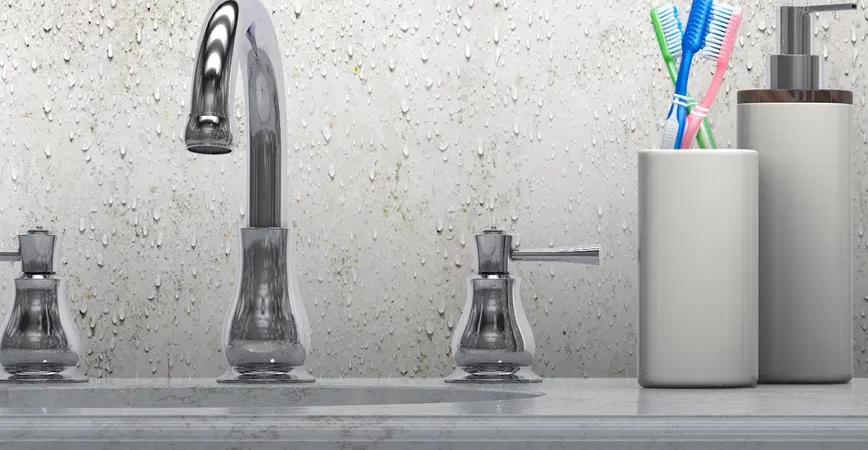
Bathroom condensation is normal — until it isn’t. That single distinction is what most guides completely skip over, leaving you either dismissing a real problem or panicking over a perfectly healthy shower. The truth is that condensation in the bathroom follows predictable physics, and once you understand those mechanics, you’ll know exactly when to act and when to leave it alone.
What Actually Causes Condensation in the Bathroom?
Every time you run a hot shower, you’re essentially creating a small indoor weather event. Water heats up, evaporates into the air as vapor, and that vapor-laden air rises and spreads through the room. When it contacts a surface that’s cooler than its dew point — the mirror, the tiles, the window — it drops back into liquid form. That’s condensation: not a plumbing issue, not a building defect, just physics doing its thing.
The dew point is the key number here. At typical bathroom conditions — say, 70°F (21°C) air temperature before your shower — the dew point might sit around 50°F (10°C). A 10-minute hot shower can push relative humidity above 90%, raising the dew point to 65°F (18°C) or higher. Any surface in the room that’s cooler than that will collect moisture. Cold tiles on an exterior wall are the most common victim, but so is a window, a mirror, or even a metal towel rail.
Here’s what catches people off guard: the amount of condensation you see doesn’t directly measure how much moisture is in the air. A bathroom with a single small mirror will look “drier” than one with floor-to-ceiling tiles, even if both rooms have identical humidity levels. Surface area and surface temperature matter more than most people realize.
Why Your Bathroom Gets More Condensation Than Any Other Room
No other room in the house generates liquid water at that volume on a daily basis. A standard 8-minute shower releases roughly 2 pints (about 1 liter) of water vapor into the air — and that’s before you factor in a bath or any hand-washing throughout the day. Kitchens come close, but cooking vapors tend to be more intermittent and spread across a larger space.
Bathrooms also tend to be small, often the smallest room in the house, which concentrates that moisture. Less air volume means relative humidity spikes faster and harder. A 40-square-foot bathroom will hit 90% relative humidity in minutes; the same vapor load in a 200-square-foot bedroom barely moves the needle.
Cold surfaces accelerate the problem. Exterior-facing walls, uninsulated pipes, and single-pane windows can stay 10 to 15 degrees cooler than the ambient room temperature, sitting well below the dew point for most of your shower. This is also why condensation in the bathroom behaves differently from condensation in other rooms — bathrooms combine high vapor output with small volume and uniquely cold surfaces, a trifecta you won’t find in a living room or bedroom.
When Is Bathroom Condensation Completely Normal?
A steamed-up mirror after a hot shower? Completely normal. Droplets on the window that disappear within 30 minutes after the extractor fan kicks in? Also normal. Brief beading on cold tiles during winter? Still normal. The body of evidence here is straightforward: temporary condensation that clears on its own is just your bathroom doing its job.
The clearing time is your best quick diagnostic. In a well-ventilated bathroom, surface condensation should disappear within 15 to 30 minutes of the shower ending and the fan running. If your mirror is still fogged an hour later, or if you’re noticing persistent wet patches on the ceiling mid-morning, something is off with either your ventilation or your wall temperatures. Normal condensation is transient by definition.
Season also matters here. Winter bathroom condensation will always be heavier than summer condensation because the temperature differential between warm, moist shower air and cold window glass is much greater. It’s honest to say: what counts as “normal” shifts depending on the time of year, the age of your windows, and how long your showers are. A one-size answer doesn’t exist.
What’s the Real Threshold Between Normal and Problematic?
This is the question nobody seems to answer clearly, and it’s the most useful one. The threshold isn’t about how much condensation you see during a shower — it’s about what’s happening to your bathroom between showers. Persistent dampness, surfaces that never fully dry, and damp smells that linger after ventilation has run: these are signs that moisture is building up faster than it’s escaping.
A useful rule of thumb: if your bathroom smells musty when you walk in first thing in the morning — before anyone has showered — your ventilation isn’t clearing yesterday’s moisture load. At that point, you’re not dealing with condensation as a normal byproduct; you’re dealing with chronic humidity accumulation, which is a different problem entirely.
Black mold appearing at grout lines or window corners is the clearest hard signal. Mold needs sustained relative humidity above 70% for roughly 24 to 48 hours to begin colonizing. If your bathroom humidity is dropping appropriately after each shower, mold won’t get the foothold it needs. Spotting it means your ventilation cycle is broken somewhere.
“Most homeowners treat bathroom condensation as a cosmetic nuisance rather than a ventilation diagnostic. But the mirror isn’t just fogging up — it’s giving you real-time feedback about your air exchange rate. If that fog takes more than 20 minutes to clear with the fan running, your extractor is undersized or your makeup air supply is restricted. Those are fixable mechanical problems, not inevitable features of bathroom design.”
Dr. Helen Marsh, Building Physicist and Indoor Air Quality Consultant, BSc (Hons) Environmental Science, PhD Building Physics
Why Ventilation Alone Doesn’t Always Solve It
This is the counterintuitive part that most guides miss entirely: extractor fans need makeup air to work properly. An extractor fan pulls moist air out of the room, but that air has to be replaced by drier air coming in from somewhere. If your bathroom is sealed tightly — think a newly weather-stripped door with no undercut, no trickle vent, no gap anywhere — the fan creates negative pressure, struggles against itself, and moves far less air than its rated capacity suggests.
In practice, this means a homeowner can install a brand-new 100 m³/h extractor fan, run it during every shower, and still find condensation building up because the door seal is too tight for air to flow in and replace what the fan is trying to push out. The fix there isn’t a bigger fan — it’s an undercut on the door (typically 10 to 15mm clearance) or a trickle vent that lets replacement air in without causing a draught.
Equally overlooked: fan placement. A fan mounted directly above the shower captures moisture at its densest point and moves it out before it spreads. A fan mounted across the room from the shower — which happens more often than you’d think, because electrical regulations in some regions restrict wiring near water — has to pull vapor horizontally across the whole room, reducing efficiency considerably. Location beats rating almost every time.
How Cold Walls Make Bathroom Condensation Worse (And What to Do About It)
Here’s a scenario that plays out in thousands of older homes: the bathroom feels warm during a shower but the outside wall stays stubbornly cold all winter. Tiles on that wall run at 45°F (7°C) even when room temperature is 70°F (21°C). Every cubic foot of humid shower air that touches that wall deposits moisture immediately. The result isn’t just a steamed-up mirror — it’s streaming tiles, wet grout, and eventually a frost-like coating of condensation that takes hours to dry.
The underlying problem is thermal bridging: cold is conducting through an uninsulated or under-insulated exterior wall directly to the tile surface. Fixing it properly means adding insulation behind that wall — a project that usually involves removing and re-tiling — which is a significant undertaking. A more realistic interim approach is to raise the surface temperature of cold walls slightly by keeping the bathroom warmer generally: a heated towel rail running on a low setting between showers can raise the ambient temperature by 3 to 5°F, which may be enough to push tile surface temperatures above the dew point during showering.
There’s no universal answer to whether wall insulation is worth the disruption — it depends on how severe the problem is, how old the building is, and whether you’re planning a bathroom renovation anyway. But if you’re in a pre-1980s home with uninsulated solid walls and you’re getting significant condensation specifically on exterior-facing surfaces, improving insulation will do more lasting good than any ventilation upgrade.
5 Signs Your Bathroom Condensation Has Crossed Into a Real Problem
- Condensation that persists more than 30 minutes after showering — with the extractor fan running, moisture should clear well within half an hour. Persistent fogging points to an airflow problem that needs investigating, not just tolerating.
- Musty odor in the morning before any shower has run — residual smell from overnight means your bathroom never fully dried out from yesterday’s use. You’ve crossed from temporary condensation into chronic dampness.
- Black specks appearing in grout or silicone sealant — this is early-stage mold, not dirt. It requires sustained moisture above 70% RH for 24+ hours to form. Once visible, it needs chemical treatment and a ventilation fix to stop it returning.
- Paint bubbling or peeling on the ceiling — paint on an unventilated bathroom ceiling absorbs moisture over time until the bond between paint and substrate fails. This is a mid-stage sign that moisture has been accumulating for weeks or months.
- Window frames showing swollen wood or rust around metal fittings — these are structural indicators. Swollen frames mean moisture has penetrated the material itself, not just condensed on the surface. At this point, periodic wiping won’t help.
What Humidity Level Should a Bathroom Be At?
During a shower, relative humidity in the bathroom will routinely hit 90 to 100% — that’s unavoidable and you shouldn’t try to prevent it. What matters is how quickly it falls back to normal once the shower is done. The target is to return to 50 to 60% relative humidity within 15 to 30 minutes of finishing and running the extractor. Above 60% RH sustained for several hours creates conditions where mold and dust mites thrive.
A cheap hygrometer — the kind with a digital display that costs less than $15 — is genuinely useful here. Put it in your bathroom and check it 30 minutes after your next shower. If it’s still reading above 65%, you have a ventilation gap worth addressing. Below 60%? Your system is working.
One nuance worth flagging: relative humidity readings vary with temperature. A bathroom that cools rapidly after a shower will show higher RH readings even if the absolute amount of moisture in the air hasn’t changed, because cooler air holds less vapor. This is why heated bathrooms sometimes perform better on a hygrometer even without better extraction — the warmer air masks the humidity problem rather than solving it.
| Humidity Level (Post-Shower) | Status | Typical Cause |
|---|---|---|
| Below 60% within 30 min | Normal — no action needed | Good ventilation and air exchange |
| 60–70% at 30–60 min | Marginal — monitor and improve | Undersized fan or restricted airflow |
| Above 70% after 60+ min | Problematic — act now | Ventilation failure or cold wall issue |
Practical Steps to Reduce Bathroom Condensation Without a Full Renovation
Running the extractor fan before you start the shower — not just during — makes a measurable difference. Pre-running for 5 minutes lowers the baseline humidity in the room before you add vapor load, which means the air reaches its condensation point later and less moisture ends up on surfaces. Most people switch the fan on after they’ve already been showering for several minutes; by then, the mirror is already gone.
Keeping the bathroom door slightly open during a shower (if privacy allows) allows replacement air to flow in steadily, supporting the extractor rather than fighting it. Even a 1-inch gap dramatically improves the fan’s actual output compared to a sealed room. And running the fan for at least 15 to 20 minutes after the shower ends — not switching it off the moment you step out — clears the residual moisture the fan hasn’t had time to extract yet.
A few practical adjustments that don’t require tools:
- Run the extractor fan for at least 15 minutes after leaving the shower, not just during it
- Leave the bathroom door ajar (even 1 inch) to allow makeup air into the room
- Open the window slightly after showering even in winter — 2 to 3 minutes of through-ventilation clears more moisture than 20 minutes of fan-only extraction
- Wipe down cold tiles and window glass immediately after showering to remove liquid water before it evaporates back into the room air
- Switch to slightly cooler showers — dropping water temperature by 5°F generates significantly less vapor and reduces peak humidity by up to 15%
Pro-Tip: If your extractor fan has a humidistat setting, calibrate it to activate at 65% RH rather than the default, which is often set higher from the factory. This ensures the fan kicks in earlier in the humidity cycle and prevents the air from spending time in the mold-risk zone before extraction begins.
Does Condensation on Bathroom Walls Mean You Have Rising Damp?
This is one of the most common misdiagnoses in older homes, and it’s worth spending a moment on. Rising damp — moisture wicking up through a wall from the ground — presents at low levels, typically below 1 meter from the floor, and tends to leave a visible tide mark and mineral deposits (efflorescence) on the wall surface. Condensation, by contrast, appears anywhere cold air contacts a cold surface, often higher up and most visibly on the upper walls and ceiling where humid air naturally rises.
If your wet patches are appearing at shoulder height or above, and they disappear after a few dry, ventilated days, that’s condensation. If they’re concentrated at the base of walls, present year-round, and associated with peeling paint from the outside in rather than bubbling from behind, it’s worth getting a damp specialist to check for rising damp specifically. The treatments are completely different, so misdiagnosing one for the other wastes time and money.
A simple test: tape a piece of aluminum foil (about 12 inches square) flat against the suspect wall with all edges sealed, leave it for 24 hours, then check. If moisture appears on the room-facing side of the foil, it’s condensation coming from the air. If it appears on the wall-facing side, moisture is coming through the wall itself — a different problem entirely.
Why Old Bathrooms Handle Condensation Better Than New Sealed Ones
This will surprise people who assume newer is always better. Older bathrooms — the kind with drafty windows, gaps around pipework, and old-style ventilation bricks — were often naturally “leaky” in ways that actually helped with humidity management. Air moved in and out passively all the time, which meant post-shower humidity dispersed without any mechanical assistance at all.
Modern bathrooms are built to a much tighter standard: energy-efficient window seals, insulated walls, and minimal air infiltration. These are genuinely good things for heat retention. But they shift the entire burden of humidity management onto a single mechanical extractor fan, and if that fan is undersized, poorly placed, or running without adequate makeup air, moisture has nowhere to go. The bathroom essentially traps itself.
This doesn’t mean you should punch holes in your walls. It means that in a modern, well-sealed bathroom, the extractor fan specification and placement aren’t optional upgrades — they’re the critical mechanism that replaces what drafts and gaps used to do for free. Treat the fan as a core building system, not an afterthought.
Bathroom Condensation in Winter vs. Summer: Why the Season Changes Everything
The same shower that barely fogs your mirror in July can completely steam out the room in January. The reason is temperature differential: in winter, exterior walls, windows, and even interior wall surfaces can be 15 to 25°F colder than the warm shower air. That massive gap between air temperature and surface temperature means vapor deposits rapidly and heavily. In summer, surface temperatures are closer to air temperature, so far less vapor crosses the dew point threshold.
This means seasonal condensation peaks are expected and don’t necessarily indicate a worsening problem. If you’re seeing heavier condensation in December than in August, that’s physics, not a building defect. What you’re watching for is whether winter condensation is clearing properly after each shower — if it is, your ventilation is keeping pace even under peak winter conditions. If it’s not clearing, winter is just exposing a ventilation gap that exists year-round but becomes visible under stress.
Pre-heating the bathroom before showering in winter — running a heated towel rail or a small wall heater for 10 minutes before you start — raises surface temperatures enough to reduce the amount of condensation that forms. It won’t eliminate it, but it narrows that temperature differential enough to make a real difference in how much moisture ends up on tiles and glass.
A Final Thought on Getting This Right
Bathroom condensation sits at the intersection of thermodynamics, ventilation engineering, and building fabric — which sounds intimidating but really just means there are three levers you can pull: reduce the moisture going in, raise surface temperatures, or improve how fast moisture gets out. Most people only think about the third lever and ignore the first two entirely. Start paying attention to shower duration, water temperature, and how cold your walls actually get, and you’ll have a far more complete picture of what’s really happening in your bathroom than any guide that just tells you to “run your extractor fan.”
Buildings that manage humidity well don’t do it by accident — they do it because someone understood the mechanics well enough to set the system up properly. Get your ventilation working correctly, keep your surfaces warm enough, and you’ll spend a lot less time worrying about whether that foggy mirror is normal or not.
Frequently Asked Questions
Is condensation in the bathroom normal?
Yes. It is very common after showers or baths.
Why does condensation appear on bathroom ceilings?
Because warm, moist air rises and ceilings stay cooler.
Can bathroom condensation happen without leaks?
Yes. It usually comes from steam, not water damage.
Why does condensation last longer in winter?
Cold surfaces slow evaporation.
Does bathroom condensation cause mold?
Only if surfaces stay damp repeatedly over long periods.