
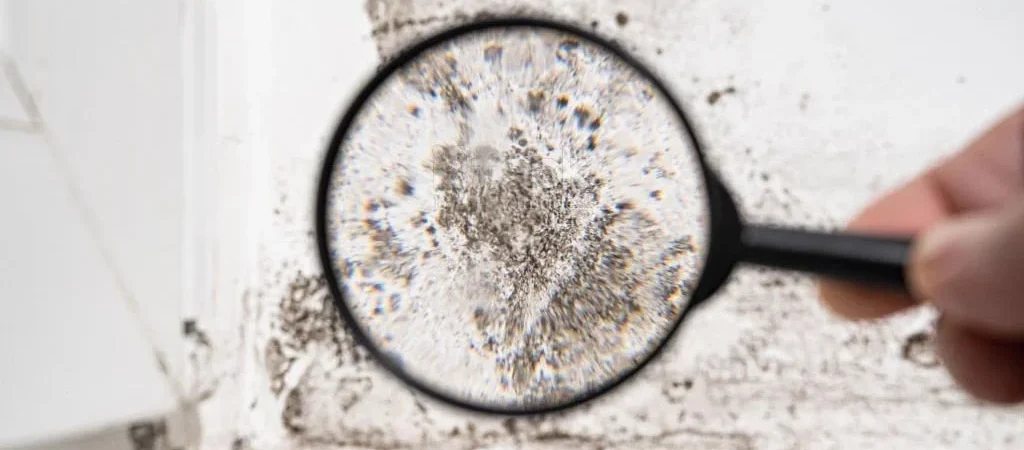
Bottom line: That musty odor you’re chasing through your home almost certainly comes from mold that’s actively growing somewhere you can’t see — and the smell alone means the colony is already large enough to release measurable concentrations of microbial volatile organic compounds (MVOCs) into your air. Visible mold is the late-stage version of the problem. The smell is the early warning, and most people treat it backwards.
Why You Can Smell Mold Before You Can See It
Mold produces gases called microbial volatile organic compounds — MVOCs — as a byproduct of its metabolic activity. These compounds, which include 1-octen-3-ol, geosmin, and various aldehydes, are detectable by the human nose at concentrations as low as a few parts per billion. That’s the part most articles skip: you don’t need a lot of mold to generate a powerful smell, you just need actively metabolizing mold.
A colony the size of a postage stamp, growing in a warm, damp cavity inside a wall, can generate enough MVOCs to make a whole room smell musty. The smell intensity doesn’t map to colony size the way people assume — it maps to how actively the mold is feeding. A large dormant colony can smell less than a small, very active one that’s been freshly wetted.
This is why spraying bleach on a visible spot and declaring victory is almost always the wrong call. The visible surface growth is rarely where the real metabolic action is happening.
What Does Hidden Mold Actually Smell Like?
The classic descriptor is “musty” or “earthy,” but that’s not always accurate. Different mold species produce different MVOC profiles, which means the smell can range from a damp basement odor to something faintly sweet, faintly cheesy, or even slightly chemical. Stachybotrys — what people call black mold — tends to produce a strong, sour, almost sewage-adjacent odor when it’s actively wet.
Cladosporium and Penicillium, which are far more common in homes, produce that classic musty library smell. Aspergillus species can smell faintly sweet or soil-like. If you’re in a room and the smell shifts depending on which corner you’re standing in, or it gets stronger when the HVAC kicks on, that’s a meaningful diagnostic clue — not just background weirdness.
The smell will often be more noticeable first thing in the morning, when the house has been closed up overnight and MVOC concentrations have had time to build. If you open the windows and the smell is mostly gone within 20 minutes but returns by evening, you’re dealing with an active, ongoing source — not residual odor from something that’s already dried out.
Where Is the Mold Hiding? The Most Overlooked Sources
The question everyone asks is where to look, and most answers give you the same list: check the bathroom, check under the sink, check the basement. That list isn’t wrong — it’s just incomplete in ways that matter. The locations that generate the most calls to remediation companies are the ones that don’t appear on the standard checklist.
Here are the six most commonly missed hidden mold sources, roughly in order of how often they’re found after a thorough inspection:
- Inside HVAC ducts and on the air handler coil. The evaporator coil in your air handler sits in a dark, perpetually damp environment, and the drain pan underneath it is one of the most reliable mold habitats in any home. When the system runs, it aerosolizes spores and MVOCs directly into every room. You’ll notice the smell gets worse the moment the fan kicks on — that’s the tell.
- Behind and beneath bathroom tile. Grout looks waterproof. It isn’t, especially after a few years of hot showers. Water migrates through hairline cracks into the cement board or drywall behind the tile, where it sits for days between showers. The mold smell without visible mold scenario is almost textbook here — the surface tile looks fine, but the cavity behind it is colonized.
- Inside wall cavities near plumbing. A slow drip from a supply line fitting — the kind that loses maybe a tablespoon of water a day — can saturate wall insulation for months before it shows up as a stain or soft spot. Fiberglass insulation is particularly hospitable because it traps moisture against the wood framing while remaining invisible from outside.
- Under flooring, especially glued-down vinyl or laminate. Concrete subfloors often have higher moisture content than people realize, and moisture vapor migrating up through a concrete slab can get trapped under impermeable flooring. The organic adhesive, the backing material, and any wood underlayment become the food source. The mold is essentially sandwiched in a sealed, dark, damp environment — ideal for rapid growth.
- In the attic, near roof penetrations. Bathroom exhaust fans that vent into the attic instead of through the roof — a common installation shortcut — dump warm, humid air into a space that can’t handle it. The condensation soaks into the roof decking and insulation, and the mold that grows there sends odors down through light fixtures, recessed lights, and ceiling gaps into the living space below.
- Inside the wall cavity behind the refrigerator or dishwasher. Both appliances have condensate lines and water supply connections that develop slow leaks at their fittings. The space directly behind them is rarely inspected. A refrigerator ice maker line that weeps half a cup of water per week can sustain mold growth in the adjacent wall for years without producing a visible stain on the exterior surface.
Why the Smell Gets Worse in Some Rooms but Not Others
Pressure differentials inside a home are one of the most underappreciated factors in how mold odor distributes. When your HVAC system is running and one room has a closed door, that room may become slightly negative or positive pressure relative to adjacent spaces. Air — and the MVOCs carried in it — flows from high pressure to low pressure, which means the smell can concentrate in a room that has no mold at all while the actual source is two rooms away.
Stack effect makes this even more complicated. In cold weather, warm air rises through the house and exits at the upper levels while drawing fresh air in at the lower levels. If you have mold in a basement or crawl space, the stack effect pulls those odors upward through floor gaps, electrical penetrations, and wall cavities into the main living areas. People smell mold in their bedroom and spend hours searching the bedroom walls while the source is directly below them.
Temperature also affects MVOC volatilization — warmer air causes mold to off-gas more aggressively. So a hidden colony that’s barely noticeable in winter can become overwhelming in summer when the surrounding wall temperature rises. If the smell intensifies predictably with season or time of day, you’re getting useful information about where the source is located.
How to Find Hidden Mold Without Tearing Your Walls Apart
There’s a systematic way to narrow down a hidden mold source before you start cutting drywall, and it starts with using your nose like an instrument rather than just registering “it smells bad in here.” Systematic odor mapping — moving through spaces methodically, getting low, getting close to surfaces, testing with and without HVAC running — will usually get you to within a few square feet of the source.
A thermal imaging camera (many home inspectors bring these, and they’re available to rent for around $50–75 per day) can reveal moisture anomalies inside walls without invasive cuts. Cold spots on walls that should be thermally uniform often indicate moisture accumulation. Combine this with a pin-type moisture meter, which you can buy for under $30, and you can confirm moisture presence in drywall before committing to opening anything.
Air sampling is worth understanding but worth being realistic about. A DIY petri dish test from a hardware store tells you that mold spores are present in your air — which is true in virtually every building on earth. It won’t tell you where the mold is or whether the concentrations are problematic. A professional air quality test with ERMI (Environmental Relative Moldiness Index) analysis is far more diagnostic, though it costs $200–400 and requires interpretation by someone who understands the methodology.
Pro-Tip: Before spending money on any testing, turn your HVAC system off completely, close all windows, and sit quietly in the room with the strongest odor for 20 minutes. Then move your nose within 6 inches of every outlet, switch plate, baseboard gap, and floor seam in that room. Air leaks from wall cavities are often detectable as slightly cooler spots on your cheek or forearm — and wherever air is leaking in, that’s where the smell is strongest and most concentrated, pointing directly toward the hidden source.
What Causes the Mold to Grow Where You Can’t See It?
Hidden mold growth has exactly the same requirements as visible mold: a food source, moisture, and temperatures above roughly 40°F. The “hidden” part happens because the moisture source is hidden — a slow leak, condensation inside a wall cavity, or vapor migrating through a building material. Understanding the moisture pathway is the real diagnostic challenge, and it’s where most DIY mold searches fall short.
Condensation inside walls is particularly common in mixed climates. When warm, humid interior air meets a cold wall surface — typically an exterior wall in winter, or an interior wall near a cold-water supply line — the dew point is reached and water condenses onto the framing, insulation, or drywall paper. The paper facing on standard drywall is essentially a cellulose food source sitting in a dark, still-air environment. Once humidity stays above 70% in that cavity consistently, mold will establish within 24–72 hours.
Condensation issues that create mold smell without visible mold are especially tricky because there’s no active drip or stain to follow — just physics operating slowly and invisibly inside your building envelope. Solving it means addressing the temperature differential or the humidity source, not just the mold itself.
“People focus on finding the mold colony, but what they really need to find is the moisture pathway. The mold is just living where the water is — remove the water and the mold can’t persist, regardless of whether you physically remove every spore. Remediation without moisture control is just temporary odor management.”
Dr. Patricia Ramirez-Okafor, Industrial Hygienist and Certified Indoor Environmentalist, Building Health Associates
Is the Smell Itself Dangerous, Even Without Visible Mold?
This is the question people are most anxious about, and the honest answer is: it depends on the individual and the exposure duration. MVOCs themselves — the compounds creating the smell — can cause irritation of the eyes, throat, and upper respiratory tract at elevated concentrations even in people with no mold allergy. They’re not inert. That said, the health risk from hidden mold is better understood as the total spore and MVOC load in the air, not the smell intensity alone.
Some people live with significant hidden mold loads and experience only mild, intermittent symptoms — headaches, a persistent runny nose, fatigue that they attribute to other causes. Others, particularly those with asthma, allergies, or compromised immune systems, can develop more acute reactions. The counterintuitive fact here is that mold smell intensity is not a reliable proxy for mold health risk — because different species produce vastly different MVOC profiles but similar spore loads, or vice versa.
Certain hidden bathroom smells that people dismiss as “just the drain” or “old grout” are sometimes the clearest early warning sign of a meaningful hidden mold load. The tendency to normalize persistent odors is one of the reasons hidden mold situations escalate to the point where remediation becomes a multi-thousand-dollar project rather than a targeted fix.
Hidden Mold vs. Other Musty Smells: How to Tell the Difference
Not every musty smell is mold. Accumulated dust in HVAC returns, damp cardboard in storage areas, old upholstered furniture, and even VOCs off-gassing from aging building materials can all produce odors that people describe as musty or moldy. The distinction matters because the remediation approach is completely different.
Here’s a practical way to differentiate the most common confusable sources:
| Smell Source | Key Distinguishing Feature | Quick Test |
|---|---|---|
| Hidden mold (active) | Smell intensifies when HVAC runs, persists after ventilation, often stronger at specific wall or floor areas | Odor returns within hours of thorough ventilation |
| Dust/HVAC debris | Smell appears only when system first turns on, fades within minutes | Replace filter and clean return grille; smell reduces immediately |
| Old organic materials (cardboard, books) | Smell is localized to storage area, not present in living spaces away from the materials | Remove materials and smell disappears within 24 hours |
| Sewage/drain biofilm | Has sulfur or rotten-egg notes, strongest near drains and plumbing fixtures | Pour water into floor drain to restore trap seal; smell from dry P-traps disappears immediately |
What to Do Once You’ve Located the Probable Source
Finding the general area is a win, but what you do next determines whether you actually solve the problem or just relocate it. The sequence matters more than people realize.
- Fix the moisture source first, always. Opening a wall to treat mold while a slow leak continues is genuinely pointless. Identify and repair the water pathway before any remediation work begins.
- Don’t use bleach on porous materials. Bleach kills surface mold on non-porous surfaces but doesn’t penetrate into drywall, wood framing, or insulation where the hyphae are embedded. EPA guidelines recommend physical removal of affected porous materials, not chemical treatment.
- Contain the work area before opening walls. Cutting into a mold-colonized wall releases significant numbers of spores. Use plastic sheeting and painter’s tape to isolate the work area and run an air purifier with a HEPA filter during and after the work.
- Replace, don’t clean, heavily affected drywall. Any drywall or insulation with visible mold growth covering more than roughly 10 square feet should be treated as a remediation project, not a DIY clean-up. The EPA’s 10 square foot guideline exists for a reason — scale determines exposure risk.
- Address the humidity, not just the mold. If the hidden mold was caused by chronically high indoor humidity (above 60% RH), no amount of remediation will produce lasting results without a dehumidification strategy. The conditions that produced the first colony will produce the next one.
When Should You Call a Professional?
There’s a real case for doing preliminary investigation yourself — it saves money and helps you describe the situation accurately when you do call someone. But there are clear situations where professional assessment isn’t optional, it’s genuinely necessary.
If the smell is building-wide rather than room-specific, if you’ve had any major water event (flooding, burst pipe, roof leak), or if anyone in the household has been experiencing unexplained respiratory symptoms or fatigue, the scope of assessment should go beyond what a homeowner can reasonably manage. A Certified Industrial Hygienist (CIH) or Certified Indoor Environmentalist (CIE) can perform a systematic inspection with proper equipment and provide a written assessment that isn’t influenced by the financial interest of selling you remediation services — which is a meaningful distinction when you’re getting estimates from remediation contractors.
Real-world scenario: a family in a townhouse noticed a persistent musty smell in their first-floor living room. They checked the bathroom above, the basement below, and every visible surface they could find. Clean. A home inspector with a thermal camera found a 4-foot-wide moisture anomaly in the exterior wall behind a built-in bookcase — a slow leak at a window flashing that had been directing water into the wall cavity for what was estimated to be 18–24 months. The colony was entirely inside the wall, the exterior siding was intact, and the only symptom for nearly two years had been that smell. The remediation cost $4,800. Had the flashing been repaired at the first sign of the smell — when the moisture content in the wall was still recoverable — it would have cost around $400.
Can You Reduce the Smell While You’re Tracking Down the Source?
Temporarily, yes — but with an important caveat. Masking the smell with air fresheners, ozone generators, or scented candles does nothing to reduce MVOC or spore concentrations, and ozone generators in particular can react with MVOCs to create secondary pollutants that are more irritating than the original compounds. They’re not a neutral stopgap.
Air filtration with a true HEPA filter rated for your room size will reduce airborne spore counts measurably — by 85–95% in a properly sized application. This genuinely reduces exposure while the source investigation is ongoing. Activated carbon filters added in combination will capture some MVOC load and reduce the smell intensity. Neither approach addresses the source, but they’re defensible interim measures while you work the problem.
Ventilation is context-dependent. In low-humidity conditions, increasing fresh air exchange dilutes MVOC concentrations and reduces symptoms. In high-humidity outdoor conditions, ventilating aggressively can add moisture to the indoor environment and feed the mold faster. Check your outdoor dew point before deciding to open everything up — if the outdoor relative humidity is above 60%, mechanical dehumidification beats ventilation for managing indoor moisture while the source remains active.
The Real Reason Hidden Mold Gets Missed for So Long
Here’s the sub-angle that almost no article about this topic addresses directly: the reason hidden mold persists so long isn’t that it’s hard to detect. It’s that humans are remarkably fast at adapting to ambient odors. Olfactory adaptation — the technical term for what happens when you stop consciously registering a smell you’re constantly exposed to — kicks in within minutes for most people. You stop noticing the smell in your own home within days of continuous exposure, even when guests who walk in the front door immediately register it.
This means the person most likely to detect hidden mold in your home is someone who doesn’t live there. The fact that you’ve “gotten used to it” is not evidence the smell is gone or minor — it’s just evidence that your nose has deprioritized it. Inviting a friend or family member who hasn’t been in your home recently to do a cold walk-through and tell you what they notice is genuinely one of the most diagnostically useful steps you can take, and it costs nothing.
The homes with the worst hidden mold situations are almost never the ones where the occupants have been complaining loudly. They’re the ones where the occupants have quietly adjusted to the baseline and only discovered the problem when selling the property, doing a renovation, or developing symptoms serious enough that they finally connected the dots. Treating mold smell as background noise rather than as an active signal is the single most expensive mistake people make with this problem.
The good news is that modern moisture detection tools and systematic inspection methods have made it possible to find hidden mold with far less destructive investigation than was required even a decade ago — and the sooner the moisture source is interrupted, the narrower the window of time mold has to establish deeply enough that physical removal becomes the only option.
Frequently Asked Questions
Can mold smell exist without visible mold?
Yes. Mold often grows in hidden areas before becoming visible.
Does mold smell always mean there is a leak?
No. High humidity and condensation are common causes.
Why does the smell get stronger at certain times?
Humidity, airflow, and temperature changes affect odor intensity.
Can ventilation remove mold smell permanently?
Ventilation may reduce odor temporarily but does not remove the source.
Is mold smell common in apartments?
Yes. Apartments often have hidden areas where moisture accumulates.
Disclaimer: This article is for informational purposes only and isn’t a substitute for professional mold inspection or remediation advice. Mold problems vary a lot depending on the material affected, the extent of growth, and your specific health situation. Always follow product label instructions when using cleaning chemicals, ensure proper ventilation, and consider consulting a certified mold remediation professional for anything beyond a small, surface-level patch. If you have respiratory conditions, allergies, or a compromised immune system, talk to a doctor before starting any DIY mold removal.