
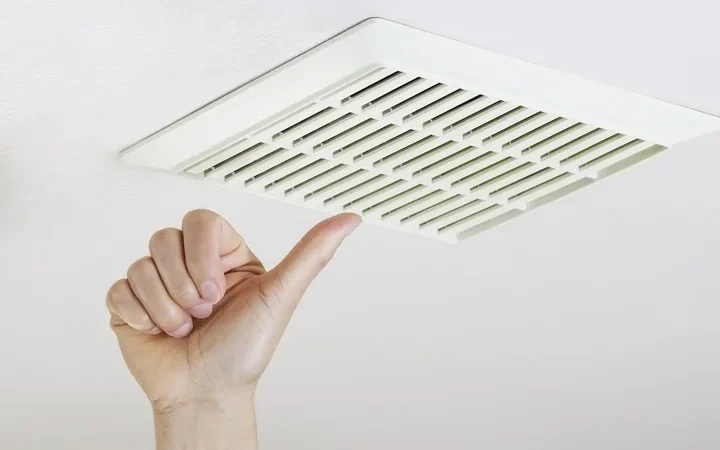
- Exhaust-only ventilation pulls air out of the home — typically through bathroom fans or kitchen hoods — and relies on passive infiltration to replace it. It’s inexpensive but creates negative pressure, which in humid climates can pull moist outdoor air through wall cavities, potentially causing hidden moisture problems inside the building envelope.
- Supply-only ventilation pushes fresh air in, pressurizing the home slightly. This keeps outdoor air from infiltrating through uncontrolled gaps, but in humid climates, you’re actively introducing outdoor moisture — which can raise indoor humidity if the system isn’t paired with dehumidification.
- Balanced ventilation (HRV/ERV systems) exchanges equal volumes of air in and out. A Heat Recovery Ventilator (HRV) transfers heat between the airstreams; an Energy Recovery Ventilator (ERV) transfers both heat and moisture. ERVs are generally better for humid climates because they limit how much outdoor moisture enters with the incoming air.
- Natural ventilation relies on pressure differences from wind and temperature to move air. It works, but it’s uncontrollable — you can’t tune it to a specific humidity target, and it fails entirely when outdoor conditions are similar to indoor conditions (no pressure differential).
- Hybrid systems combine mechanical and natural ventilation strategically. They can be highly effective in mixed climates where outdoor conditions vary significantly by season, allowing you to use free natural ventilation when conditions are favorable and switch to mechanical control when they’re not.
- Persistent musty or earthy smell, especially in bathrooms, closets, or basements — this is often early-stage mold before it’s visible
- Window condensation that appears most mornings and takes hours to clear, rather than dissipating quickly after sunrise
- Peeling paint or bubbling wallpaper on exterior walls — moisture migrating through the wall is pushing against the surface finish
- Wood floors cupping or doors swelling seasonally, which indicates sustained elevated humidity affecting structural materials
- Allergic symptoms that improve when you leave the home and worsen upon return — this pattern often points to elevated mold spore counts driven by poor humidity control
- Run bathroom exhaust fans correctly. Install a timer or humidity-sensing switch set to run for 20–30 minutes after a shower, not just during it. The steam load peaks in the first few minutes but the moisture stays airborne for much longer.
- Use the kitchen range hood consistently. Even low-heat cooking produces significant moisture and combustion byproducts. A range hood venting to the outside (not a recirculating filter type) at 100–150 CFM handles the load; a recirculating hood does essentially nothing for humidity.
- Seal duct leaks. Leaky supply ducts in humid crawlspaces or attics can pull unconditioned air — packed with moisture — into the living space. Duct sealing with mastic compound or metal tape (not standard duct tape) is one of the highest-ROI humidity interventions available.
- Improve crawlspace and basement control. Ground moisture migrating up through crawlspace dirt floors accounts for a significant portion of whole-home humidity in many climates. A ground vapor barrier combined with mechanical crawlspace ventilation or encapsulation dramatically reduces the moisture load the rest of the house has to manage.
- Consider a whole-home dehumidifier paired with ventilation. Standalone dehumidifiers work room by room; a whole-home unit integrated with the HVAC manages humidity across the entire house and can be set to maintain a specific RH target regardless of outdoor conditions. This pairs best with controlled ventilation so you’re not constantly fighting outdoor humidity with mechanical dehumidification.
- Monitor dew point, not just relative humidity. Relative humidity changes with temperature even when the actual moisture content of the air hasn’t changed. Dew point is stable regardless of temperature — a dew point above 60°F indoors is consistently uncomfortable regardless of what the thermometer reads, and it’s a more reliable trigger for taking action.
- 40–60% RH: the target range for indoor relative humidity; below 40% causes respiratory irritation and static buildup, above 60% promotes mold growth and dust mites
Bottom line up front: Ventilation doesn’t just “air out” your home — it actively controls how much moisture stays in the air. Most humidity problems aren’t caused by humidity itself, but by ventilation that’s either missing, mismatched, or running at the wrong time. Fix the ventilation, and you fix the humidity.
That’s the thesis almost every article on this subject skips. They’ll tell you to buy a dehumidifier, crack a window, or check your HVAC filter. But they rarely explain the actual relationship: ventilation is the delivery mechanism for humidity control. Without understanding how air exchange rates interact with moisture loads inside your home, you’re essentially guessing. And guessing is why so many people end up with persistent dampness, musty smells, or condensation they can’t explain.
This article is about getting that relationship right — not just what to do, but why it works.
Why Does Ventilation Affect Indoor Humidity Levels?
Every breath you exhale adds moisture to the air. So does cooking, showering, running the dishwasher, and even houseplants slowly transpiring through their leaves. A single person at rest releases about 40 grams of water vapor per hour. A family of four, plus a dog, plus a pot of pasta boiling — you’re looking at a significant daily moisture load that has nowhere to go unless air is actually moving out of the building.
Ventilation works by exchanging indoor air — which is loaded with that moisture — for outdoor air, which typically carries a different moisture content. The mechanism isn’t magic: it’s dilution. Fresh air coming in displaces humid air going out, and if the exchange rate is sufficient for the size of the space and the activity level inside it, relative humidity stays in the healthy range of 40–60%.
Here’s where it gets interesting: outdoor air isn’t always drier than indoor air. In humid climates, pulling in outdoor air in summer can actually raise indoor humidity. That’s why “just open a window” is advice that works in some seasons and actively backfires in others.
What Happens When Ventilation and Humidity Are Out of Sync?
Think about a newer, tightly sealed home. Modern construction is excellent at energy efficiency — it keeps heated or cooled air inside — but it also traps moisture with nowhere to go. The result is a slow climb in relative humidity that most people don’t notice until they see foggy windows, feel a sticky sensation in the air, or discover mold growing behind a bookshelf.
Older homes have the opposite issue. They’re drafty, which means they ventilate naturally — but inconsistently. In winter, cold dry outdoor air infiltrates through gaps, which can tank indoor humidity to 20–25%, causing dry skin, static electricity, and cracked wood floors. The home is “breathing,” but not in a controlled way.
Neither extreme is good. The goal is controlled, intentional ventilation that’s calibrated to the actual moisture load in the space — not too little, not too much, and definitely not dependent on weather luck.
How Much Ventilation Does a Home Actually Need to Control Humidity?
ASHRAE Standard 62.2 — the industry benchmark for residential ventilation — recommends a whole-house ventilation rate of 0.01 CFM (cubic feet per minute) per square foot of floor area, plus 7.5 CFM per occupant. For a 1,500-square-foot home with four occupants, that works out to roughly 45 CFM of continuous mechanical ventilation. That’s not a huge number, but most homes don’t hit it.
Spot ventilation matters just as much. Bathrooms should exhaust at a minimum of 50 CFM during use, and kitchen range hoods should move 100 CFM or more depending on cooking intensity. These aren’t arbitrary figures — they’re based on the moisture and contaminant loads those specific rooms generate per hour of use.
Running a bathroom fan for just two minutes after a shower and then switching it off is one of the most common mistakes people make. The fan needs to run for at least 20 minutes post-shower to actually remove the moisture load from the room — the steam lingers long after the visible fog clears.
“Humidity control isn’t really a humidity problem — it’s a ventilation design problem. The homes I see with the worst moisture issues almost always have mechanical ventilation that was sized for code compliance, not for actual occupancy patterns. When you add a working-from-home adult, a pet, and daily cooking to a system designed for minimum occupancy, the math stops working.”
Dr. Renata Kovacs, Indoor Environmental Quality Consultant, ASHRAE Member
What’s the Difference Between Exhaust, Supply, and Balanced Ventilation for Humidity?
Not all ventilation systems handle humidity the same way, and the type you have shapes everything about how moisture moves through your home. Understanding the three main categories helps you diagnose why your current setup might be underperforming.
The honest nuance here: there’s no universally “best” system. An ERV that works beautifully in a hot humid climate might over-retain humidity in a mild temperate one. The right choice depends on your climate zone, home construction type, and how the space is used.
What Is the Counterintuitive Thing About Ventilation and Humidity Nobody Talks About?
Here it is: increasing ventilation can temporarily raise indoor humidity before it lowers it. If outdoor air is warm and moisture-laden — as it is on a summer afternoon in most of the eastern United States — opening vents or running a supply fan will dump humid air into the home. Relative humidity spikes. People panic, assume the ventilation is making things worse, and shut it off. Then the interior moisture load builds unchecked, and the problem gets significantly worse over the next several hours.
The fix isn’t to stop ventilating — it’s to time ventilation correctly. In humid climates, the best outdoor air conditions occur in the early morning, when overnight cooling has brought both temperature and absolute humidity down. Running mechanical ventilation during those hours, and closing up during peak afternoon humidity, is the single most underused residential humidity strategy there is.
This is why smart ventilation controllers that read outdoor dew point — not just temperature — are genuinely useful tools. Dew point is a far more reliable indicator of outdoor moisture content than relative humidity alone, and a controller set to avoid ventilation when outdoor dew point exceeds 55°F can prevent hours of unnecessary moisture loading per day.
How Does Poor Ventilation Cause Condensation and Mold?
When warm, moist indoor air contacts a surface cold enough to drop the air below its dew point, condensation forms. This is the physical mechanism behind every foggy window, every dripping pipe, and every patch of mold behind furniture or in corners. Condensation in apartments is especially common because apartments tend to have limited wall and ceiling insulation, shared walls with unconditioned spaces, and restricted tenant control over HVAC systems.
Ventilation breaks this cycle by keeping indoor relative humidity low enough that the dew point of the air stays below the temperature of cold surfaces. If your indoor air is at 65% RH and 70°F, the dew point is around 56°F — meaning any surface below 56°F will collect condensation. But if ventilation keeps indoor RH at 45%, the dew point drops to roughly 47°F, and far fewer surfaces in a conditioned home will be that cold.
Mold is the downstream consequence of persistent condensation. It doesn’t need standing water — it needs surface moisture that stays present for more than 24–48 hours. Poor ventilation is the reason condensation becomes chronic rather than occasional, and it’s the reason mold grows in predictable spots: low air circulation corners, behind furniture against exterior walls, around window frames, and inside closets that share exterior walls.
Pro-Tip: If you have chronic condensation on a specific wall or window, place a small fan nearby to increase air movement across that surface. Airflow raises the effective surface temperature slightly and prevents the still-air boundary layer from accumulating enough moisture to condense — a cheap fix that works while you address the underlying ventilation issue.
What Are the Specific Signs Your Ventilation Is Failing at Humidity Control?
A hygrometer — a simple device you can buy for under $15 — should be your first diagnostic tool. Place it in the main living area and check readings at different times of day. Healthy indoor relative humidity sits between 40% and 60%. Consistently above 60% means your ventilation isn’t removing enough moisture. Consistently below 30% suggests over-ventilation in dry weather or insufficient humidification in winter.
Beyond the numbers, certain physical signs are reliable indicators that something is wrong with the ventilation-humidity balance in your home:
Each of these signals is the end of a chain that starts with inadequate air exchange. The visible symptom is moisture; the root cause is usually ventilation that wasn’t designed — or isn’t being operated — to handle the actual moisture load in the space.
How Do HVAC Systems and Standalone Ventilation Work Together?
Your central HVAC system does some ventilation work — but less than most people assume. Forced-air systems circulate and filter air, and the cooling cycle removes moisture as a byproduct of lowering air temperature. But they don’t necessarily bring in meaningful amounts of fresh outdoor air unless specifically designed to do so with a dedicated outdoor air intake.
Recirculating HVAC without fresh air supply is excellent at temperature control but does nothing for CO2 buildup or moisture removal from activities like cooking and showering — because it’s moving the same air in loops, not exchanging it. This is why a home can feel stuffy and humid even with the AC running: the system is cooling the air but not exchanging it.
Pairing your HVAC with dedicated whole-home ventilation — an HRV or ERV integrated into the duct system, or a standalone unit — closes that gap. The ventilation system handles fresh air exchange and humidity control; the HVAC handles temperature. Each does what it’s actually designed to do, rather than asking one system to do both jobs poorly.
| System Type | Humidity Control Method | Best Climate Application |
|---|---|---|
| Exhaust-only (bathroom fans) | Removes moisture at source; draws in uncontrolled outdoor air | Dry or mixed climates; low-cost situations |
| HRV (Heat Recovery Ventilator) | Exchanges air; transfers heat but not moisture | Cold climates where winter humidity is low |
| ERV (Energy Recovery Ventilator) | Exchanges air; transfers both heat and moisture | Hot humid climates; limits summer moisture entry |
| HVAC with dedicated OA intake | Conditions and filters incoming outdoor air | All climates; highest control when properly sized |
Does Ventilation Work Differently in Winter Than Summer for Humidity?
Yes — and confusingly, the problem flips completely between seasons. In summer, the challenge is too much moisture indoors: internal sources like cooking and bathing combine with warm humid outdoor air to push RH above comfortable levels. Ventilation strategy in summer is about removing moisture-laden indoor air while being careful about when and how much outdoor air enters.
In winter, the challenge reverses. Cold outdoor air holds very little absolute moisture — when you heat it to room temperature, its relative humidity drops dramatically. A winter day at 32°F and 80% outdoor RH, once heated to 70°F indoors, becomes air at roughly 15% RH. That’s desert-dry. Ventilating aggressively in winter to remove cooking or shower moisture can over-dry the home, causing cracked skin, wood damage, and increased susceptibility to respiratory illness.
This seasonal reversal is why HRVs are so valuable in cold climates — they exhaust stale moist indoor air but transfer heat back to the incoming cold air, reducing both heat loss and the drying effect of winter ventilation. Without heat recovery, every cubic foot of cold dry air you bring in costs you both heat energy and indoor humidity, which often leads people to under-ventilate in winter to stay comfortable, creating a buildup of pollutants and CO2.
What Practical Changes Actually Improve Indoor Humidity and Ventilation Together?
The most effective changes address the source-to-exit pathway for moisture: where it’s generated, how quickly it’s captured, and how efficiently it leaves the building. Starting at the source is almost always more efficient than trying to fix humidity after it’s already spread throughout the space.
Can You Over-Ventilate a Home and Make Humidity Worse?
Absolutely — and this is one of the most underappreciated failure modes in residential ventilation. In humid climates, oversized or always-on ventilation systems can pull in so much outdoor air during peak humidity periods that no amount of cooling or dehumidification can keep up. The result is high indoor humidity even though — or technically because — the home is extremely well ventilated.
This scenario plays out most dramatically in commercial buildings with oversized HVAC systems, but it happens in homes too, especially when DIY installation of whole-home fans or ERVs doesn’t account for local climate data. A whole-house fan designed for a hot dry climate, installed in a home in coastal Louisiana, will actively worsen indoor humidity on most summer days.
The solution isn’t less ventilation — it’s smarter ventilation. Demand-controlled ventilation that responds to CO2 levels, outdoor dew point, or occupancy patterns ventilates when needed and holds back when conditions make outdoor air a humidity liability. This technology exists at every price point now, from simple humidity-sensing fan controllers to integrated whole-home systems.
How Do You Know When to Add Dehumidification Instead of More Ventilation?
Ventilation and dehumidification are partners, not substitutes — but knowing when to lean on which one saves both money and frustration. Ventilation is the right tool when your indoor moisture problem is driven by internal sources: occupants, cooking, bathing, plants. You’re removing humid air and replacing it with drier outdoor air. That works when outdoor air actually is drier, which it often is in temperate climates or during certain times of day.
Dehumidification becomes the primary tool when outdoor conditions make ventilation ineffective or counterproductive — during hot humid summers, in coastal regions, or in below-grade spaces like basements where outdoor air is persistently more humid than indoor targets allow. In these situations, a dehumidifier removes moisture from the same air volume without exchanging it for outdoor air that would just re-introduce the problem.
A practical decision rule: if your indoor humidity is high and outdoor dew point is above 60°F, run the dehumidifier and minimize fresh air intake. If outdoor dew point is below 55°F, ventilate — the free drier air will do the job without the electricity cost of mechanical dehumidification. The threshold between those two numbers is climate-dependent and time-of-day dependent, which is why automated controllers that read outdoor conditions beat timers for real-world performance.
Indoor Humidity and Ventilation: The Numbers That Matter
Most of the advice floating around on this topic is directionally correct but light on specifics. These are the actual numbers worth knowing and applying: