
Sixty percent of homes in humid climates have indoor relative humidity levels above 60% for at least part of the year — and the vast majority of people living in them have no idea. That’s not because high indoor humidity symptoms are subtle. It’s because most of us have been trained to look at the wrong things. We blame a scratchy throat on allergies, a musty smell on “old house,” and a foggy bathroom mirror on a weak exhaust fan. The real culprit — air that’s holding too much moisture — goes undiagnosed for months, sometimes years, while the damage quietly compounds.
What Are High Indoor Humidity Symptoms (And Why Do People Keep Missing Them)?
The core problem is that high indoor humidity symptoms rarely announce themselves as a humidity problem. They masquerade as something else — a health issue, a maintenance issue, a “that’s just how old houses are” issue. Homeowners treat the symptom, not the source. The mold gets bleached off the grout. The peeling paint gets a fresh coat. The musty smell gets an air freshener. Six months later, everything is back, and nobody connects the dots.
Most articles about this topic give you a checklist of signs. That’s useful, but it skips the more valuable question: why do these symptoms appear in the first place? Understanding the mechanism behind each symptom is what actually helps you act faster and smarter. So that’s the angle this article takes — not just what to look for, but what each symptom is telling you about what’s happening inside your walls, your air, and your body.
The sweet spot for indoor relative humidity is between 40% and 50%. Once you push past 60%, the conditions shift enough that biological and physical processes start working against you. Above 70%, you’re in a different category entirely — structural damage, rapid mold growth, and significant health impacts become likely rather than possible.
What Does High Humidity Actually Feel Like in a Home?
The physical experience of a high-humidity home is distinct, once you know what you’re feeling for. Air above 60% relative humidity has a weight to it — not metaphorically, but literally. Water vapor is lighter than dry air, but humid air carries more total mass per unit volume, and that affects how heat transfers to and from your skin.
You’ll feel warmer than the thermostat suggests. Your body cools itself through sweat evaporation, and in saturated air, sweat evaporates slowly. A room at 75°F and 65% humidity will feel more uncomfortable than the same room at 78°F and 40% humidity — the heat index accounts for this, but most people don’t apply that logic indoors.
Surfaces feel subtly damp or tacky. Wooden furniture takes on a slightly swollen quality. Doors that fit fine in winter start sticking in summer. These aren’t random maintenance failures — they’re the building’s physical response to excess moisture in the air.
What Are the Physical Health Symptoms of High Indoor Humidity?
Here’s where the misdiagnosis problem gets expensive. A lot of people spend real money on allergy testing, over-the-counter antihistamines, and doctor visits for symptoms that are being continuously generated by the air quality in their own home. High indoor humidity creates at least three distinct biological threats that all produce overlapping symptoms.
First, mold spores. Mold grows aggressively above 60% relative humidity on virtually any organic surface — drywall, wood, fabric, paper, dust. Mold spores are airborne and inhaled constantly in affected homes. Symptoms include nasal congestion, sneezing, itchy or watery eyes, skin irritation, and in sensitive individuals, asthma flare-ups. These are clinically indistinguishable from seasonal allergies without environmental testing.
Second, dust mites. These microscopic organisms thrive at humidity levels above 50% and essentially cannot survive below 40%. Their fecal matter — not the mites themselves — is one of the most common indoor allergens in the world. A humid home is, functionally, a dust mite farm. Symptoms: same as mold, with a particular emphasis on morning congestion (you’ve been breathing mite-saturated air for eight hours while you sleep).
Third, volatile organic compounds (VOCs) from bacteria. High humidity accelerates microbial growth on surfaces throughout the home. Some bacteria produce VOCs as byproducts — these gases can cause headaches, dizziness, and fatigue. It’s one reason that “sick building syndrome” correlates so strongly with moisture problems.
“The single most underappreciated indoor air quality problem I see in residential settings is chronic humidity mismanagement. Patients come in with persistent respiratory symptoms and have often been cycling through allergy medications for years. When we finally test their home environment and find relative humidity consistently above 65%, and they address it, the improvement is often dramatic. High humidity isn’t just a comfort issue — it’s a clinical one.”
Dr. Margaret Holloway, Board-Certified Allergist and Indoor Environmental Health Consultant
What Do High Indoor Humidity Symptoms Look Like on Walls, Ceilings, and Floors?
Your home’s surfaces are, in a sense, the most honest reporters you have. They don’t adapt, compensate, or ignore the problem — they just react. And what they show you is often the clearest evidence of chronic high humidity that you can act on right now without buying any equipment.
Paint peeling or bubbling on interior walls (not just exterior-facing ones) is one of the most reliable indicators. Moisture vapor migrates through walls, and when it hits a barrier — like a paint film — it pools beneath the surface, breaks the adhesion, and causes bubbling or flaking. If this is happening on an interior wall nowhere near plumbing, excess ambient humidity is one of the first things to investigate.
Efflorescence on concrete walls or floors — that chalky white mineral residue — happens when moisture moves through concrete and carries dissolved salts to the surface. It’s not dangerous on its own, but it’s a reliable marker of persistent moisture infiltration. In basements specifically, it often means ambient humidity is staying high enough for prolonged periods that condensation is regularly forming on the cooler concrete surfaces.
Warped hardwood floors are particularly telling. Wood expands perpendicular to the grain when it absorbs moisture. If your hardwood floors are cupping (edges curving upward) or crowning (center boards higher than edges), the subfloor moisture content has changed significantly. This typically requires sustained indoor humidity above 60% over weeks or months to produce visible warping.
What Does Mold From High Humidity Look Like — And Where Does It Hide?
Visible mold is the symptom people take most seriously, but it’s actually the late-stage indicator. By the time you can see mold, you’ve already had a humidity problem long enough for spore colonies to establish, grow, and become large enough to detect. Think of visible mold as the “check engine” light that’s been on for a while before you noticed it.
The most common locations for humidity-driven mold are places where temperatures drop enough to cause condensation on surfaces even when the room air humidity is only moderately elevated. Window frames and sills, exterior-facing wall corners near the floor, areas behind large furniture pushed against exterior walls, the underside of bathroom exhaust fans, and the back panel of kitchen cabinets on exterior walls. These are thermal bridging points where the surface temperature drops below the dew point.
A counterintuitive place many people miss: inside closets on exterior walls. The clothes act as insulation for the outer wall, lowering the surface temperature further. Combined with limited air circulation, this creates near-perfect mold conditions even in homes that seem otherwise fine. If your closet smells musty but the rest of the house doesn’t, check the back wall.
Color isn’t a reliable identifier for mold species — the “black mold” panic is largely overstated. Green, black, white, and gray mold can all produce allergens and irritants. What matters more than color is location, texture (fuzzy indicates active growth), and smell. A persistent musty, earthy smell is often detectable before any visual mold appears.
How Do You Know If Indoor Humidity Is the Cause (And Not Something Else)?
This is the honest nuance most articles skip: not every symptom on this list is automatically caused by high humidity. A scratchy throat could be low humidity. Peeling paint could be poor surface preparation before painting. Warped floors could be a plumbing leak. Before you invest in dehumidifiers or HVAC upgrades, confirm that ambient humidity is actually the problem.
A hygrometer — a device that measures relative humidity — costs between $10 and $30 and takes about two seconds to read. Place one in the area where you’re seeing the most symptoms and check it at different times of day over a week. If you’re regularly seeing readings above 60%, especially above 65%, you have your answer. If readings are staying below 55%, the symptoms have a different source and you’re solving the wrong problem.
One real-world scenario worth knowing: a family in a well-insulated newer home replaces their windows, adds weatherstripping, and dramatically reduces air infiltration. Within one heating season, indoor humidity climbs because the cooking, bathing, and breathing that used to escape through gaps now stays inside. The house is “tighter” and more energy-efficient — but now has a humidity problem it didn’t before. This is increasingly common in modern construction, and the solution isn’t to un-seal the home but to add controlled ventilation.
Pro-Tip: Take your first hygrometer reading first thing in the morning before opening windows or running exhaust fans. Overnight is when indoor humidity peaks in most homes — activity stops, ventilation drops, and moisture from breathing accumulates. If that reading is already above 60%, you’re dealing with a structural humidity issue, not just occasional spikes from cooking or showering.
What Are the Structural and Home Damage Symptoms of Chronic High Humidity?
Structural damage from chronic high humidity tends to be slow, progressive, and invisible until it becomes expensive. The mechanism is straightforward: wood absorbs and releases moisture cyclically, and repeated expansion and contraction weakens cell structure over time. Metal fasteners corrode. Adhesives degrade. Insulation loses effectiveness as it absorbs moisture and compresses.
Here are the structural symptoms that warrant immediate attention, in order of urgency:
- Soft spots in wood floors or subfloor: This indicates rot has begun. Press the floor gently near walls or in corners — if it gives at all, the structural integrity of the subfloor is compromised and mold is almost certainly present beneath the surface.
- Rust stains on walls or ceilings: Caused by corroding metal fasteners (nails, screws) inside the wall or ceiling assembly. The rust stain is the mineral runoff. This means moisture has been penetrating building cavities consistently enough to oxidize metal.
- Staining on ceiling drywall without an obvious leak source above: Warm, moist air rises and can condensate on cooler ceiling surfaces, particularly in poorly insulated areas. If your roof is sound and plumbing is above that point, the staining may be from repeated condensation rather than a penetrating leak.
- Swollen door frames or window casings: Wood frames that have permanently expanded past their designed tolerances indicate long-term humidity absorption. Unlike seasonal sticking, these frames won’t return to normal when weather changes — the wood has taken a new shape.
- Deteriorating grout or caulk in bathrooms: While grout sees direct water exposure, humidity-driven condensation accelerates the microbial degradation that breaks down grout and caulk composition. If it’s deteriorating faster than normal wear would suggest, sustained ambient humidity is a likely accelerant.
What Are the Less Obvious Signs of High Indoor Humidity?
Beyond the obvious mold and structural issues, high indoor humidity symptoms include several that most homeowners would never connect to air moisture without prompting. These “soft” symptoms are worth knowing because they’re often the first to appear — before the damage becomes visible or the health impacts become chronic.
Electronics behaving erratically or failing prematurely is one that surprises people. Moisture accelerates oxidation on circuit boards and electrical contacts. A home with sustained high humidity tends to go through batteries faster, experience more corrosion on outlets and switches, and see electronics (especially those in basements or near exterior walls) fail sooner than their rated lifespan.
Books, photos, and paper goods deteriorating faster than expected is another quiet indicator. Paper is highly hygroscopic — it absorbs moisture readily, and pages begin to wrinkle, yellow, and become brittle when ambient humidity is elevated chronically. If your bookshelves are showing this pattern, your home’s humidity level is the first thing to check.
Here are additional less-obvious signs to watch for:
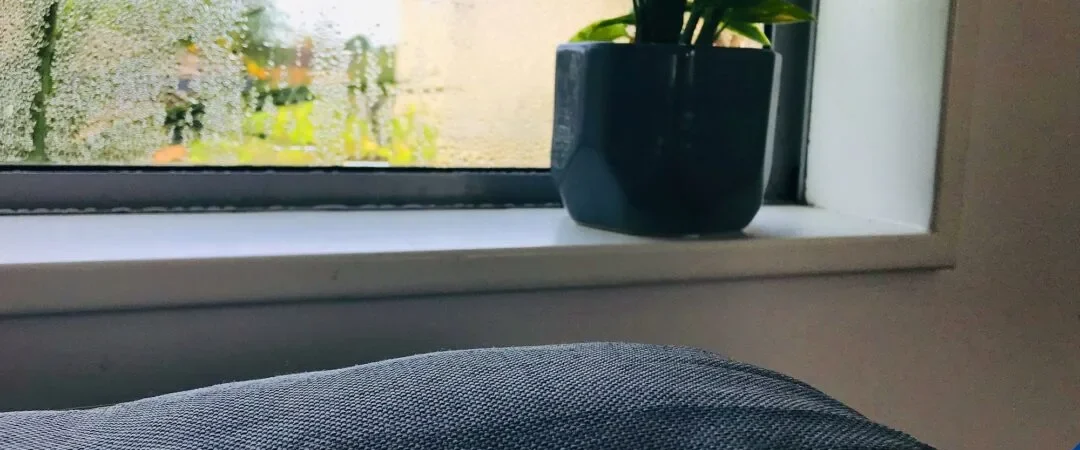
- Condensation on windows in winter: Interior window condensation happens when warm humid air meets a cool glass surface. Occasional condensation is normal, but if it’s dripping or pooling on the sill daily, indoor humidity is too high for the outdoor temperature.
- Salt shakers clumping: Salt is a hygroscopic mineral that absorbs moisture from air. If your table salt is consistently clumping despite a dry container, ambient humidity in your kitchen is elevated.
- Metal items rusting in unexpected places: Tools in a garage, cabinet hardware, bathroom fixtures corroding faster than normal — these all point to sustained elevated moisture levels in those spaces.
- Clothing or towels smelling musty even after washing: If fabric is slow to dry or stored in a high-humidity closet, microbial growth resumes quickly after laundering. The smell returns because the environment recolonizes the fabric.
- Increased insect activity: Cockroaches, silverfish, and certain mite species are all attracted to high-humidity environments. A sudden uptick in these pests, especially in basements and bathrooms, correlates strongly with elevated ambient moisture.
High Indoor Humidity vs. Low Indoor Humidity: How to Tell the Difference
Some symptoms of high and low humidity overlap enough to create real confusion. Dry skin, for example, can result from air that’s too dry — or from skin irritation caused by mold spores and dust mites in air that’s too humid. Respiratory irritation shows up at both extremes. Without a hygrometer reading, you can misidentify the problem and apply exactly the wrong solution.
| Symptom | High Humidity (Above 60% RH) | Low Humidity (Below 30% RH) |
|---|---|---|
| Skin feel | Clammy, tacky, slow-drying sweat | Tight, flaky, itchy, static-prone |
| Respiratory symptoms | Congestion, mucus, allergy-like reactions | Dry throat, nosebleeds, irritated sinuses |
| Wood and furniture | Swelling, warping, sticking doors | Cracking, splitting, gaps between boards |
| Air feel | Heavy, warm, muggy despite thermostat | Dry, crackling, static electricity common |
What Causes High Indoor Humidity in the First Place?
Diagnosing the symptoms is only half the job. Identifying the source is what actually fixes the problem. Indoor humidity has both internal and external sources, and the proportions vary significantly by home, season, and occupancy.
Internal sources account for more than most people expect. A family of four produces roughly 2 to 4 gallons of water vapor per day through breathing, cooking, showering, and washing. A single 10-minute shower releases approximately 0.5 pints of moisture into the air. Boiling a pot of pasta adds measurable humidity to a kitchen for hours afterward. In a well-sealed home without adequate ventilation, this moisture accumulates rather than escaping.
External sources include ground moisture infiltrating through basement walls or slabs, outdoor air that’s naturally humid entering through infiltration, and inadequate vapor barriers in crawl spaces. Crawl spaces are particularly significant — a damp crawl space can elevate whole-home humidity measurably because warm air from the living space above creates a convective loop that draws crawl space air upward.
HVAC systems also play a role that often gets overlooked. An oversized air conditioner cools air faster than it dehumidifies it — the system short-cycles (runs in short bursts), which drops temperature quickly but doesn’t run long enough for the evaporator coil to wring moisture out of the air. The result: a house that feels cool but remains humid. This is why right-sizing HVAC equipment matters for humidity control, not just temperature control.
What Should You Do After Identifying High Indoor Humidity Symptoms?
Once you’ve confirmed elevated humidity with a hygrometer and identified which symptoms are present, the response depends on severity. Mild and recent cases respond well to behavioral and equipment changes. Chronic cases with visible structural damage or established mold require professional remediation before preventive measures make sense — there’s no point controlling future humidity if the existing mold colony is already producing spores.
For most homes dealing with moderately elevated humidity (60–70% RH), the highest-leverage interventions are: running exhaust fans during and for 20 minutes after cooking and bathing, ensuring clothes dryers vent outside (not into the garage or crawl space), adding a dehumidifier rated for the square footage of the affected area, and checking that crawl space venting and vapor barriers are intact.
Portable dehumidifiers are effective for contained spaces but require regular emptying and maintenance — a clogged filter or full reservoir turns them into expensive furniture. Whole-home dehumidifiers integrated into HVAC systems maintain consistent humidity across all rooms and are generally more appropriate when the problem is building-wide rather than room-specific.
The decision between portable and whole-home solutions honestly depends on the scope of the problem, the age of the HVAC system, and whether the home has a crawl space or basement contributing significantly to the moisture load. There’s no universal answer, and anyone who tells you there is probably hasn’t assessed your specific situation.
At What Humidity Level Do Symptoms Start to Appear?
The threshold isn’t a sharp line — it’s a gradient. Different symptoms emerge at different humidity levels, and the speed at which they appear depends on temperature, air circulation, and how long the elevated humidity persists. That said, there are practical thresholds worth knowing.
At 50–55% RH, most people notice no symptoms. Some individuals with severe dust mite allergies may begin to notice minor respiratory irritation, since mite populations start to grow above 50%. At 55–65% RH, comfort begins to drop noticeably in warm weather, mold growth becomes possible on cool surfaces, and dust mite populations accelerate. Musty odors may begin to appear. At 65–75% RH, visible mold can develop within 24 to 48 hours on suitable surfaces, structural effects on wood become measurable, and health symptoms in sensitive occupants are likely. Above 75% RH, condensation on surfaces is common, structural deterioration is rapid, and virtually everyone in the home will be affected to some degree.
Temperature modifies these thresholds significantly. At lower temperatures, air holds less moisture overall, so the same relative humidity represents a lower absolute moisture content. Condensation forms more readily on cold surfaces even at moderate relative humidity levels. This is why a 60% RH basement in winter causes more surface condensation than a 60% RH living room in summer.
The real-world takeaway: start taking high indoor humidity seriously at 60% and treat anything consistently above 65% as an active problem requiring intervention, not just monitoring.
What’s worth keeping in mind as you work through this is that high indoor humidity symptoms are a system telling you something. They’re not isolated inconveniences — each one is a data point pointing toward the same underlying condition. The homes that handle this well aren’t the ones with the most aggressive dehumidification; they’re the ones where the occupants understand what they’re seeing and respond to early signals rather than waiting for the visible damage to
Frequently Asked Questions
What are the first signs of high indoor humidity?
Early signs often include condensation on windows, heavy-feeling air, and mild musty odors.
Can high indoor humidity exist without visible mold?
Yes. Odors, damp surfaces, and condensation can appear before mold becomes visible.
Are high humidity symptoms worse in apartments?
They can be. Limited ventilation and shared walls can trap moisture more easily in apartments.
Can high humidity symptoms appear only in one room?
Yes. Bathrooms, bedrooms, and rooms with exterior walls often show symptoms first.
Do high humidity symptoms always mean there is a serious problem?
Not always. Short-term symptoms are common, but persistent signs may indicate ongoing moisture imbalance.